Top STEM Bin Ideas On A Budget
We may earn a commission for purchases made using our links. Please see our disclosure to learn more.
You know that moment when a child says, “I’m bored,” and your brain instantly starts buffering? That’s where STEM Bin Ideas can save the day. A STEM bin is a small container filled with simple materials that kids can use to build, test, solve, and create without needing a full science lab in your living room or classroom.
Some product links may be affiliate links, which means you may earn a small commission at no extra cost to the reader.
In this guide, you’ll find budget-friendly STEM activities, easy bin setup tips, product ideas, research-backed benefits, and simple ways to make hands-on learning feel fun instead of forced.
What Are STEM Bins?
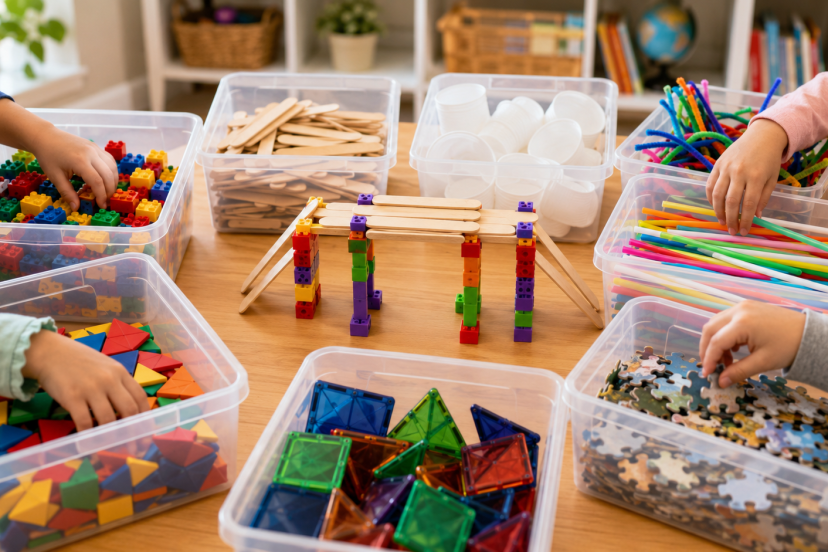
STEM bins are small activity containers filled with building materials, puzzles, craft items, or simple engineering tools. Kids use them for quick hands-on challenges like building towers, designing bridges, making patterns, or solving mini problems.
They work well because they feel like play, not homework. And honestly, that’s the magic. STEM education works best when children apply knowledge through real projects and problems, which is how the National Science Teaching Association describes effective STEM learning.
Why STEM Bin Ideas Work for Busy Homes and Classrooms
The best STEM Bin Ideas do not require fancy supplies. A few cups, craft sticks, blocks, straws, magnets, or puzzle pieces can turn into a tiny engineering studio.
They help kids practice:
- Problem-solving
- Fine motor skills
- Spatial reasoning
- Creative thinking
- Patience
- Teamwork
Think of STEM bins like a snack tray for the brain. Small portions, easy access, and enough variety to keep kids curious.
The Budget Setup: What to Put in Each Bin
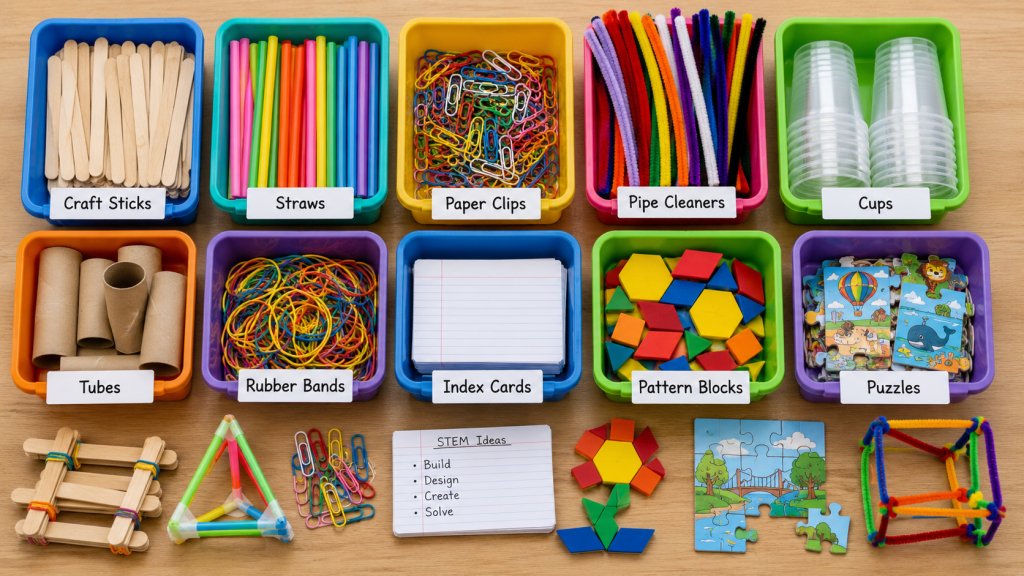
Start with clear plastic bins, zipper pouches, shoeboxes, or recycled containers. You do not need matching Pinterest-perfect labels unless that brings you joy.
Good starter materials include:
- Craft sticks
- Plastic cups
- Pipe cleaners
- Linking cubes
- Pattern blocks
- Dominoes
- Straws
- Index cards
- Tape
- Toy gears
- Magnetic tiles
- Puzzle cards
Keep each bin focused. One material plus one challenge is often better than a chaotic “junk drawer with ambition.”
STEM Bin Idea 1: Build-a-Bridge Challenge
Give kids craft sticks, paper strips, cups, and tape. Ask them to build a bridge that can hold coins, toy cars, or small blocks.
Easy challenge prompt
“Can you build a bridge between two cups that holds five coins?”
This teaches balance, structure, weight, and redesign. When the bridge collapses, do not jump in too quickly. That little “oops” moment is where the learning sneaks in.
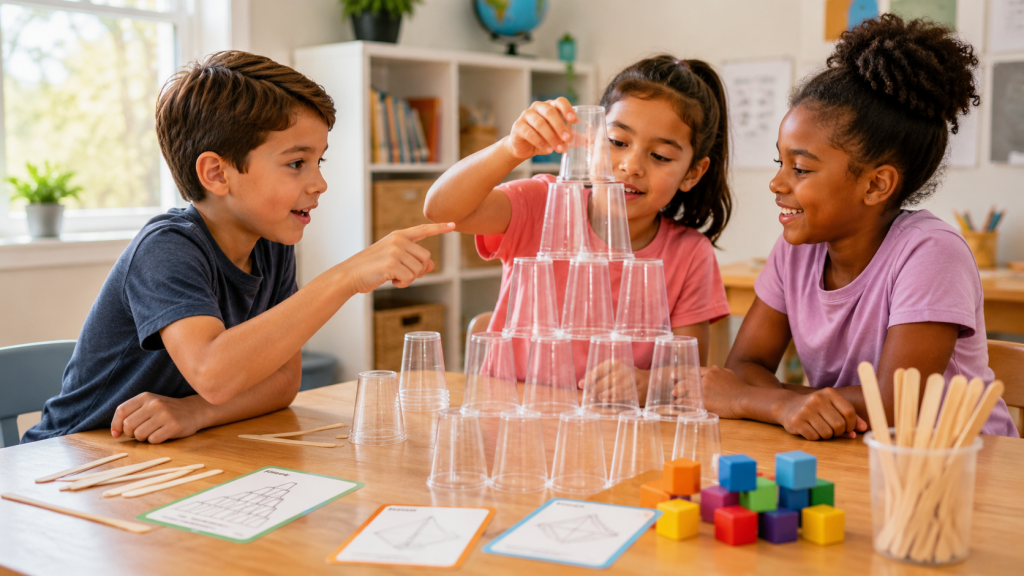
STEM Bin Idea 2: Cup Tower Engineering
Plastic cups are cheap, stackable, and surprisingly dramatic. One wobbly tower can create more suspense than a season finale.
Ask kids to build:
- The tallest tower
- The widest tower
- A tower with a doorway
- A tower that holds a small toy
This is a great STEM activity for younger kids because it builds coordination and early engineering thinking without small parts.
STEM Bin Idea 3: Straw and Connector Structures
Use straws with pipe cleaners, play dough, or small connector pieces. Kids can build cubes, pyramids, houses, bridges, and towers.
Practical tip
Cut straws into different lengths so children can compare short, medium, and long supports. This naturally brings in math vocabulary without turning the activity into a lecture.
STEM Bin Idea 4: Pattern Block Puzzles
Pattern blocks are perfect for visual thinking. Kids can copy designs, create symmetrical shapes, or invent animals, houses, rockets, and mosaics.
This bin supports early geometry, sorting, color recognition, and spatial awareness. It also works beautifully as a calm morning activity because it feels quiet and focused.
STEM Bin Idea 5: Marble Maze or Ball Run
Use cardboard strips, paper towel tubes, tape, and small balls or marbles. Kids can design a path and test how speed changes when the slope changes.
Safety note
Use larger balls for younger children and avoid marbles with toddlers.
This is one of those STEM challenges that makes kids say, “Wait, let me try again.” That sentence is basically gold.
STEM Bin Idea 6: Gears, Motion, and Cause-and-Effect
Gear bins help kids see motion in action. When one gear turns, another moves, and suddenly cause-and-effect is not just a phrase. It is happening right in their hands.
The Learning Resources Gears! Gears! Gears! Super Building Set includes 150 pieces and is designed for open-ended building that supports engineering, design, and critical thinking.
STEM Bin Idea 7: Magnetic Tile City
Magnetic tiles are great for building houses, towers, roads, rockets, and pretend cities. They also invite teamwork because kids naturally start combining ideas.
One child may build a garage. Another adds a hospital. Someone else creates a “dragon airport,” because children are wonderfully unserious architects.
This activity supports shape recognition, balance, planning, and creative storytelling.
STEM Bin Idea 8: Puzzle Toy Challenge
A puzzle-themed bin is perfect for quiet problem-solving. Add tangrams, brain teaser cards, shape puzzles, or logic games.
You can also connect this idea with hands-on puzzle toys that build problem-solving skills for more screen-free learning inspiration.
Simple prompt
“Can you solve this puzzle two different ways?”
That tiny twist pushes kids beyond “finish it” and into flexible thinking.
Recommended Products for STEM Bins
hand2mind STEM Bins Essential Kit by Brooke Brown
This is a ready-made option for teachers or parents who want the full setup without gathering every piece separately. The hand2mind kit includes 12 STEM bins, task cards, challenge cards, writing prompt cards, and a variety of manipulatives such as base ten blocks, dominoes, pattern blocks, linking cubes, pipe cleaners, craft sticks, straws, and more.
Features: 12 labeled bins, teacher guide, task cards, mixed building materials
Use cases: Best for classrooms, homeschool rooms, learning centers, and busy parents who want a complete STEM station.
LEGO Classic Medium Creative Brick Box 10696
This classic brick set is flexible enough for open-ended STEM builds. Kids can make vehicles, animals, towers, bridges, and whatever odd little invention pops into their heads. The Amazon listing highlights the set’s storage box and build examples like a train, car, and tiger figure.
Features: Assorted LEGO bricks, storage box, creative build options
Use cases: Great for building challenges, pattern work, symmetry, and engineering play.
PicassoTiles 100 Piece Set Magnetic Building Tiles
Magnetic tiles are excellent for building 3D structures. This PicassoTiles set is listed as a 100-piece clear magnetic building tile set for preschool, pretend play, and educational construction.
Features: 100 magnetic tiles, clear colors, 3D building possibilities
Use cases: Best for geometry, architecture, city building, and collaborative play.
Learning Resources Gears! Gears! Gears! Super Building Set
This set brings movement into your STEM bins. Kids can connect gears, axles, and bases to create spinning designs. It supports sorting, grouping, counting, designing, constructing, and basic physics concepts through gear movement.
Features: Interlocking gears, colorful pieces, open-ended designs
Use cases: Great for cause-and-effect lessons, engineering centers, and motion experiments.
hand2mind Makerspace Task Cards
These cards are helpful when kids stare at a bin and say, “What do I make?” The set includes 36 open-ended STEM learning cards that prompt children to build, improve designs, and think creatively.
Features: 36 task cards, open-ended challenges, NGSS-aligned prompts
Use cases: Best for morning tubs, fast finishers, makerspace stations, and guided STEM challenges.
Research-Backed Reasons STEM Bins Support Learning
The American Academy of Pediatrics explains that play supports executive function, language, early math skills, social development, and healthy caregiver relationships. That matters because STEM bins are not just “busy boxes.” They give kids space to plan, test, talk, negotiate, and try again. You can read more in this research review on play and executive function.
The National Academies’ How People Learn II also emphasizes that learning is shaped by context, culture, prior knowledge, and active engagement. That fits STEM bins beautifully because children bring their own ideas, family experiences, and creative problem-solving styles into each challenge. Explore the full report here: active learning and how children build understanding.
How to Keep STEM Bins Organized
Keep it simple. Label each bin by material or challenge type.
Try labels like:
- Build a Bridge
- Magnetic Tiles
- Pattern Blocks
- Cup Towers
- Gears and Motion
- Puzzle Challenge
If you teach a group, add a picture label too. This helps early readers, multilingual learners, and younger children build independence.
How to Use STEM Bins Without Overplanning
You do not need a full lesson plan every time. Give kids a simple prompt and let them explore.
Try:
- “Build something that can stand on its own.”
- “Create a pattern that repeats.”
- “Make a tower using only 20 pieces.”
- “Design something that moves.”
- “Build a home for a tiny animal.”
Small prompts create big thinking.
Mistakes to Avoid With STEM Bins
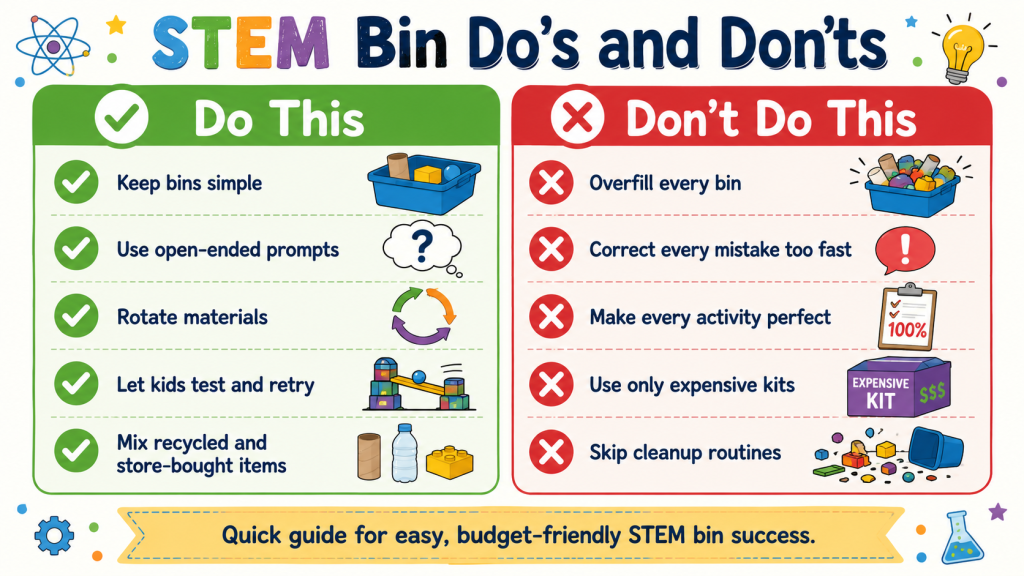
Do not overfill the bins. Too many supplies can overwhelm kids.
Avoid making every activity outcome-based. If the tower falls, the maze fails, or the bridge bends, that is not wasted time. That is the experiment.
Also, rotate materials every few weeks. Novelty helps, but you do not need new purchases. Just rearrange what you already own.
FAQs About STEM Bin Ideas
What are the best STEM Bin Ideas for kindergarten?
The best kindergarten STEM bins use simple, safe materials like cups, blocks, magnetic tiles, pattern blocks, and craft sticks. Choose activities that focus on building, sorting, stacking, matching, and testing.
How many STEM bins should I start with?
Start with 4 to 6 bins. That is enough variety without creating storage chaos. You can add more once you see which activities kids enjoy most.
Are STEM bins good for homeschool learning?
Yes. STEM bins work well for homeschool because they are flexible, hands-on, and easy to adapt by age. Use them for morning work, brain breaks, science lessons, or independent exploration.
What can I put in a STEM bin on a tight budget?
Use recycled cardboard, bottle caps, paper tubes, cups, craft sticks, rubber bands, paper clips, straws, and tape. Budget STEM activities often work better because kids have to think creatively.
How long should a STEM bin activity last?
Most STEM bin activities work well in 10 to 20 minutes. Younger kids may need shorter sessions, while older kids may stay engaged longer if the challenge has levels.
Conclusion: Start Small, Build Wonder
The best STEM Bin Ideas do not need expensive supplies or complicated prep. Start with a few containers, simple materials, and open-ended prompts. Then let kids build, fail, laugh, redesign, and surprise themselves.
STEM learning becomes powerful when children feel curious instead of pressured. So start with one bin this week. A few cups, sticks, blocks, or puzzle pieces can become a bridge, a tower, a maze, or maybe even a dragon airport. And honestly? That sounds like a pretty great place to begin.