5 Christmas STEM Activities
We may earn a commission for purchases made using our links. Please see our disclosure to learn more.
Christmas can get wonderfully chaotic. There are decorations half-finished, glitter somehow on the dog, and at least one child asking, “Can we make something?” That is where Christmas STEM Activities come in beautifully. They turn festive energy into building, testing, measuring, guessing, and laughing.
In this guide, you will find five simple holiday STEM projects that help kids explore science, engineering, math, and problem-solving without making your home feel like a formal classroom. Think less “worksheet at the table” and more “let’s build something and see what happens.”
Why Christmas STEM Activities Work So Well
Christmas already feels magical to kids. Lights glow, cookies change shape in the oven, snowflakes appear in decorations, and ornaments balance on branches. STEM simply gives children a way to ask, “Why does that happen?”
Instead of separating learning from play, these activities blend both. A gumdrop tower becomes engineering. A sleigh parachute becomes physics. A spinning ornament becomes motion and force.
That is the sweet spot: kids learn because they are curious, not because they are being forced.
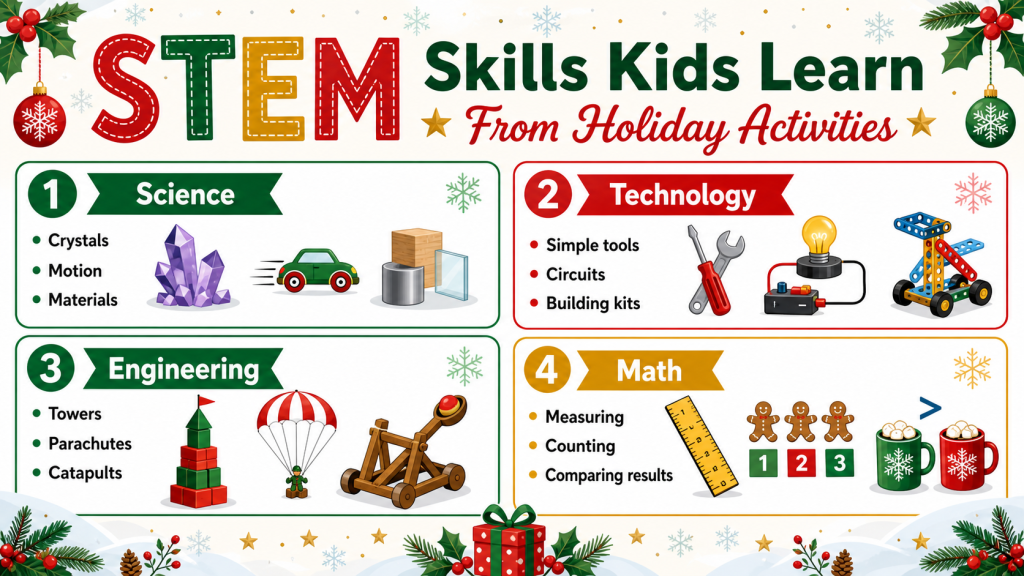
What Kids Learn From Holiday STEM Projects
Good holiday STEM projects teach more than facts. They help kids practice patience, teamwork, observation, and flexible thinking.
Children learn how to:
- Make predictions
- Test ideas
- Notice patterns
- Fix mistakes
- Explain what changed
- Try again without feeling like they “failed”
That last one matters. A collapsed tower is not a disaster. It is data wearing a tiny Santa hat.
Before You Start: Create a Simple STEM Station
You do not need fancy supplies. A small tray, table, or counter space works fine.
Gather basic materials like:
- Craft sticks
- Paper cups
- Tape
- String
- Bells
- Pipe cleaners
- Gumdrops
- Cardstock
- Straws
- Measuring tape
Keep wipes nearby. Holiday science can get sticky, sparkly, and suspiciously crunchy.
Activity 1: Build a Gumdrop Christmas Tree Tower
This is one of the easiest Christmas STEM Activities for younger kids because it feels like building with candy. The goal is simple: build the tallest tree-shaped tower using gumdrops and toothpicks.
How to Do It
Give kids gumdrops and toothpicks. Ask them to build a structure that stands on its own.
Encourage questions like:
- What shape feels strongest?
- Does a wider base help?
- Can your tower hold a paper star?
Triangles usually work better than squares because they add stability. Kids may not say “structural engineering,” but they will feel it when their tower stops wobbling.

Activity 2: Make a Jingle Bell Catapult
This activity turns a spoon, craft sticks, and rubber bands into a mini launcher. Kids can test how far jingle bells travel and how angle changes the distance.
What Kids Explore
This project introduces force, motion, angles, and measurement. It also sneaks in math because children can record distances and compare results.
Try asking, “What happens if we pull the spoon back gently instead of far?” That simple question turns random launching into a real experiment.
Activity 3: Grow Crystal Snowflakes
Crystal snowflakes feel magical, but they are really chemistry in action. Kids shape pipe cleaners into snowflakes, place them in a borax solution, and watch crystals form as the water cools.
Why It Works
This is a great winter STEM activity because kids can observe change over time. They learn that some science does not happen instantly. Sometimes, you set it up, go eat a cookie, and come back to a surprise.
Adult supervision is important here, especially with hot water and borax.
Activity 4: Design a Santa Sleigh Parachute
This activity asks kids to help Santa’s “gift” land safely. Use a small toy, paper cup, or wrapped block as the package. Then let kids build parachutes from tissue paper, plastic-free gift wrap, napkins, or fabric scraps.
Make It a Challenge
Ask kids to test:
- Which parachute falls slowest?
- Does a larger canopy help?
- What happens if the strings are uneven?
- Can the gift land without tipping?
This activity is especially fun for mixed ages because older kids can measure fall time while younger kids decorate the parachute.
Activity 5: Explore Spinning Christmas Toys
Spinning toys are perfect for teaching motion, balance, and patterns. Kids can decorate paper circles like ornaments, place them on a pencil or skewer, and test how design affects the spin.
For a deeper hands-on idea, you can connect this activity to this creative spinning toy STEM project and adapt the colors, shapes, and patterns for Christmas.
Try This Twist
Draw red and green sections on the spinner. When it spins fast, ask kids what they see. Colors may blur together, which opens a simple conversation about motion, vision, and patterns.

How to Adapt These STEM Challenges by Age
For preschoolers, keep the goal simple: build, touch, sort, count, and describe. You might say, “Which tower is taller?” or “Which bell went farther?”
For ages 6–9, add measuring, predicting, and drawing designs before building.
For older kids, add constraints. For example, “Build a sleigh parachute using only three materials,” or “Create a tower that holds five ornaments.”
Constraints sound strict, but they often make creativity stronger.
Easy Materials You Probably Already Have
Holiday STEM does not need a big shopping list. Many supplies are already hiding in your kitchen drawer or craft bin.
Useful materials include:
- Leftover wrapping paper
- Cardboard boxes
- Cookie cutters
- Cotton balls
- Ribbon scraps
- Paper plates
- Clothespins
- Recycled tubes
- Measuring spoons
This also teaches resourcefulness. Kids see that science is not only something in a lab coat. It can start with a cereal box and a very determined imagination.
Safety Tips for Christmas Science Experiments
Keep safety simple and clear. Hot water, small items, sharp tools, and food-based materials all need attention.
A few helpful rules:
- Supervise hot water and chemical reactions.
- Avoid toothpicks with toddlers.
- Keep small bells away from children who still mouth objects.
- Use washable surfaces when working with crystals or color.
- Remind kids not to eat experiment materials unless you clearly say they can.
Safety does not ruin the fun. It simply keeps the fun from turning into “why is there borax in your sock?”
How to Turn Each Project Into a Mini Lesson
After each activity, ask three questions:
- What did you think would happen?
- What actually happened?
- What would you change next time?
That tiny routine builds scientific thinking. It also keeps kids from feeling judged. You are not asking, “Did you get it right?” You are asking, “What did you notice?”
That shift makes STEM learning for kids feel warmer and more inviting.
Best Products for Christmas STEM Activities
Here are some product-style picks that fit the theme of hands-on holiday STEM learning.
1. Blue Marble Santa’s Christmas Science Workshop
This holiday STEM kit includes five Christmas-themed experiments plus bonus activities, making it a natural fit for festive science activities at home.
Features: Holiday experiments, guided activities, festive theme.
Best for: Families who want ready-made Christmas science experiments without gathering every supply from scratch.
2. Snap Circuits Jr. SC-100 Electronics Exploration Kit
This classic kit introduces kids to circuits through more than 100 projects and includes a full-color manual and 28 parts.
Features: Circuit projects, snap-together parts, beginner-friendly guide.
Best for: Kids ages 8+ who like lights, switches, sounds, and “how does this work?” moments.
3. National Geographic Mega Science Lab
This kit includes 75 easy experiments across earth science, chemistry, and magic-style STEM projects.
Features: Multiple experiment types, broad science coverage, hands-on format.
Best for: Curious kids who enjoy variety and may not want to repeat the same project style.
4. Learning Resources STEM Explorers Pixel Art Challenge
This set uses pattern blocks and math manipulatives to support fine motor skills, pattern recognition, and early logic.
Features: Pattern play, math thinking, visual problem-solving.
Best for: Younger learners who enjoy puzzles, designs, and quiet hands-on activities.
5. 6-in-1 STEM Kits for Kids Age 8–12 by FliipFlaap Toys
This wooden building kit includes six models and encourages kids to explore engineering and scientific principles through hands-on construction.
Features: Wooden models, engineering builds, gift-ready packaging.
Best for: Kids who like building, assembling, and seeing moving parts come together.
What Research Says About Playful STEM Learning
Christmas STEM Activities are not just cute holiday projects. They support the kind of hands-on learning that helps kids think, test, talk, and try again.
The American Academy of Pediatrics explains in its 2018 report, The Power of Play, that play helps children build important skills like problem-solving, language, self-regulation, and executive function. That means when a child builds a gumdrop tower or tests a jingle bell catapult, they are doing more than playing. They are practicing focus, planning, patience, and flexible thinking.
A 2022 report from the National Academies of Sciences, Engineering, and Medicine, Science and Engineering in Preschool Through Elementary Grades, also highlights the importance of giving young children strong science and engineering experiences early. The report explains that children naturally ask questions, explore patterns, and try to understand how things work. Hands-on STEM activities help turn that curiosity into real learning.
That is why festive STEM projects work so well. A spinning ornament, a crystal snowflake, or a sleigh parachute may look simple, but each one invites kids to observe, predict, test, and improve. In other words, holiday fun becomes meaningful STEM learning without feeling like schoolwork.
Common Mistakes to Avoid
The biggest mistake is making the activity too perfect. Kids do not need a Pinterest-level result. They need room to wonder.
Avoid:
- Giving all the answers too quickly
- Fixing every mistake for them
- Choosing projects that are too advanced
- Focusing only on the final product
- Rushing the reflection part
Let the tower lean. Let the parachute flop. Let the catapult launch one sad little bell two inches. That is where learning starts.
How to Make Christmas STEM More Inclusive
Not every family celebrates Christmas in the same way. Some celebrate religiously, some culturally, some not at all. A thoughtful STEM activity can still feel welcoming.
You can use winter themes like snowflakes, stars, lights, bells, and gift delivery challenges. You can also invite children to share traditions from their own homes, such as lanterns, winter foods, handmade decorations, or family games.
This makes STEM feel bigger than one holiday. It becomes a way to explore light, structure, motion, warmth, patterns, and community.
FAQs About Christmas STEM Activities
What are some simple STEM Christmas activities for children?
Easy Christmas STEM Activities include gumdrop towers, jingle bell catapults, crystal snowflakes, sleigh parachutes, and spinning paper ornaments. These projects use simple materials and teach basic science, engineering, and math ideas.
Which age group is most suited for Christmas STEM projects?
Most Christmas STEM projects work well for ages 4–12 with small adjustments. Younger kids need simpler instructions and more supervision. Older kids can add measurements, design limits, and written predictions.
How do you make Christmas science experiments less messy?
Use trays, washable tablecloths, small containers, and pre-measured materials. Also, choose dry activities like building towers or spinning toys when you want less cleanup.
Can Christmas STEM Activities be done in the classroom?
Yes. These activities work well in classrooms, homeschool groups, libraries, and after-school programs. Use stations so children can rotate between building, testing, measuring, and reflecting.
What supplies do I need for holiday STEM projects?
Common supplies include craft sticks, paper cups, string, bells, tape, cardboard, pipe cleaners, gumdrops, toothpicks, paper, straws, and measuring tools. Many materials can come from recycled holiday packaging.
Conclusion
Christmas STEM Activities give kids something better than a perfectly polished craft. They give them a chance to wonder, build, test, laugh, and try again. With simple projects like gumdrop towers, jingle bell catapults, crystal snowflakes, sleigh parachutes, and spinning toys, you can turn holiday excitement into real learning without losing the joy of the season. Start small, keep it playful, and let kids lead with curiosity. The best STEM moments often begin with one simple question: “What do you think will happen?”