Fun Science Experiments for Kids: Easy Ideas and Helpful Kits
We may earn a commission for purchases made using our links. Please see our disclosure to learn more.
A science activity can look exciting online yet fall flat at home because it needs obscure supplies, creates a huge mess, or gives children little to do beyond watching a reaction. The best fun science experiments for kids invite them to predict, test, notice, and explain. They can fit a weekday afternoon while still building real scientific habits.
This guide will help you match activities to your child’s age, manage safety and cleanup, use everyday materials, and decide when a kit is worth buying. You will also find product recommendations for different interests and budgets, plus research-backed ways to turn a fizzy reaction or rolling toy into meaningful STEM learning.
Why Fun Science Experiments for Kids Work So Well
Children naturally ask questions that begin investigations: Why did that sink? Can this roll faster? What happens if we add more? A good activity lets them find evidence.
Participation matters more than spectacle. Measuring, comparing, drawing, and explaining connect results with the steps that produced them. Fun science experiments for kids also make abstract ideas visible: balloons demonstrate air pressure, while layered liquids reveal density.
Choose Experiments by Age, Not Just the “Wow” Factor
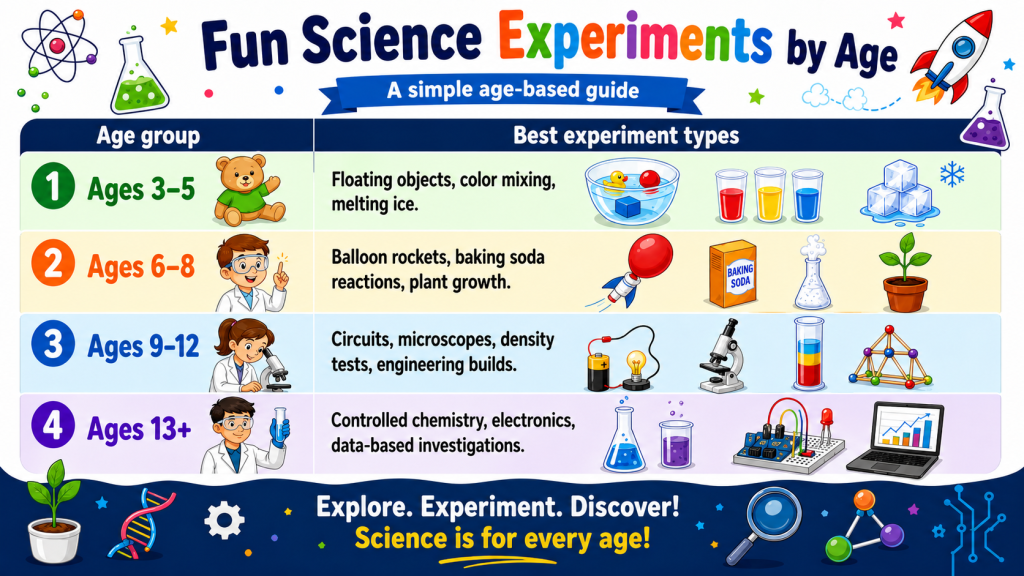
Preschoolers usually need short activities, large materials, and quick results, such as sorting floating objects or watching ice melt. Elementary-age children can compare designs, record plant growth, or test insulation. Older children may prefer circuits, microscopes, and engineering.
Age labels are only starting points. Consider reading ability, patience, coordination, and adult involvement. The right fun science experiments for kids feel challenging without requiring constant rescue.
Start With a Simple Safety Routine
Clear the work surface and read every step first. An adult should control heat, sharp tools, batteries, glassware, and irritating substances. Use eye protection when splashes are possible and wash hands afterward.
Never mix household cleaners or let children taste experiment materials. Keep magnets, button batteries, and small parts away from younger children. Before pouring, ask what may happen; that pause supports safety and scientific thinking.
Easy Kitchen Chemistry With Everyday Materials
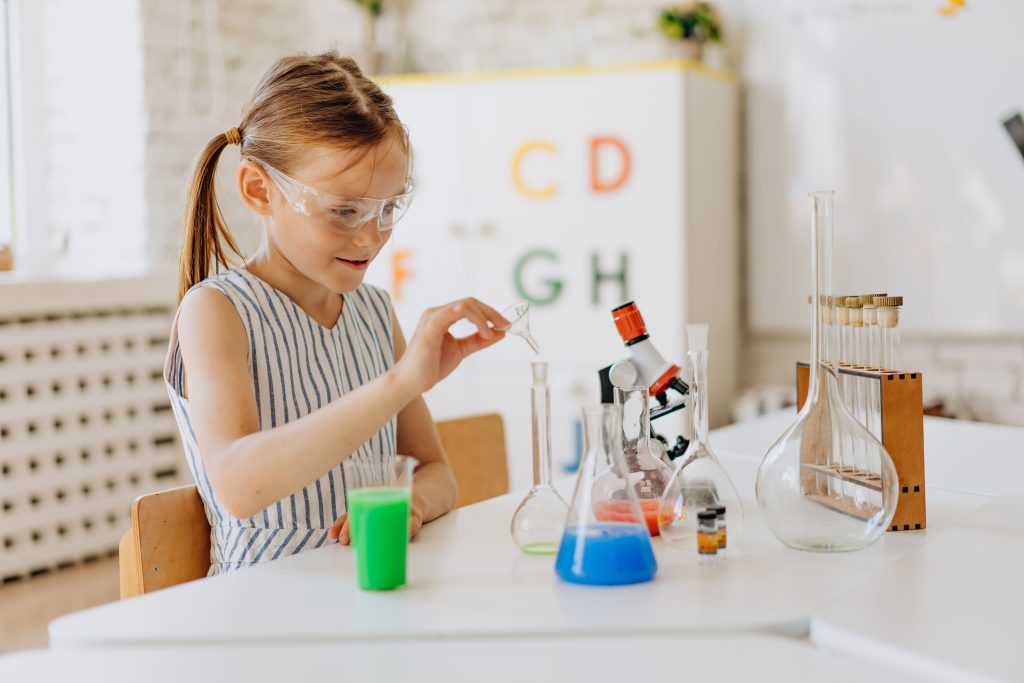
Kitchen chemistry offers low-cost fun science experiments for kids. Baking soda and vinegar demonstrate gas production, red-cabbage indicator compares acids and bases, and sugar dissolving in warm versus cold water creates a simple test.
Change only one factor and keep quantities, containers, and stirring time consistent. Small reactions teach the same idea with less cleanup. A clear cup, teaspoon, tray, and notebook are often enough.
Physics Experiments That Get Kids Moving
Try balloon rockets, cardboard marble ramps, paper helicopters, or index-card bridges. These activities make force, motion, gravity, friction, and structural strength visible.
Ask children to improve a design: Does a steeper ramp move the marble farther? How many coins can folded paper hold? Movement-focused fun science experiments for kids suit energetic learners, but define a launch direction and use lightweight materials indoors.
Biology and Nature Investigations Without a Lab
Children can compare seedlings in different light, inspect leaves, or observe colored water moving through flower stems. Such investigations build patience because living systems rarely change instantly.
Observe insects briefly, replace moved rocks and logs, and avoid unknown plants, fungi, or animals. A dated drawing or measurement helps children notice patterns. These quiet observations can become favorite fun science experiments for kids.
Turn Any Activity Into a Real Experiment
A demonstration shows what happens. An experiment asks whether changing one factor affects another. Start with a question, prediction, one variable, and a measurable result.
When comparing paper towels, keep sheet size and water quantity consistent, change only the type, and repeat the test. Repetition reveals whether the result was dependable.
For a ready-made next step, try these scientific method experiments for kids, which show how to move from a question to a simple test.
How to Keep Mess, Cost, and Setup Under Control
Keep cups, droppers, spoons, tape, string, a ruler, and reusable trays in one science bin. Add consumables only when needed.
Place liquids, sand, or soil inside a tray or tub. Pre-measure materials for younger children, use small batches, and keep a towel nearby. Photograph results, then assign one cleanup job. Fun science experiments for kids are easier to repeat when cleanup belongs to the routine.
Recommended Products for Fun Science Experiments for Kids
A kit can reduce preparation and provide tools that are hard to improvise. Match it to the child’s age, space, reading level, and strongest interest.
| Product | Best for | Strength | Consideration |
| Primary Science Deluxe Lab Set | Preschool beginners | Child-sized tools | Adult guidance needed |
| STEM Explorers Magnet Movers | Low-mess physics | Reusable magnet activities | Small parts |
| Kids First Science Laboratory | Shared learning | Guided early experiments | Basic for older kids |
| Mega Science Lab | Broad exploration | 130+ activities | Needs storage |
| Snap Circuits Jr. SC-100 | Electronics beginners | Rebuildable circuits | Ages 8+ |
| Microscope for Kids | Close observation | Slides and specimens | Focusing takes patience |
Learning Resources Primary Science Deluxe Lab Set, 45 Pieces, Ages 3+
Best for: Preschool beginners
This 45-piece set includes child-sized tools, a viewscope, activity cards, and a write-and-wipe journal. Its sturdy pieces make measuring and observing approachable for younger learners. An adult still needs to guide each activity, and the small components mean it is not suitable for children under three.
Learning Resources STEM Explorers Magnet Movers, 39 Pieces, Ages 5+
Best for: Low-mess physics exploration
Magnetic wands, rings, balls, and shaped magnets support investigations into attraction, repulsion, and magnetic force. Ten experiment cards provide a clear starting point, while the reusable pieces allow open-ended exploration afterward. Keep the small parts organized and away from younger siblings.
Thames & Kosmos Kids First Science Laboratory STEM Experiment Kit for Preschoolers, Young Learners Ages 3+ | Includes Durable, Colorful, Plastic Scientific Tools for a Hands-on Learning Experience
Best for: Adult-and-child learning together
Designed for ages three to seven, this set provides 25 tools and materials for 10 guided experiments, supported by a 16-page manual. It suits adults who want clear prompts for early observation and investigation. Because the activities target beginners, older elementary learners may outgrow the challenge quickly.
NATIONAL GEOGRAPHIC Mega Science Lab – Science Kit for Kids with 130+ Easy Experiments, Featuring Earth Science, Chemistry Set, and Magic STEM Projects for Boys and Girls Mega Science Bundle
Best for: Families wanting broad subject variety
With more than 130 activities across chemistry, earth science, and science-themed magic, this kit gives children around age eight and older plenty of choice. It suits families who prefer one broad collection over several small kits. The tradeoff is storage, so organize materials by activity.
Snap Circuits Jr. SC-100 Electronics Exploration Kit, Over 100 Projects, Full Color Project Manual, 28 Parts, STEM Educational Toy for Kids 8+
Best for: First electronics and circuit projects
Snap-together components let children build more than 100 projects without soldering. The illustrated manual and reusable parts make rebuilding and comparing circuits straightforward. It best suits children eight and older who can follow diagrams; younger builders will need substantial adult help.
NATIONAL GEOGRAPHIC Microscope for Kids – Science Kit with an Easy-to-Use Kids Microscope, Up to 400x Zoom, Blank and Prepared Slides, Rock & Mineral Specimens, STEM Project Toy
Best for: Curious observers in small spaces
This compact kit combines a microscope with prepared and blank slides plus rock and mineral specimens. Magnification reaches 400x, and large knobs support basic focusing. Beginners may find the highest setting difficult, so starting at lower magnification can produce a clearer, less frustrating experience.
How to Choose the Right Science Kit
Start with a genuine interest. A leaf collector may use a microscope more than a chemistry kit, while a builder may prefer circuits.
Check required ingredients, batteries, storage, age guidance, and warnings. Then consider repeat value. Strong kits let children alter designs, ask new questions, or reuse tools with household materials. That supports more fun science experiments for kids than a one-result novelty.
Research-Backed Ways to Support STEM Learning
A 2012 meta-analysis of inquiry-based science teaching reviewed 37 experimental and quasi-experimental studies and reported an overall mean effect size of 0.50. Results were stronger when teachers provided guidance rather than leaving learners to discover everything alone. At home, ask questions, help control variables, and let the child explain the result.
The National Academies’ 2022 report on elementary science and engineering emphasizes investigating phenomena, gathering data, building explanations, and communicating reasoning. A drawing, measurement, or explanation therefore belongs to the science—not just the reaction.
NAEYC’s guidance for nurturing a young scientist recommends modeling curiosity and asking open-ended questions instead of immediately correcting children. However, much research concerns structured learning settings, not isolated home activities. It supports guided inquiry as an approach; it does not prove that every kit improves achievement.
Common Mistakes That Reduce the Learning
Do not explain the result before the child predicts or observes it. Ask, “What do you notice?” and avoid changing several factors at once.
When a tower collapses or a reaction seems weak, ask what failed and what could change. Fun science experiments for kids should welcome unexpected ideas when the test remains safe. A sketch and one thoughtful sentence are often enough; not every activity needs a formal report.
A Simple Weekly Science Routine
Use a repeatable rhythm: choose a question, gather materials, predict, test, and discuss. Younger children can complete the cycle in one short sitting.
Switch between biology, chemistry, physics, earth science, and engineering. Revisit favorites with one controlled change. Familiar fun science experiments for kids often teach more the second time because children can concentrate on evidence and redesign.
Frequently Asked Questions About Fun Science Experiments for Kids
What are the easiest fun science experiments for kids at home?
Start with water, ice, paper, cups, or kitchen ingredients. Test which objects float, compare how quickly ice melts in two locations, build paper bridges, or observe color mixing. Choose one clear question and small material quantities. A simple setup lets children focus on prediction and observation rather than complicated instructions.
What age can children start doing science experiments?
Preschoolers can begin with supervised observation and activities using large, familiar materials. Keep sessions short and avoid small parts. As reading, coordination, and patience develop, introduce measurement, repeated trials, written predictions, circuits, or microscopes. Always follow product age guidance and the safety instructions for the specific activity.
Are science kits better than household-material experiments?
Neither is automatically better. Household materials reduce costs and connect science with everyday life. Kits save planning time and may provide magnets, circuit pieces, prepared slides, or guided cards. A practical balance is to buy reusable equipment for a strong interest while continuing to use ordinary materials for open-ended investigations.
How can I make experiments safer and less messy?
Read instructions first, supervise continuously, and avoid cleaners, unknown substances, and small hazardous components. Work on a washable tray, pre-measure liquids, use small batches, and keep towels nearby. When there is a chance of splashing, wear eye protection. Treat cleanup as the final step of the experiment instead of an afterthought.
How do I keep a child interested when an experiment fails?
Call the outcome evidence, not failure. Ask what happened, how it differed from the prediction, and what the child would change. Check materials and instructions together without taking over. Repeating the test with one adjustment teaches troubleshooting, persistence, and fair comparison—skills more valuable than a picture-perfect reaction.
Final Recommendation: Start Small and Follow Curiosity
The most valuable fun science experiments for kids fit the child, the available time, and the adult’s ability to supervise. Begin with a small household activity, ask for a prediction, change one variable, and leave room for surprising results. Then buy equipment that extends an existing interest rather than choosing the largest kit by default.
The Primary Science Deluxe Lab Set gives preschoolers approachable tools, while Snap Circuits Jr. SC-100 offers older beginners a structured route into electronics. A microscope may better suit a child who inspects every leaf and pebble.
Favor reusable materials, clear safety habits, and guided questions. Start with one manageable experiment, record what happened, and let the child’s next question choose the follow-up.