Best Science Toys for Kids: 5 Picks and a Buying Guide
We may earn a commission for purchases made using our links. Please see our disclosure to learn more.
Shopping for a child who loves asking how things work? Science toys can turn that curiosity into something they can build, observe, or investigate, but the choices are surprisingly different. A microscope offers quiet discovery; a circuit kit involves patient troubleshooting; a chemistry set may produce exciting results and then run out of supplies.
The most useful purchase depends on the child’s age, interests, and the time adults can spend helping. A large experiment count means little if the instructions are too difficult or the materials are never unpacked. This guide covers five distinct toys, what to check before buying, safety considerations, and simple ways to make play more educational. The goal is to choose something that gets used, rather than admired in its box.
What Should You Look for When Choosing a Science Toy?
A worthwhile toy gives a child an action to perform and a result to investigate. Building a circuit, comparing two objects under magnification, or watching crystals form offers a question that a child can explore firsthand.
Look beyond phrases such as “educational” or “STEM approved.” Check what the child does: predict, measure, observe, or solve problems. Some structured sets introduce important basics, while open-ended tools invite entirely new questions. Neither approach is automatically better; the right level of guidance depends on the learner.
Choose Science Toys by Age and Ability
Ages 3–5: Choose large, easy-to-handle tools, brief activities, and obvious cause-and-effect results. Preschool lab sets and low-power introductory microscopes can work with close adult involvement. Watch for small-parts warnings even when a product is labeled for this age group.
Ages 6–8: Children may enjoy simple observations, illustrated experiments, and engineering challenges that allow several attempts. Reading ability matters: a child who struggles with dense instructions may need an adult partner despite meeting the stated age.
Ages 9–12: Reusable electronics kits, more detailed investigations, and multiday crystal projects can support longer attention spans. Age ranges are starting points. Aim for a satisfying challenge.
Match the Toy to the Child’s Favorite Subject
For children fascinated by bugs, plants, and tiny details, an introductory microscope encourages close observation. Rocks and crystals suit patient collectors who like tracking gradual changes. Circuits appeal to builders who wonder how switches, motors, and lights work.
Mixed science kits offer several subjects when interests are still developing. Before ordering, ask whether the child would rather look, mix, build, or collect. That answer often predicts which box will be opened again more accurately than an impressive experiment count.
Reusable Tools or Single-Use Experiments?
Reusable lab equipment, magnifiers, and electronic components can support new challenges without replacing the entire toy. They offer flexibility, although children may need fresh ideas once the included activity cards become familiar.
Crystal-growing supplies and reaction materials are different. They create memorable projects but are gradually consumed, and the results may take days to appear. Check whether replacement materials are available, whether household supplies are required, and which parts remain useful when the original projects are finished.
Features That Make Activities Easier to Understand
Illustrated instructions are especially valuable for early readers. For older children, look for explanations that connect each result to a scientific idea, rather than simply revealing what should happen.
Useful details include labeled parts, sturdy containers, and storage that keeps small pieces together. Instructions should also identify what adults must do. A toy with fewer well-designed activities can provide more satisfying learning than a crowded kit with confusing steps.
Recommended Science Toys for Different Interests
These five options cover early experimentation, observation, electricity, broad discovery, and geology. Each has a different learning style and practical trade-off.
Learning Resources Primary Science Lab Set
Best for: Preschoolers beginning hands-on experiments
This 22-piece set includes child-sized beakers, test tubes, a dropper, funnel, magnifier, goggles, and activity cards. It is intended for ages three and older and lets children practice pouring, comparing, and observing with reusable equipment. Household ingredients are needed for many investigations, and its small pieces require careful supervision and storage.
Educational Insights GeoSafari Jr. My First Microscope
Best for: Young children who enjoy observing everyday objects
With two large eyepieces, a broad focusing knob, LED illumination, and approximately 2.5x–8x magnification, this beginner microscope makes leaves and household textures easier to examine. Its approachable controls suit preschool exploration, although it cannot reveal the tiny structures visible through a higher-powered laboratory microscope. Three AAA batteries are needed separately.
SNAP CIRCUITS Jr. SC-100 STEM Electronics Kit
Best for: Children aged eight and older interested in electronics
Snap-together components let young builders complete more than 100 guided projects without soldering. Children can change connections to investigate how switches, lights, sounds, and motors work, then rebuild the parts for another challenge. The kit needs two AA batteries and careful attention to circuit diagrams and the manufacturer’s electrical safety instructions.
National Geographic Mega Science Lab with 75 Experiments
Best for: Curious children who want several science themes
This collection combines earth science, chemistry, and science-magic demonstrations, including volcano and reaction activities. It lists 45 experiments using included supplies, plus additional projects requiring common household materials. That variety suits children who have not chosen a favorite subject, but cleanup, adult preparation, and organizing consumable materials take more effort than with dry building toys.
National Geographic Mega Crystal Growing Kit with 6 Crystals
Best for: Patient young geology enthusiasts
Children grow six colorful crystals using the kit’s growing supplies and can display finished specimens with the included illuminated stand. The process encourages regular observation rather than instant results, making it suitable for a child who likes checking progress. Crystal materials are consumable, and the growing containers need a safe, undisturbed location for several days.
Compare the Real Cost, Not Just the Box
A fair comparison includes everything needed for the first activity and later sessions. Batteries, basic household ingredients, replacement chemicals, and storage containers can change the overall cost.
Reusable circuits may be better value for a child who builds weekly. A broad chemistry set may be worthwhile for occasional family activities, even though its consumables run out. Before purchasing, examine the contents list and note which advertised projects rely on materials that are not included. Do not assume the largest number on the package equals the most usable activities.
Plan for Space, Mess, and Setup Time
A kitchen table can accommodate most beginner projects, but the cleanup varies. Magnifiers and circuits generally need a clear, dry surface. Chemistry activities benefit from a washable tray, accessible water, and somewhere to dry equipment.
Crystal projects require a stable surface where containers cannot be knocked over. For short play sessions, choose a kit without a lengthy preparation routine. A convenient setup makes repeat use more realistic.
Check Safety Warnings Before Ordering
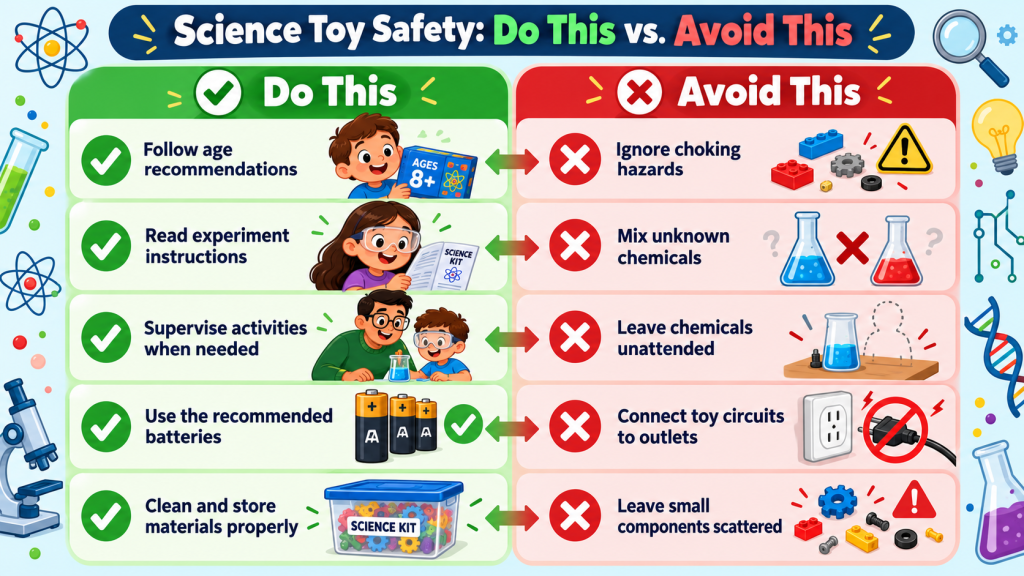
Read the exact product’s age label, parts warning, battery requirements, and supervision instructions. The U.S. Consumer Product Safety Commission’s toy safety guidance recommends matching toys to children’s interests and abilities and keeping small parts away from children under three.
For household experiments, never substitute an unknown chemical or combine substances outside the directions. Keep experiment materials separate from food, supervise heating or sharp tools, and wash hands afterward. Electronic kits must never be connected to household outlets. Also consider younger siblings who might reach loose components left on a table.
What Research Shows About Learning Through Science Play
A 2024 randomized field study of guided STEM activity kits compared 50 families receiving activity guides with 25 receiving the same materials without guides. Parents in the guided group reported more sustained kit use and greater confidence supporting learning. Children’s gains were parent-reported, however, rather than independently measured.
A 2014 review of elementary science programs found that school programs using science kits alone did not consistently improve test outcomes. That concerns classroom instruction, not proof that household toys fail. Together, the studies suggest that questions, useful prompts, and repeated investigations matter more than owning equipment. A clear activity guide is therefore a meaningful buying feature, but it cannot guarantee an individual child will learn specific concepts.
Choosing Toys for Siblings, Groups, and Classrooms
For two children, a general lab kit provides roles such as measuring, recording, and observing. A circuit kit often works best when partners take turns placing parts and checking diagrams rather than competing over one work surface.
For group activities, check the number of tools; one microscope creates long waits. Reusable equipment is particularly practical for classrooms, provided pieces are counted after each session and adults can supervise any shared liquids or batteries.
Turn a New Toy Into a Real Investigation
Before starting, ask: “What do you think will happen?” After the activity, invite the child to describe what changed and what surprised them. If the directions allow it, repeat the experiment while changing one safe variable, such as the angle of a ramp or the distance between a magnifier and an object.
Keep a small notebook for sketches, predictions, and results. For a practical next step, use these scientific method experiments for kids to practice changing one variable at a time. Discussing one result can be more useful than rushing to another project.
Keep Science Toys Useful After the First Week
Store instructions with the parts, label containers, and separate dry electronics from wet experiment supplies. After each session, check for missing pieces or damaged wires and clean equipment according to the manufacturer’s directions.
For open-ended kits, write a few new challenges on cards: build a different alarm circuit, compare three leaves, or record crystal changes each day. Rotating those challenges keeps familiar tools interesting without buying another box. If an experiment requires fresh consumables, confirm compatible replacements before promising another session.
Frequently Asked Questions About Science Toys
Which science toys are best for a five-year-old?
Choose simple lab equipment or a low-power microscope with easy controls and large viewing areas. A five-year-old may enjoy inspecting leaves, mixing colored water, or using a dropper with help. Check the exact age guidance and choking warnings; supervision remains important even with toys designed for preschoolers.
Are science toys better than regular toys?
They are not automatically better. Construction blocks, household objects, and ordinary outdoor play can also inspire experimenting and problem-solving. Dedicated science toys are useful when they provide special tools or helpful instructions that match a child’s curiosity. The best choice is whichever encourages repeated, age-appropriate exploration rather than a one-time demonstration.
Do children need adults to use science kits?
Many do, especially younger children and sets involving liquids, batteries, or chemicals. Older children may follow diagrams independently, but an adult should still review warnings and be available for troubleshooting. Even where direct help is minimal, asking what happened and why can make the activity more meaningful.
Is a microscope or chemistry kit a better first purchase?
Choose a microscope for a child who enjoys observing nature and objects repeatedly, with little cleanup. Choose a chemistry kit for someone excited by mixing, visible reactions, and guided experiments. A beginner microscope has limited magnification; a chemistry kit may need extra ingredients and eventually run out of materials.
Can science toys be used for homeschooling?
Yes, if the activities connect to a learning objective and children have opportunities to explain their findings. Use a toy to introduce a question, collect observations, and compare results with a book or lesson. A commercial kit should supplement, rather than replace, a complete science curriculum covering different concepts and skills.
Conclusion: Choose Science Toys That Fit the Child
The best science toys are the ones a child can use with interest, appropriate support, and a manageable amount of preparation. Check age guidance first, then decide whether the child prefers building circuits, inspecting small details, or conducting colorful investigations. Factor in batteries, replacement supplies, cleanup, and storage before choosing.
For a preschool beginner, the Learning Resources Primary Science Lab Set offers versatile tools. For an older child who likes puzzles and building, SNAP CIRCUITS Jr. SC-100 provides repeatable electronics challenges. A broad kit may be the better gift for a child still exploring different subjects.
Choose the toy that suits the child’s current curiosity and leaves room for the next question, not simply the one advertising the most experiments.