Children’s Experiments for Science: Simple Activities
We may earn a commission for purchases made using our links. Please see our disclosure to learn more.
Trying to make science fun at home can feel oddly intimidating. One minute you’re looking for a quick activity, and the next your child is already asking for a snack.
That is why children’s experiments for science should be simple, hands-on, and doable with real-life materials. You do not need a perfect homeschool lab. You need curiosity, a little structure, and permission for things to get mildly messy.
In this guide, you’ll find easy STEM activities, safety tips, research-backed ideas, Amazon product suggestions, and practical ways to help kids think like scientists.
Affiliate disclaimer: This article may contain affiliate links, which means we may earn a small commission if you buy through them, at no extra cost to you.
Why Children’s Experiments for Science Matter
Science becomes real when kids can touch it, test it, and say, “Wait… why did that happen?”
Children’s experiments for science help kids practice observation, prediction, problem-solving, and patience. A child who builds a craft-stick bridge is learning resilience. A child who watches ice melt is learning cause and effect.
The goal is not to create a tiny professor. The goal is to help your child ask questions.
What Makes a Good STEM Experiment?
A good STEM activity gives your child something to do, notice, change, and explain.
Before choosing an experiment, ask:
- Can my child safely handle the materials?
- Is there something to predict?
- Can the result change if we adjust one thing?
- Will this lead to conversation?
Often, the best learning happens after the “official” experiment, when your child asks what would happen with warm water or a bigger cup.
Start With Safety Before the Fun Begins
Before you start children’s experiments for science, set a few simple rules.
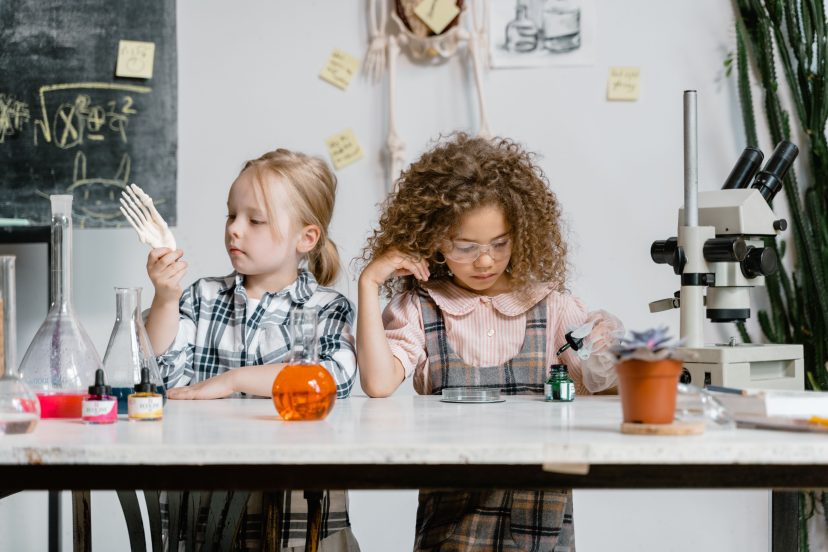
Use safety goggles when mixing, pouring, or working with small particles. Keep experiments away from eyes and mouths. Supervise heat, electricity, sharp tools, and chemicals.
A tray, baking sheet, or washable mat also helps. It tells your child, “This is the experiment zone,” and tells your table, “You may survive.”
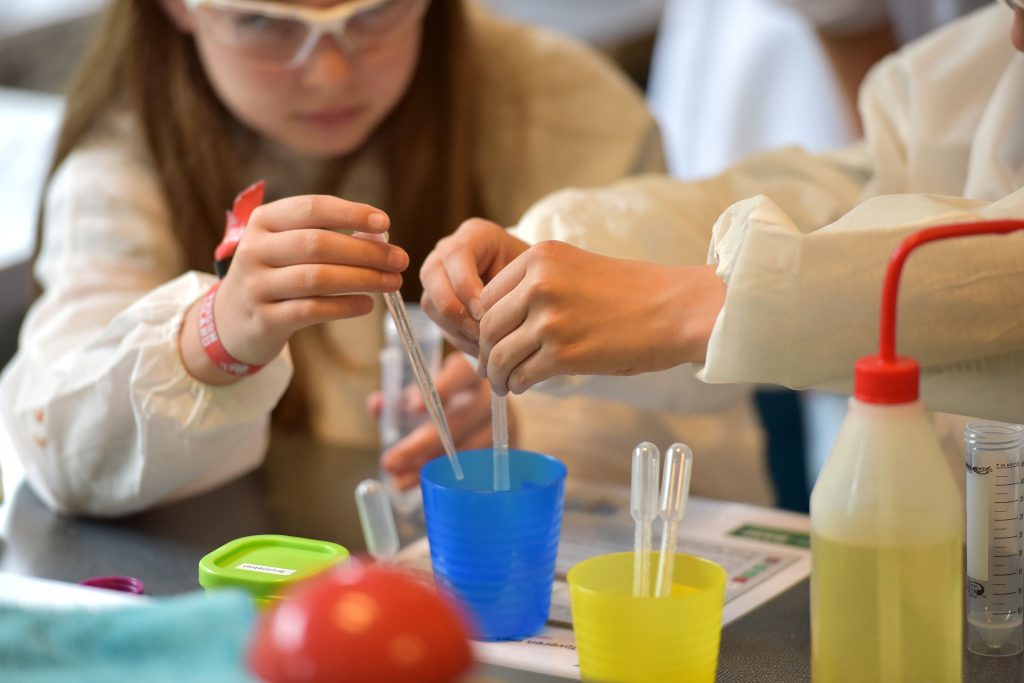
Kitchen Chemistry Kids Can Actually Understand
Kitchen chemistry works because kids already know the materials. Vinegar, baking soda, salt, oil, water, and food coloring can teach big ideas.
Try this: Fizzy color mixing
Add baking soda to small cups. Mix vinegar with food coloring in separate cups. Let your child use a dropper to add colored vinegar to the baking soda.
Ask:
- What do you notice?
- Which color reacted first?
- What will happen if we add more vinegar?
This introduces chemical reactions, gas formation, color mixing, and measurement. It also makes a glorious fizz.
Physics Experiments Kids Can See and Feel
Physics can sound serious, but kids meet it daily. Rolling balls, falling toys, shadows, ramps, and magnets are physics in disguise.
Try making a ramp with cardboard and books. Roll toy cars from different heights and measure how far they travel. Then make changes one at a time.
You can connect this to motion, gravity, force, and energy ideas through this helpful guide to physics concepts for kids.
Nature and Earth Science Activities
Nature-based STEM activities are wonderful because they slow kids down. A leaf becomes a data point. A rock becomes a mystery. A puddle becomes an investigation if you have the patience for wet shoes.
Try a backyard soil test. Put soil in a clear jar, add water, shake it, and let it settle. Over time, layers of sand, silt, clay, and organic matter appear.
This teaches observation, earth science, ecosystems, and patience. It works for apartments too. Use park soil, garden soil, or potting mix.
Engineering Challenges With Everyday Supplies
Engineering is not just building. It is building with a purpose.
Give your child a challenge like:
- Build a paper bridge that holds coins.
- Make a tower from straws and tape.
- Design a boat from foil that floats.
- Create a marble maze from cardboard.
The magic is in the redesign. When the bridge collapses, that is not failure. That is data wearing a dramatic costume.
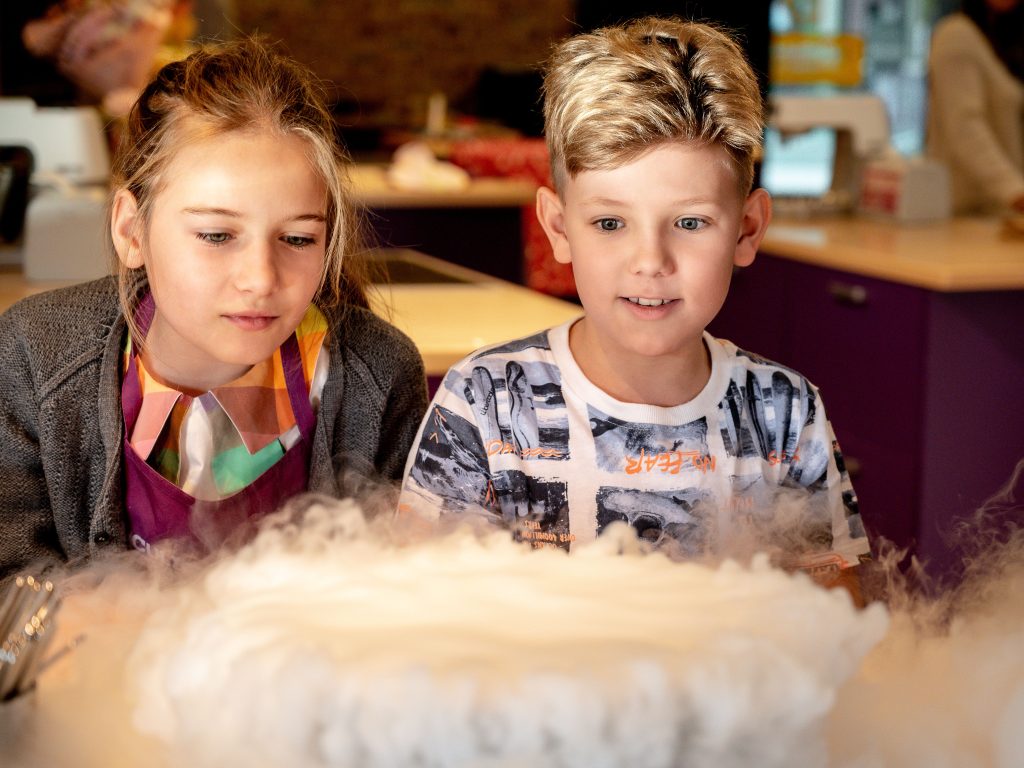
Math and Measurement Make Experiments Stronger
Math helps children’s science activities become more than “watch this cool thing happen.”
Use measuring spoons, rulers, timers, cups, and simple charts. Younger kids can compare “more” and “less.” Older kids can record numbers and look for patterns.
If your child tests which paper towel absorbs the most water, they can measure tablespoons, count drops, or compare soaked areas. Now math has a real purpose.
Technology and Simple Coding Connections
You do not need screens for every STEM activity, but technology can deepen learning when used wisely.
Kids can take photos of experiment steps, record short videos, use a stopwatch, or make a simple chart. Older children can use beginner coding tools to model patterns, sequences, or cause and effect.
The key is balance. Technology should help kids observe, document, or explain. It should not do the thinking for them.
How to Ask Better Science Questions
The question you ask can change the whole activity.
Instead of saying, “That happened because…” try asking:
- What do you think will happen next?
- Why do you think that changed?
- What could we test next?
- How could we make this fair?
- What surprised you?
These questions invite kids to reason. They also keep you from accidentally taking over, which is harder than it sounds when you know the answer.
Research-Backed Benefits of Hands-On STEM
Research supports what many parents and teachers notice: children learn deeply when they explore, build, talk, and test ideas.
A 2022 systematic review on informal STEM learning for young children found that meaningful informal STEM experiences can support school readiness and early learning.
NAEYC recommends STEM activities where children build, mix, roll, dig, make shadows, solve problems, and talk about what they notice. Their guide on choosing hands-on STEM activities is useful for families.
A 2025 review on guided inquiry in science learning also emphasizes that inquiry works best with structure, guidance, and chances to revise ideas.
In plain English: do not just hand kids supplies and hope for magic. Give them a question, a small challenge, and room to think.
5 Amazon Products for Children’s Science Experiments
These Amazon-friendly picks support children’s experiments for science at home, in classrooms, or during weekend STEM time.
1. National Geographic Mega Science Lab
This kit includes 75 experiments across earth science, chemistry, and science magic.
Features: experiment guide, multiple activity types, hands-on materials, broad STEM coverage.
Best for: curious kids who want variety and families who prefer one big all-in-one kit.
2. Scientific Explorer My First Mind Blowing Science Kit
This beginner science kit introduces chemical reactions, color changes, and basic science tools.
Features: simple activities, child-friendly materials, introductory chemistry concepts.
Best for: younger experimenters who love fizzy, colorful, “whoa!” moments.
3. Snap Circuits Jr. SC-100 Electronics Exploration Kit
This electronics kit lets kids build circuits without soldering or complicated wiring.
Features: snap-together parts, project manual, more than 100 projects, reusable pieces.
Best for: kids who like building, problem-solving, lights, sounds, and figuring out how gadgets work.
4. Learning Resources Primary Science Lab Activity Set
This set gives younger kids real-looking lab tools sized for small hands.
Features: beaker, flask, magnifying glass, dropper, funnel, goggles, and activity cards.
Best for: preschool and early elementary kids who enjoy pretend play mixed with real observation.
5. National Geographic Earth Science Kit
This kit focuses on volcanoes, crystals, tornadoes, rocks, and earth science.
Features: geology projects, crystal growing, volcano activity, multiple experiments.
Best for: kids who love rocks, nature, weather, and big visual results.
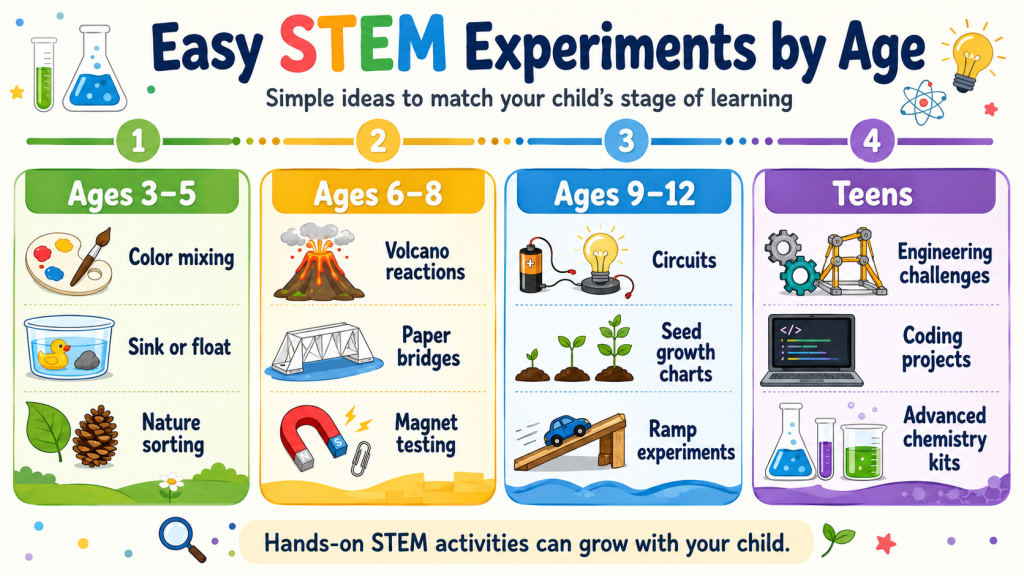
How to Adapt Experiments for Different Ages
For preschoolers, keep experiments sensory and short. Let them pour, sort, mix, and describe.
For ages 6–8, add predictions. Ask them to guess what will happen and compare the result.
For ages 9–12, add variables. Let them test one change at a time and record results.
For teens, invite design thinking. Ask them to improve the experiment or explain it to a younger sibling.
The same activity can grow with your child. A baking soda volcano can be a fizzy surprise at four and a reaction study at ten.
Common Mistakes to Avoid
The biggest mistake is making every experiment too perfect.
If a child only follows steps, they may miss the thinking. Let them make safe changes. Let them guess wrong. Let the paper tower fall over.
Also, avoid doing all the work yourself. Kids learn more when they pour, measure, draw, count, build, and explain.
FAQ: Children’s Experiments for Science
What are easy children’s experiments for science at home?
Easy options include baking soda and vinegar reactions, paper bridges, floating foil boats, seed sprouting, shadow tracing, magnet testing, and ice melting races. Start with safe household materials and one clear question.
What age should kids start science experiments?
Kids can start simple science exploration as toddlers through pouring, sorting, observing, and asking questions. Experiments with steps and predictions usually work better around preschool and early elementary age.
How do I make science experiments less messy?
Use trays, washable mats, small cups, and limited supplies. Set up near a sink when possible. Also, choose “dry” STEM activities sometimes, like building bridges, sorting rocks, or testing magnets.
Are science kits better than homemade experiments?
Both work. Homemade experiments are affordable and flexible. Science kits are helpful when you want guided activities, special materials, or less planning. A mix is ideal.
How can I help my child think like a scientist?
Ask open questions, encourage predictions, test one change at a time, and talk about results. Most importantly, treat mistakes as clues. That mindset builds confidence.
Conclusion
Children’s experiments for science do not need to be complicated to be powerful. A cup of vinegar, a cardboard ramp, a pile of leaves, or a handful of craft sticks can open the door to big ideas. When kids ask questions, test guesses, and try again, they learn more than facts. They learn curiosity, patience, creativity, and problem-solving. Start small, keep it safe, and let your child see that science is happening right there on the table, in the backyard, and sometimes all over the kitchen counter.