5 Baking Soda Experiments For Kids
We may earn a commission for purchases made using our links. Please see our disclosure to learn more.
A box of baking soda can turn an afternoon into a lively chemistry lesson, but the best activities do more than create foam. They help children predict, measure, compare, and explain what they see. These Baking Soda Experiments For Kids use familiar supplies and manageable steps for home or classroom learning. You will discover why the reaction fizzes, how to run five different activities, which tools make setup easier, and how to adjust each experiment for different ages. You can keep the focus on curiosity instead of chasing a picture-perfect eruption.
Affiliate disclosure: This article may contain affiliate links. We may earn a small commission from qualifying purchases at no extra cost to you.
Why Baking Soda Experiments For Kids Work So Well
Baking soda is a mild base made of sodium bicarbonate. When it meets an acid such as vinegar, the ingredients react and produce carbon dioxide gas, water, and sodium acetate. The gas creates the bubbles children can see and hear.
That immediate result invites questions. Children can compare ingredient amounts, liquid temperatures, or container shapes. Because the supplies are inexpensive, repeating a test is easy—and repetition turns a fun demonstration into a real investigation.
Set Up a Safe, Low-Stress Experiment Zone
Run Baking Soda Experiments For Kids on a wipe-clean surface. Place containers inside a rimmed tray and keep towels nearby. Children and supervising adults should wear properly fitting goggles.
Do not taste materials or trap the reaction inside a rigid sealed container because gas pressure can build. Use plastic containers for younger children, and let adults handle glass, cutting, or hot water. The American Chemical Society recommends adult supervision and eye protection for household fizzing activities.
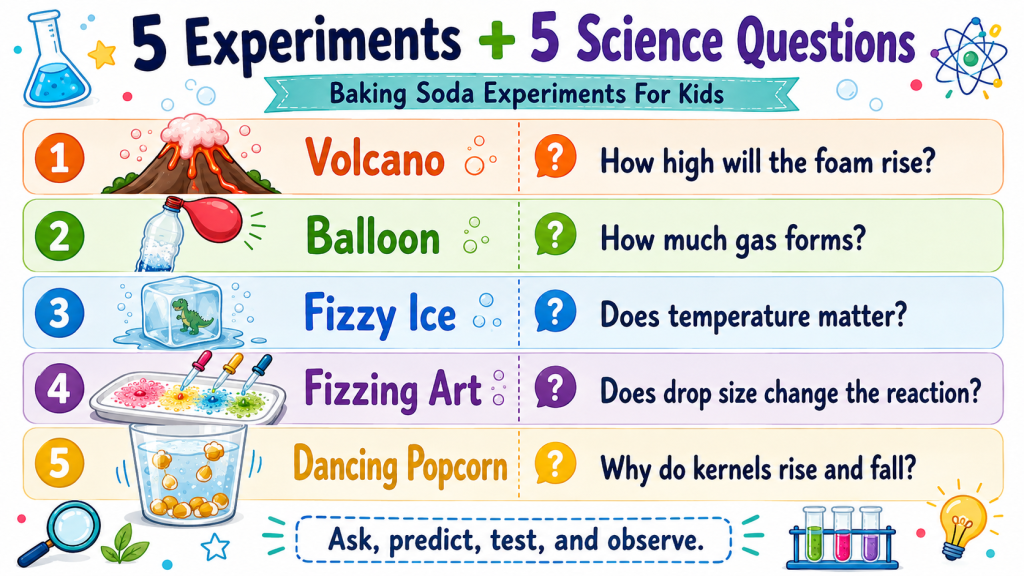
Baking Soda Experiments For Kids #1: Classic Foaming Volcano
Place a small plastic cup on a tray and shape clay, sand, or foil around it. Add two tablespoons of baking soda, one teaspoon of dish soap, and food coloring. Slowly pour in one-half cup of white vinegar.
The soap holds gas in longer-lasting bubbles, creating thicker “lava.” Repeat the reaction in a wider cup while keeping quantities constant. Ask how crater shape changes the foam’s path, and mark its highest level with washable tape.
Baking Soda Experiments For Kids #2: Balloon Inflation
Pour one-half cup of vinegar into a plastic bottle. Funnel two tablespoons of baking soda into an uninflated balloon, then stretch its opening securely over the bottle without dropping the powder.
Lift the balloon so the powder falls. Carbon dioxide travels upward and inflates it. Older children can measure the balloon with string, then vary the baking soda while keeping vinegar constant. Stop before it stretches tightly, and never use a rigid lid.
Baking Soda Experiments For Kids #3: Fizzy Ice Rescue
Freeze small washable toys in an ice tray or silicone pan. Move the ice to a rimmed tray, sprinkle it with baking soda, and let children add vinegar using a dropper.
Compare equal-sized blocks with cold and room-temperature vinegar. Time when each toy appears. Explain that the reaction, liquid, and surrounding air all affect the result. Choose toys without batteries, fabric, or tiny removable parts.
Baking Soda Experiments For Kids #4: Colorful Fizzing Art
Spread baking soda across a shallow tray or muffin-pan wells. Tint small cups of vinegar with food coloring, then let children release it one drop at a time.
Each drop creates a tiny eruption. Compare single drops with a teaspoon-sized pour: droplets reveal the starting point, while larger pours create faster, messier foam. Photograph the stages before colors blend, and protect clothing and porous counters from stains.
Baking Soda Experiments For Kids #5: Dancing Popcorn
Fill a tall clear glass three-quarters full with water. Stir in two teaspoons of baking soda, add several popcorn kernels, then pour in vinegar one tablespoon at a time.
Gas bubbles can attach to kernels and lift them. When bubbles pop, a kernel may sink and rise again. If movement is slow, wait, add a little more vinegar, or use fewer kernels. Compare popcorn with raisins, but never eat experiment materials.

Turn the Fizz Into a Fair Test
With Baking Soda Experiments For Kids, a demonstration asks, “What happens?” An experiment asks, “What changes when one factor changes?” Try questions such as, “Does warmer vinegar make foam rise faster?” or “Does dish soap make bubbles last longer?”
Keep the container, measurements, and timing consistent. Change one factor and run two or three trials. These scientific method experiments for kids can help learners organize questions, predictions, evidence, and next steps.
Record the variable, prediction, reaction time, foam height, and observations. Younger children can draw results; older learners can calculate averages or create a graph.
Adjust Each Activity for Different Ages
Preschoolers can explore Baking Soda Experiments For Kids by scooping, squeezing droppers, naming colors, and describing sounds with close supervision. Offer one clear choice at a time and keep the session brief.
Elementary learners can measure, time, count, and record results in a simple table. Older children can graph foam height, calculate ratios, or discuss limiting reactants. Sensory-sensitive children may prefer smaller quantities, gloves, quieter dropper activities, or watching the first trial before joining.
Troubleshoot Flat, Slow, or Overly Messy Reactions
A weak fizz may come from damp, clumped baking soda, too little vinegar, or poor contact between ingredients. Break up clumps and pour the acid directly onto the powder.
Dish soap does not make carbon dioxide; it helps bubbles last longer. If a balloon barely inflates, check its seal and shake down trapped powder. When foam repeatedly escapes the tray, reduce the ingredient amounts. Smaller batches are easier to compare and cheaper to repeat.
Clean Up and Store Supplies for Another Day
Pour fully reacted liquid down the drain with plenty of water unless a kit says otherwise. Scoop up large amounts of unused powder or paste first. Wash reusable cups, droppers, trays, and spoons, then dry them thoroughly.
Store experiment tools separately from food utensils. Keep baking soda in its original closed package, away from moisture and young children. A labeled bin with goggles, measuring spoons, cups, a funnel, balloons, droppers, and a notebook makes the next session easier.
Discard used balloons where young children cannot reach them. Wipe food coloring promptly and wash hands after cleanup.
Recommended Products for Baking Soda Experiments For Kids
The most useful supplies solve different problems: replenishing ingredients, improving control, providing child-sized tools, or offering structured instructions. The table below helps you match each option to your learner and available space.
| Product | Best for | Practical advantage | Consideration |
| ARM & HAMMER Baking Soda, 2.7 Lbs | Frequent experiments | Resealable everyday supply | Smaller than classroom bags |
| Learning Resources Primary Science Lab Activity Set | First lab setup | Child-sized tools | Ingredients sold separately |
| Learning Resources Primary Science Jumbo Eyedroppers with Stand | Preschool control | Six large droppers | Suits small liquid amounts |
| 4M Kitchen Science Kit | Guided chemistry | Six structured activities | Needs household ingredients |
| 4M KidzLabs Volcano Making Kit | School display | Build-and-paint model | Requires drying time |
| NATIONAL GEOGRAPHIC Amazing Chemistry Set | Older learners | Broad activity variety | More setup and reading |
ARM & HAMMER Baking Soda, 2.7 Lbs
Best for: Families repeating experiments
The 2.7-pound resealable bag supplies repeated volcanoes, trays, and comparison trials without occupying the space of a classroom-size sack. It fits regular home use well. Adults should pour a working amount into a cup instead of placing the full package on a child’s table.
Learning Resources Primary Science Lab Activity Set
Best for: Preschoolers building a first lab setup
This child-scaled set includes a beaker, funnel, eyedropper, test tubes, goggles, magnifying glass, and activity cards. Its plastic tools suit small hands better than full-size labware. The set provides equipment rather than ingredients, so families must supply baking soda, vinegar, and other materials.
Learning Resources Primary Science Jumbo Eyedroppers with Stand
Best for: Controlled fizzing and fine-motor practice
Six oversized droppers let young children add colored vinegar gradually instead of dumping a cup. The stand keeps them upright between rounds, making them useful for fizzing art and ice rescue. Their modest capacity improves control but is less convenient when an experiment needs a fast, larger pour.
4M Kitchen Science Kit
Best for: Children who prefer guided instructions
This compact kit provides materials and directions for six kitchen-based activities, offering more structure than loose supplies. It extends learning beyond one baking soda reaction without needing a large lab. Several activities still require household ingredients, so adults should review the instructions before beginning.
4M KidzLabs Volcano Making Kit
Best for: A school project with a reusable volcano model
The kit includes a volcano mold, fast-drying plaster, paint, a brush, a stir stick, and instructions. Children build and decorate the model before creating an eruption. Its art-and-geology element suits school displays, although preparation and drying make it less convenient for spontaneous experiments.
NATIONAL GEOGRAPHIC Amazing Chemistry Set
Best for: Older kids ready to explore beyond fizzing
This broader set combines tools with illustrated guidance for reactions, color changes, crystals, and other chemistry activities. It offers a next step after these Baking Soda Experiments For Kids. Its wider scope requires more setup, reading, and adult oversight, so it may overwhelm a child seeking one quick activity.
What Research Says About Fizzing Chemistry and Learning
The American Chemical Society’s 2024 lesson on controlling reaction products explains that vinegar and baking soda form carbon dioxide, water, and sodium acetate. It also shows why adding more of one reactant stops increasing the products once the other reactant runs out.
A peer-reviewed 2014 Journal of Chemical Education guided-inquiry activity used inexpensive, store-bought baking soda and vinegar to teach gas production, stoichiometry, and limiting reactants.
Meanwhile, the National Academies’ 2012 K–12 science framework emphasizes asking questions, planning investigations, analyzing data, and explaining evidence. That does not mean one kitchen activity guarantees broad academic gains. Its learning value comes from prediction, repetition, measurement, and discussion.
For safety, Poison Control’s baking soda guidance advises storing it away from children and treating significant ingestion seriously.
Frequently Asked Questions About Baking Soda Experiments For Kids
Are Baking Soda Experiments For Kids safe?
They can be suitable with close adult supervision, small quantities, eye protection, and a no-tasting rule. Use open containers, protect surfaces, and store ingredients away from unsupervised children. Significant ingestion can be harmful, so contact Poison Control or local medical services if it occurs.
Is it possible to substitute lemon juice for vinegar?
Indeed. Citric acid, which is found in lemon juice, reacts with baking soda to produce carbon dioxide. Acidity varies among products, so the foam may differ. Turn the substitution into a comparison: use equal liquid amounts, keep other variables constant, and record the result.
Why did the experiment stop fizzing?
The reaction slows when one reactant runs out or the ingredients stop making good contact. Extra baking soda cannot restore a strong fizz after the acid has reacted, and extra vinegar cannot help once the baking soda is gone. Small, measured additions reveal which ingredient remains.
Is it possible to substitute baking powder for baking soda?
Baking powder is not a direct replacement. It contains sodium bicarbonate, powdered acids, and other ingredients, so it behaves differently when wet. Use plain baking soda for a predictable vinegar reaction. Comparing both can become a separate test, provided you label materials and keep quantities small.
What age is ideal for these experiments?
Preschoolers can join dropper activities with hands-on adult supervision. Elementary children can measure, predict, and record results, while older learners can investigate ratios and limiting reactants. Follow product age guidance and consider whether the child can follow instructions, avoid tasting, and handle tools calmly.
Final Recommendation for Baking Soda Experiments For Kids
Choose the colorful fizzing tray for a short, controlled activity or the balloon experiment when your child is ready to investigate gas. A 2.7-pound ARM & HAMMER Baking Soda bag suits regular sessions, while the Learning Resources lab set gives younger children manageable tools. The 4M volcano kit makes more sense for a planned school display.
Whichever activity you select, keep quantities small, wear goggles, change one variable at a time, and ask the child to explain what the bubbles suggest. The most useful Baking Soda Experiments For Kids are not always the tallest eruptions. They are the ones children can repeat, compare, and turn into a thoughtful next question.