What STEM Stands For: A Clear Guide to Science, Technology, Engineering, and Math

We may earn a commission for purchases made using our links. Please see our disclosure to learn more.
If you have heard teachers, schools, or toy makers talk about STEM and wondered what the letters mean, you are not alone. In short, STEM refers to science, technology, engineering, and mathematics. More importantly, STEM describes a way of learning that connects those subjects through questions, experiments, design, problem-solving, and real-world applications.
This guide explains what each part of STEM means, how the four areas work together, what STEM learning looks like at home and school, how STEAM differs, and how to choose useful learning tools. You will also find research-backed guidance, product suggestions, and answers to common questions.
What STEM Stands For
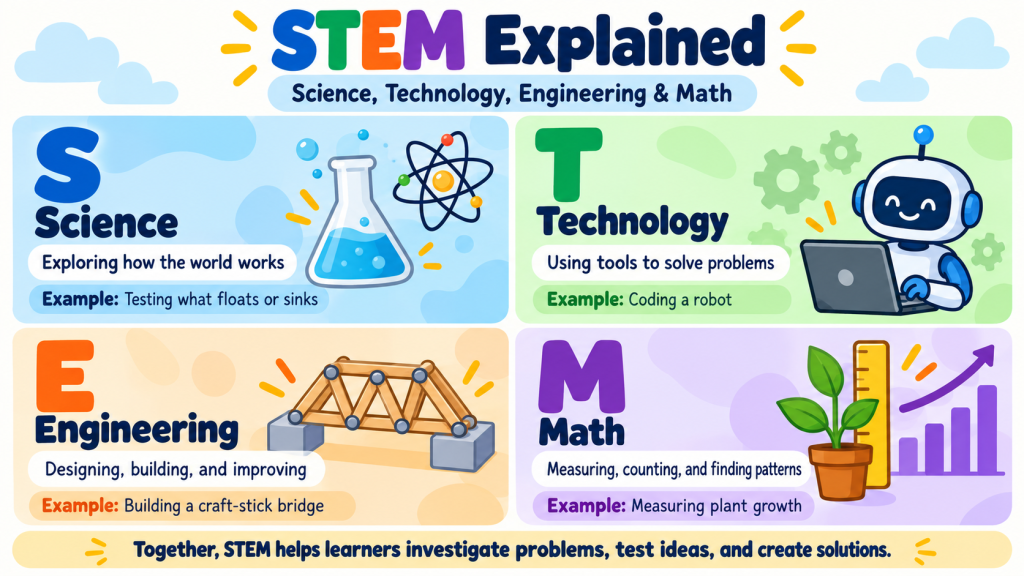
STEM stands for Science, Technology, Engineering, and Mathematics. The term is used broadly in education for learning in those four fields, whether they are taught separately or combined in one project. The U.S. Department of Education also uses STEM for science, technology, engineering, and mathematics education, including computer science.
Think of STEM as four lenses for solving problems. A child building a craft-stick bridge might investigate materials, use tools, redesign the structure, and measure length or load.
The S in STEM Means Science
Science asks questions about the natural and physical world. Children use observation, evidence, comparison, and experiments to figure out why things happen.
Testing which objects float, for example, involves prediction, observation, recording results, and looking for patterns. Science is not only memorizing facts; it also means testing ideas and using evidence to explain results.

The T in STEM Means Technology
Technology often gets mistaken for computers, but the term is broader. It includes tools, systems, devices, and processes people create or use to solve problems.
A microscope, calculator, coding robot, thermometer, pulley, or ruler can all function as technology. The tool may help collect information or improve a solution.
For children, technology can include coding and robotics, but also understanding how tools work and choosing the right one for a task.
The E in STEM Means Engineering
Engineering is where ideas become designs. Engineers identify a need, consider constraints, create possible solutions, test them, and improve the design.
Ask a child to build a paper-and-tape bridge for a toy animal. Testing, strengthening, and rebuilding become an engineering challenge, while a failed design provides useful information for the next version.
The M in STEM Means Mathematics
Mathematics helps STEM learners describe quantity, pattern, space, change, and relationships through skills such as counting, measuring, graphing, geometry, fractions, and statistics.
Math becomes meaningful when children need it to solve something. Measuring a paper airplane’s flight gives numbers a purpose; comparing plant growth introduces data; and measuring a model house connects geometry to design.
Hands-on STEM can help children see mathematics as a practical language rather than a set of isolated rules.
Why STEM Subjects Work Better Together
Real problems rarely arrive labeled “science only” or “math only.” Designing a water filter may involve science to understand materials, engineering to arrange filter layers, mathematics to compare flow rates, and technology to measure or record results.
The National Academies notes that integrated STEM can connect subjects to real-world issues, although results depend on program design and the evidence base remains uneven.
For learners, the benefit is context. Measurement matters because it helps a bridge fit, a robot turn correctly, or an experiment stay fair.
What STEM Learning Looks Like in Real Life
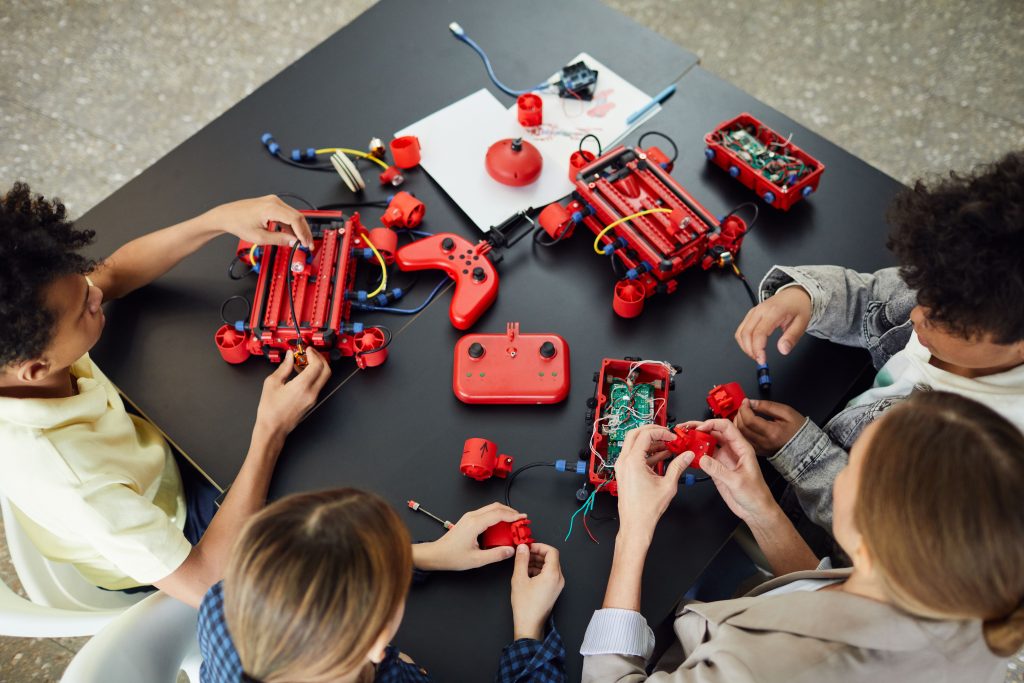
STEM learning does not require a laboratory. It can happen while cooking, gardening, building with blocks, tracking weather, or comparing paper airplane designs.
A child growing beans can observe germination, use a ruler or camera, design plant support, and measure growth—bringing all four areas together.
A good STEM activity usually has a question, challenge, or decision. The learner does something, observes what happens, and adjusts.
STEM vs. STEAM: What Is the Difference?
STEAM adds A for arts to science, technology, engineering, and mathematics. It highlights creativity, design, communication, and artistic thinking alongside technical problem-solving.
A bridge project can become STEAM when students consider architecture or presentation. A coding project may include digital art or music. A geometry lesson can connect to pattern design.
STEM is a clear label for scientific inquiry and technical problem-solving, while STEAM better describes projects that intentionally blend those areas with creative expression.
Why STEM Skills Matter for Kids
STEM education builds habits beyond any one school subject. Learners practice asking questions, testing ideas, explaining evidence, and adapting when a first attempt fails—skills useful in careers and everyday decisions.
There is also a workforce connection. The U.S. Bureau of Labor Statistics reported in 2026 that STEM occupations employed about 10.9 million people in 2025 and are projected to grow 7.4% from 2025 to 2035, compared with 3.2% for non-STEM occupations.
Not every child needs a STEM career. STEM literacy still helps young people interpret data, science, tools, and engineered systems.
How to Support STEM Learning at Home
You do not need to turn the kitchen into a science fair every weekend. Start with questions such as, “Why do you think that happened?” “How could we make it stronger?” and “What should we change next time?”
Simple materials such as cardboard, tape, cups, blocks, rulers, and recycled containers can support many activities. Choose projects that fit your child’s age, patience, space, and interests.
The guide on choosing a STEM activity kids will actually learn from offers a practical way to match activities with the learner.
Avoid solving the problem too quickly. A hint can help, but the thinking belongs to the learner.
Recommended Products for Understanding What STEM Stands For
A STEM product is most useful when it gives a learner something meaningful to investigate, build, test, or revise. These options suit different needs.
| Product | Best for | Main STEM emphasis |
| Learning Resources STEM Explorers MathLink Builders | Early math and building | Math + engineering |
| Learning Resources Botley 2.0 The Coding Robot Activity Set | Screen-free beginner coding | Technology + logic |
| SNAP CIRCUITS Jr. SC-100 STEM Electronics Kit, 100+ Projects, Ages 8+ | Introductory electronics | Technology + engineering |
| National Geographic Mega Science Lab with 75 Experiments for Kids 8-12 | Broad experiment variety | Science |
| Kids First Coding & Robotics by Thames & Kosmos | Story-based early coding | Technology + engineering |
Learning Resources STEM Explorers MathLink Builders
Best for: Ages 5+ who learn through building and visual math
This 100-piece set uses interlocking MathLink Cubes with challenges involving symmetry, sequencing, perspective, and spatial reasoning. It suits younger learners who enjoy making objects while thinking mathematically. Its strength is flexibility; however, children expecting motors, electronics, or dramatic experiments may find it intentionally simple.
Learning Resources Botley 2.0 The Coding Robot Activity Set
Best for: Young beginners who need screen-free coding practice
Botley 2.0 uses a remote programmer, coding cards, activity boards, and obstacles so children can create sequences without a screen. The 78-piece set supports direction, sequencing, object detection, and longer programmed routes. It suits early elementary learners who like movement and immediate feedback, though it requires five AAA batteries not included.
SNAP CIRCUITS Jr. SC-100 STEM Electronics Kit, 100+ Projects, Ages 8+
Best for: Kids who want to understand basic electronics
This kit uses 30 snap-together circuit parts and an illustrated manual to build more than 100 electronic projects. Components connect on a grid without soldering, making circuits easier to see and rearrange. It fits learners who like structured projects before open experimentation. Two AA batteries are required and are not included.
National Geographic Mega Science Lab with 75 Experiments for Kids 8-12
Best for: Curious kids who want a broad science sampler
This kit combines Earth science, chemistry, and science-magic activities in one package, with 75 experiments and projects. It suits children who have not settled on one science interest because the topics vary widely. The breadth is useful, although a 75-experiment kit also demands more storage, setup, and cleanup than a single-topic activity.
Kids First Coding & Robotics by Thames & Kosmos
Best for: Ages 4–8 who enjoy stories and hands-on sequencing
This kit uses a robot and hands-on coding materials in a 30-lesson program for early learners. Thames & Kosmos says the lessons align with Computer Science Teachers Association standards, with ISTE guidance and Code.org courses referenced. It works for younger learners who enjoy story-led sequencing, though older kids may outgrow its introductory pace.
How to Choose a STEM Kit Without Overbuying
Start with the child, not the product category. A six-year-old who loves stories may prefer a coding robot. A nine-year-old who takes things apart may prefer circuits. A child who enjoys patterns may get more from building cubes.
Check the recommended age, small-parts warnings, required batteries or extra materials, and whether an adult should supervise. Then ask whether the kit leaves room to think.
The strongest kits do more than produce one result. They let children predict, test, troubleshoot, rebuild, or create variations. Reusability matters when storage or budget is limited.
What Research Says About STEM Learning
Research supports active STEM learning but does not treat “STEM” as one uniform teaching method.
The National Academies report on integrated STEM education, published in 2014, found promising reasons to connect disciplines around meaningful problems while noting that evidence on integrated approaches was still developing. In practice, “interdisciplinary” is not automatically better; activities still need clear learning goals.
A peer-reviewed 2016 review indexed by ERIC examined how science, technology, engineering, and mathematics each contribute to STEM education and highlighted inquiry, engagement, teacher practice, and disciplinary knowledge.
The U.S. Department of Education’s STEM initiative emphasizes problem-solving, evaluating evidence, content knowledge, and access to quality learning environments. For families, that is a useful reminder: the value of an activity comes from what children think and do, not from how many gadgets are in the box.
Frequently Asked Questions About What STEM Stands For
What is the meaning of STEM in education?
STEM is an acronym for science, technology, engineering, and mathematics. In education, it can describe those subjects individually or lessons that connect two or more of them. Many STEM activities emphasize inquiry, design, measurement, problem-solving, and real-world applications rather than treating each subject as completely separate.
Is coding part of STEM?
Yes. Coding generally falls under technology and computer science, and it often overlaps with mathematics and engineering. A coding project can involve sequencing, logic, patterns, testing, debugging, and designing a solution. However, STEM is broader than coding; science experiments, engineering builds, data collection, and measurement also count.
At what age can children begin learning STEM concepts?
STEM learning can begin in early childhood because young children already explore cause and effect, patterns, shapes, motion, building, and counting. Activities should match developmental level. Preschoolers may sort objects or build towers, while older children can collect data, program robots, or design circuits.
Does STEM always require special kits or technology?
No. Many useful STEM activities use ordinary household or classroom materials. Paper bridges, homemade ramps, measuring challenges, plant observations, water experiments, and block structures can all support STEM thinking. Kits help when they provide specialized components, structured challenges, or reusable tools that would be inconvenient to assemble separately.
What is the easiest way to explain STEM to a child?
Try: “STEM is using science, technology, engineering, and math to understand things and solve problems.” Then give a concrete example. Building a tower uses engineering, measuring it uses math, testing which materials are strongest uses science, and choosing or using tools brings in technology.
Conclusion: What STEM Stands For and What to Do Next
Understanding what stem stands for is only the starting point. Science helps children investigate, technology gives them tools, engineering helps them design solutions, and mathematics helps them measure, compare, and explain what happens. The real value appears when those areas connect around a question or challenge.
For a younger learner, MathLink Builders or Botley 2.0 can make abstract ideas tangible. For an older child interested in how things work, Snap Circuits Jr. offers a focused electronics path. You can also skip the kit and begin with cardboard, tape, water, blocks, or a garden.
The best next step is simple: choose one problem your learner can explore, let them test an idea, and give them room to improve it.