
Introducing Circuits For Kids Through Hands-On Activities

We may earn a commission for purchases made using our links. Please see our disclosure to learn more.
If you have ever watched a child’s eyes light up when a tiny bulb turns on, you already know the magic of circuits. It is one of those “wait, I made that happen?” moments that turns science from a worksheet into an adventure.
That is why Circuits For Kids activities are such a great fit for home learning, homeschool lessons, preschool curiosity, Montessori-inspired projects, and elementary STEM time. Kids get to build, test, troubleshoot, and celebrate small wins with their own hands.
Affiliate disclosure: This article includes product ideas that may contain affiliate links, which means we may earn a commission at no extra cost to you.
Why Circuits Feel Like Magic To Kids
Electricity can feel invisible and mysterious. You cannot hold it like a pencil or stack it like blocks. But when kids connect a battery, wire, and light, suddenly the invisible becomes visible.
That is powerful.
A circuit teaches children that cause and effect are not just ideas in a textbook. When the path is completed, the light turns on. When the path is broken, it shuts off. Simple? Yes. But also kind of brilliant.
What Is A Circuit In Kid-Friendly Terms?
The path that electricity takes is called a circuit. Think of it like a tiny racetrack. The electricity starts at the battery, travels through the wire, powers something like a bulb or buzzer, and returns to the battery.
Open vs. Closed Circuits
A closed circuit is complete, so electricity can flow. An open circuit has a gap, so electricity stops.
A kid-friendly way to explain it: “Electricity needs a full loop, just like a train needs connected tracks.”
Circuit Vocabulary Kids Should Know
You do not need to turn your kitchen table into a college physics lab. A few simple words are enough.
Helpful Terms
- Battery: The power source
- Wire: The path electricity travels through
- Bulb or LED: The part that lights up
- Switch: A tool that opens or closes the circuit
- Conductor: A material that lets electricity move through it
- Insulator: A material that slows or blocks electricity
Once kids know these words, circuit activities become less confusing and a lot more fun.
Why Circuit Activities Belong In STEM Education
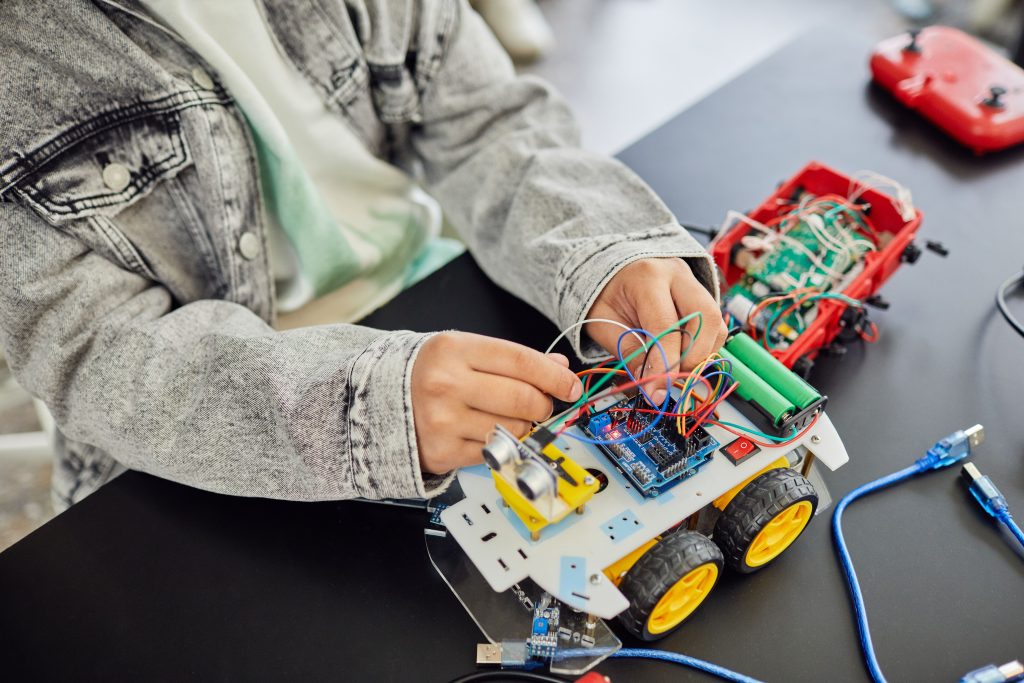
Circuits bring science, technology, engineering, and math together naturally. Kids ask questions, build models, test ideas, and adjust when something fails.
That is real STEM thinking.
For more ways to build confidence through structured learning, you can explore these hands-on STEM programs for kids and use circuit projects as a natural next step.
Supplies You Need Before You Start
You can begin with a very small setup. Honestly, the low-prep version is often better because kids are not overwhelmed by a pile of mystery parts.
Basic Materials
- Coin cell batteries or AA battery packs
- Copper tape or insulated wires
- LEDs or small bulbs
- Paper clips
- Cardstock
- Electrical tape
- Safety scissors
- Optional: buzzers, motors, switches, conductive dough
Keep supplies in a small box labeled “circuit lab.” Kids love anything that sounds official.
Safety Rules That Keep Learning Fun
Circuit projects for kids should use low-voltage batteries only. Avoid wall outlets completely. No “just this once” experiments with household electricity.
Simple Safety Tips
Use age-appropriate kits, supervise younger children, check battery orientation, and remove batteries when projects are finished. Also, remind kids that batteries can get warm if wires touch the wrong way.
Safety does not have to be scary. Just frame it as part of being a real inventor.
Start With A Simple Paper Circuit
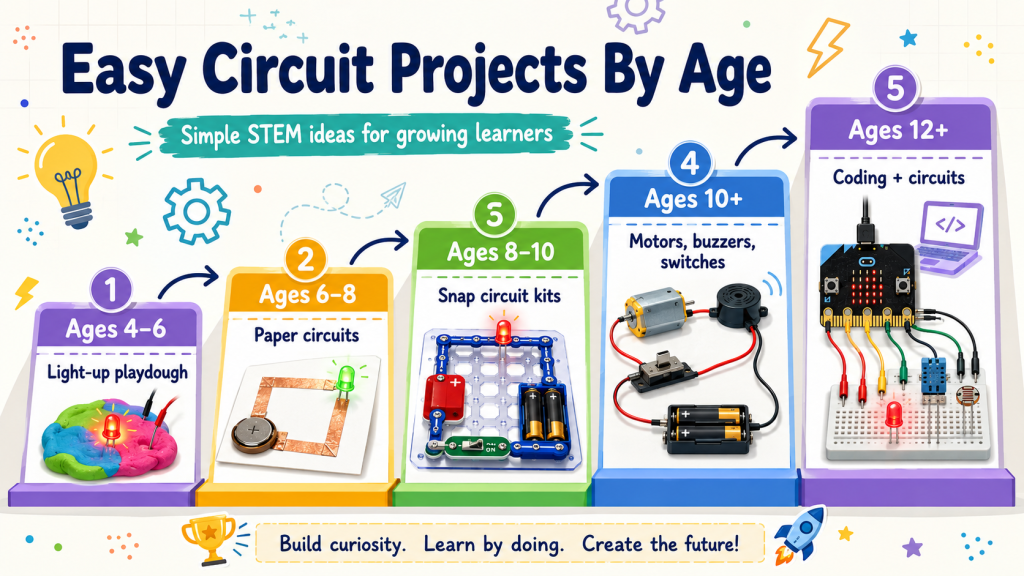
Paper circuits are perfect for beginners because they mix art with science. A child can draw a rocket, dinosaur, flower, or robot, then add an LED to make part of it glow.
How It Works
Kids use copper tape as the “road” for electricity. A coin cell battery powers the LED. The light turns on when the copper tape is properly connected on both sides.
This project is especially nice for kids who say, “I’m not a science person.” Art opens the door.
Try A Battery, Bulb, And Switch Challenge
This classic activity helps kids understand the basic structure of a complete circuit.
Give them a battery pack, wires, a bulb, and a simple switch. Then ask: “Can you make the bulb turn on and off?”
Add A Gentle Challenge
Once they succeed, ask them to change one thing. Can they add a second bulb? Can they make a brighter light? Can they draw a diagram of what they built?
That reflection step matters. It helps kids connect the hands-on work to the science behind it.

Make Conductive Playdough Circuits
Conductive playdough circuits are wonderfully weird in the best way. Kids build shapes, add LEDs, and discover that some materials carry electricity.
Why Kids Love It
It feels like play, not a lesson. Plus, it works well for younger learners who enjoy sensory activities.
Use two separate strips or blobs of conductive dough so the LED legs do not touch the same side. That little “oops” moment teaches a lot.
Build A Light-Up Greeting Card
A light-up card is a sweet project for birthdays, holidays, or family celebrations. It also gives kids a real reason to care about the circuit working.
They are not just lighting an LED. They are making Grandma’s card sparkle. Big difference.
Project Idea
Draw a night sky, add an LED star, and use copper tape to connect it to a coin cell battery. Fold one corner of the card to act like a press switch.
This is STEM with a little heart tucked inside.
Turn Everyday Objects Into Controllers
Once kids understand basic circuits, you can introduce playful technology projects. Makey Makey-style activities let children turn bananas, foil, playdough, or drawings into simple computer inputs.
The Makey Makey STEM Kit listing describes it as a hands-on technology kit with engineering and coding activities, making it a strong bridge between circuits and creative computing.
Fun Ideas
Try a banana piano, cardboard game controller, or foil maze. Kids quickly learn that technology is not only something they consume. It is something they can create.
How To Support Different Ages And Learning Styles
Not every child learns circuits the same way. Some want instructions. Others want to poke around and figure it out. Both styles can work.
Preschool And Early Elementary
Focus on observation. “What happens when we connect this?” is enough.
Upper Elementary
Introduce vocabulary, diagrams, switches, series circuits, and parallel circuits.
Neurodiverse Learners
Use visual steps, predictable routines, and low-pressure testing. Let kids repeat successful builds before adding complexity. When it boosts confidence, repetition is not boring.
Common Circuit Mistakes Kids Make
Mistakes are not failures here. They are basically the curriculum wearing a funny hat.
The Usual Suspects
- The battery is flipped the wrong way
- The LED legs are reversed
- The copper tape has a gap
- Wires touch and create a short circuit
- The switch does not fully connect
Instead of fixing everything immediately, ask, “What could we test first?” That question helps kids become problem-solvers instead of passive answer-waiters.
Research-Backed Reasons To Teach Circuits Hands-On
Kids often understand circuits better when they can build, test, and fix them with their own hands. A 2015 study in the Eurasia Journal of Mathematics, Science and Technology Education found that hands-on circuit activities encouraged more group interaction and focused discussion than computer-only learning. You can explore the study here: hands-on activities for learning electric circuits.
The National Academies also supports active science and engineering learning for young students. Its 2023 guide explains that investigation and design help children learn by asking questions, testing ideas, and improving their work. Read more here: investigation and engineering design in elementary science.
That is why circuit projects work so well: kids do not just memorize electricity terms. They see what happens, solve problems, and learn through discovery.
Product Ideas For Circuits For Kids
Here are five product ideas that fit beginner to intermediate circuit learning.
1. Snap Circuits Jr. SC-100 Electronics Exploration Kit
This classic kit includes over 100 projects, a full-color project manual, and snap-together parts for kids ages 8 and up. Amazon’s listing also notes 28 parts and a strong customer rating.
Features: Snap modules, project manual, no soldering, beginner-friendly builds
Use cases: Great for first-time electronics learners, homeschool STEM, and weekend projects
2. Playz Electrical Circuit Board Engineering Kit for Kids
The Playz kit focuses on electricity, voltage, currents, resistance, and magnetic science through 25+ STEM projects for ages 8–13+.
Features: Circuit board format, guided experiments, electricity and magnetism topics
Use cases: Best for kids who like structured lessons and visible components
3. Makey Makey STEM Kit from Joylabz
This kit helps kids explore engineering, coding, and hands-on technology by turning everyday objects into interactive inputs.
Features: Creative computing, beginner-friendly invention projects, coding connection
Use cases: Ideal for makerspaces, classrooms, and kids who love games or music
4. Snap Circuits Beginner Electronics Exploration Kit
The Snap Circuits Beginner kit is designed for ages 5–9 and introduces STEM concepts through simpler snap-together electronics.
Features: Younger age range, easy connections, simplified electronics activities
Use cases: Good for younger siblings, early elementary learners, and guided parent-child projects
5. NATIONAL GEOGRAPHIC Circuit Maker Electronics Science Kit
This kit offers hands-on electrical projects, including light, motion, and other electricity-based activities. One Amazon listing describes a version with 60+ projects, while another lists 40+ projects, so check the exact version before buying.
Features: Multiple project options, electricity demonstrations, hands-on build variety
Use cases: Best for kids who like dramatic results, such as lights, motion, and “wow” effects
How To Make Circuit Lessons Feel Like Play
The fastest way to drain the joy from circuits is to over-explain before kids touch anything.
Start with a challenge instead.
Try saying, “Can you make this light turn on?” Then let them experiment. After they care, add the vocabulary. Curiosity first, explanation second.
Make It Social
Kids can work in pairs: one builder, one tester. Then they switch roles. This helps quieter kids participate without feeling put on the spot.
Easy Ways To Extend The Learning
Once a child builds one circuit, keep the momentum going.
Ask them to design a tiny flashlight, create a quiz board, build a cardboard robot with glowing eyes, or make a simple alarm for a toy treasure box.
Reflection Questions
- What changed when you added another light?
- Why did the LED only work one way?
- What part acted like the switch?
- How would you explain this to a younger child?
These questions turn a fun activity into real understanding.
FAQs About Circuits For Kids
What age is best for teaching circuits to kids?
Many children can start exploring simple circuit ideas around ages 5–7 with close supervision and age-appropriate materials. More formal concepts like series circuits, parallel circuits, voltage, and resistance usually fit better around ages 8 and up.
What is the easiest circuit project for beginners?
A paper circuit with copper tape, a coin cell battery, and one LED is one of the easiest beginner projects. It is low-prep, visual, and creative, so kids can see the result quickly.
Are circuit kits safe for kids?
Most child-friendly circuit kits are designed for low-voltage battery use, which makes them much safer than household electricity. Still, adults should supervise, follow the product instructions, and keep small parts away from younger children.
How do you explain circuits to elementary students?
Tell them a circuit is a complete path electricity travels through. A closed circuit lets electricity flow, while an open circuit stops it. The train track analogy works beautifully here.
Do kids need a circuit kit to learn electricity?
No. A simple LED, coin cell battery, copper tape, and cardstock can teach the basics. However, circuit kits can make learning easier because the parts are organized, reusable, and often paired with guided projects.
Conclusion
Circuits For Kids activities are more than cute light-up projects. They teach problem-solving, patience, creativity, and real STEM thinking in a way kids can touch, test, and understand.
Start small. Build one glowing card, one paper circuit, or one battery-and-bulb challenge. Then let curiosity do what it does best: pull kids forward.
The first lightbulb moment may be literal. The next one might be confidence.