5 Balloon STEM Activities

We may earn a commission for purchases made using our links. Please see our disclosure to learn more.
A packet of balloons can turn an ordinary afternoon into a lively science lab—provided the learning goes beyond blowing one up and letting it disappear behind the sofa. These five Balloon STEM Activities help children explore propulsion, static electricity, engineering, chemical reactions, and air pressure with familiar materials. You will find simple instructions, questions worth testing, age-friendly adjustments, and practical product suggestions for home or classroom use. Each project encourages children to predict, measure, troubleshoot, and try again. The result may be a crooked car or a rocket that launches backward, but that is part of the fun. In STEM, an unexpected result often produces the best question.
Why Balloon STEM Activities Make Science Feel Real
Balloons make invisible ideas easier to notice. Children cannot see air pressure or electric charge, yet they can watch a rocket move, paper jump, or a hovercraft slide.
That feedback creates a simple cycle: predict, test, observe, and improve. When a balloon car curves left, axle alignment and friction stop being worksheet terms and become tools for solving a real problem. Because supplies are inexpensive, children can repeat trials without treating one mistake as the end.
Safety Rules Before You Begin
Uninflated and broken balloons can cause choking or suffocation. The U.S. Consumer Product Safety Commission advises keeping balloons away from children younger than eight, supervising their use, and discarding broken pieces immediately.
Ask about latex allergies. Adults should handle inflation for less experienced learners, preferably with a hand pump, and keep balloons away from faces. Never let anyone inhale from one.
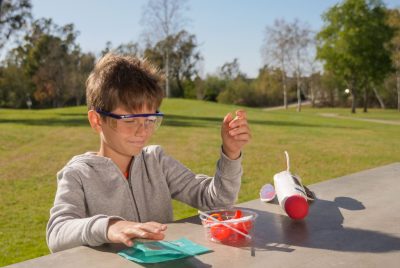
For the chemical activity, wear eye protection, use a plastic bottle, and work over a tray. Adults should handle cutting and strong adhesives.
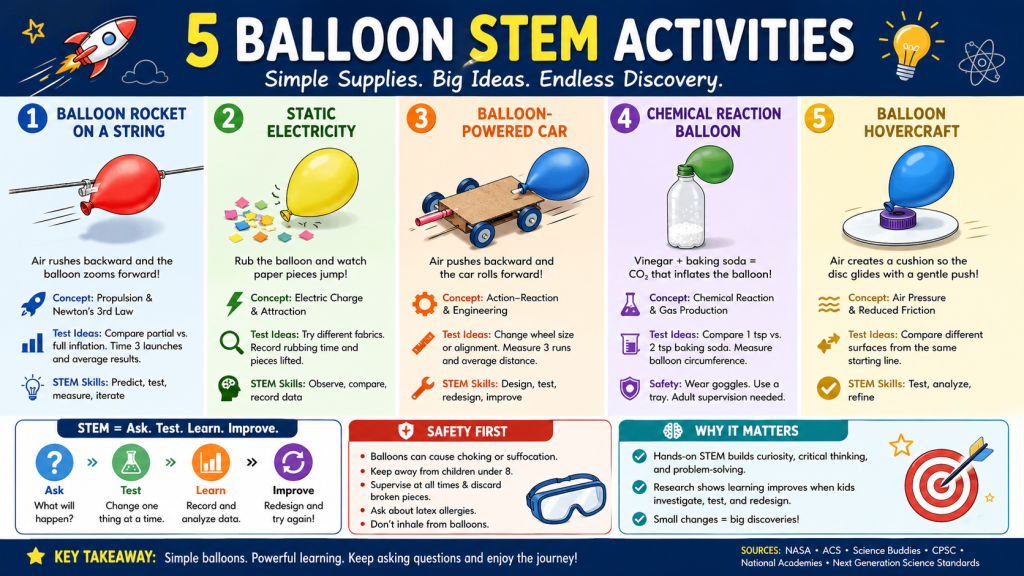
1. Launch a Balloon Rocket on a String
Thread string through a straw and pull it tightly between two stable supports. Inflate an untied balloon, tape it beneath the straw, hold the neck closed, and release.
The balloon moves forward while the air moves backward. NASA uses balloon rockets to demonstrate Newton’s third law: escaping air creates motion in the opposite direction.
Compare partly and fully inflated balloons while keeping the string, straw, starting point, and tape position unchanged. Time three launches and compare the averages with the prediction.
2. Investigate Static Electricity
Inflate and tie a balloon, then cut tissue paper into tiny pieces. Rub the balloon against wool, fleece, or dry hair and bring it close to the paper.
Rubbing can transfer electric charge between materials. The charged balloon attracts lightweight objects and may stick to a wall. Science Buddies recommends comparing fabrics to find which creates the strongest effect.
Record the fabric, rubbing time, and pieces lifted. Keep other conditions constant. Weak results may improve with a dry balloon or lower humidity.

3. Design a Balloon-Powered Car
Build a light body from cardboard, a clean tray, or craft sticks. Run two axles through straw guides, attach four equal wheels, and tape a balloon securely to a backward-pointing straw.
Inflate, pinch the straw closed, and release the car on a smooth floor. NASA’s balloon-powered rocket-car activity demonstrates the same action-reaction principle as the string rocket.
If it curves, straighten the axles or check for rubbing wheels. Measure three runs, average the distance, redesign one feature, and repeat.
4. Inflate a Balloon With a Chemical Reaction
Pour about 60 milliliters of vinegar into a small plastic bottle. Funnel one or two teaspoons of baking soda into an uninflated balloon, then stretch it over the bottle without dropping in the powder.
Lift the balloon so the powder falls into the vinegar. The balloon expands due to the carbon dioxide produced by the reaction. The American Chemical Society explains that baking soda and acid form a salt, water, and carbon dioxide.
Work over a tray. Compare one teaspoon with two while keeping the vinegar constant, then measure circumference.
5. Build a Simple Balloon Hovercraft
Use a smooth, lightweight disc and a pop-top bottle cap. An adult should seal the cap over the center hole with reusable putty or strong tape. Close the cap, inflate a balloon, and stretch its neck over it.
Place the disc on a smooth table and open the cap. Air spreads beneath the disc, reducing surface contact so it glides with a gentle push.
Compare a tabletop, cardboard, and a textured mat from the same line. If it drags, improve the seal or choose a smoother surface.

Turn Balloon STEM Activities Into Fair Experiments
A demonstration asks, “What happens?” An experiment asks, “What happens when we change one thing?”
To turn the activity into one of several scientific method experiments for kids, choose one variable, decide what to measure, and keep other conditions constant. Run at least three trials because tape loosens, wheels snag, and launches vary.
Young children can draw predictions; older learners can build tables, calculate averages, or graph results. Finish with, “What evidence supports your idea?” and “What would you change next?” Correct guessing matters less than reasoning from evidence.
Choose the Right Challenge for Each Age
For younger elementary learners, start with the string rocket or static activity. Adults can manage inflation while children predict, count, and describe.
Children age eight and older often enjoy the car because it rewards redesign. Offer several materials instead of one fixed template; a slightly wonky original creates more problem-solving than a copied model.
Older learners can compare reaction ratios, calculate speed, test added mass, or work within material limits. Match the challenge to skills, patience, knowledge, and comfort with sudden noises.
Common Problems and Easy Fixes
A stalled rocket usually needs tighter string or less tape. A curving car may have misaligned axles or rubbing wheels.
Weak static results often improve with a dry balloon, different fabric, or lower humidity. A barely inflated reaction balloon may have a loose seal or trapped baking soda.
For a dragging hovercraft, reseal the cap and use a smoother surface. Troubleshooting is where children connect cause, evidence, and design.
Recommended Products for Balloon STEM Activities
The most useful products simplify setup, support measurement, or leave room for redesign.
| Product | Best use | Consideration |
| Balloon Cars kit | Small groups | Needs extra building materials |
| Primary Science Lab Set | Younger learners | General-purpose set |
| 150 Experiments kit | Activity variety | Adult review required |
| Simple Tape Measure | Distance data | Four-foot range |
| Cylinder and beaker set | Reaction measurements | Requires washing |
Teacher Created Resources STEM Starters: Balloon Cars (TCR20880)
Best for: Classroom groups and open-ended engineering
This 60-piece set includes foam wheels, plastic sticks, straws, balloons, nozzles, and a parent/teacher guide, with core parts for six cars. Children still invent the chassis, so the kit supports redesign rather than one fixed model. You must supply tape and everyday construction materials.
Learning Resources Primary Science Lab Activity Set
Best for: Younger learners developing basic lab habits
This 22-piece set contains child-sized tools including a beaker, funnel, eyedropper, flask, tweezers, goggles, test tubes, and activity cards. It makes transferring and observing materials easier during the reaction activity. However, it is a broad early-science set, and household ingredients are not included.
UNGLINGA 150 Experiments Science Kit for Kids
Best for: Families wanting projects beyond balloons
This broad kit includes illustrated instructions and activities across chemistry and physics, including a balloon-rocket project. It offers more long-term variety than a single-purpose box. Because it covers many experiments, an adult should review each activity, required household materials, age guidance, and safety directions first.
Learning Resources Simple Tape Measure
Best for: Children recording short travel distances
This retractable tool measures up to four feet and shows customary and metric units on a plastic blade. It suits indoor rocket, car, and hovercraft trials without the weight and snap of a metal workshop tape. Longer races need floor markers or repeated measurements.
Teenitor Graduated Cylinder Plastic Beaker Set, 10 Pieces
Best for: Older learners comparing reaction quantities
This set combines five graduated cylinders and five plastic beakers in several capacities, making vinegar measurements more consistent across trials. The plastic vessels suit supervised learning, though they are not precision laboratory glassware. Wash, rinse, and dry every piece after use.
Research-Backed Reasons to Use Hands-On STEM
The value comes from guiding children to ask questions, gather evidence, explain results, and redesign—not from balloons alone.
The National Academies’ 2019 report on investigation and engineering design recommends centering science learning on relevant phenomena, evidence-based explanations, testing, redesign, and discussion.
The Next Generation Science Standards’ practices also emphasize planning investigations, analyzing data, developing models, communicating information, and designing solutions.
Hands-on work still needs focused questions and reflection. Adults should help learners notice why a design behaved as it did.
Plan a Calm, Low-Mess STEM Session
Choose one activity and place unused balloons, tools, and scraps in labeled trays. Write the investigation question where everyone can see it.
For groups, assign builder, launcher, timer, measurer, and recorder roles, then rotate them. Three trials and one redesign usually fit a short session better than an unlimited experiment.
Save the data sheet or photograph the setup. Revisiting evidence helps children see STEM as a process of improving ideas, not isolated tricks.
Frequently Asked Questions About Balloon STEM Activities
What age is appropriate for Balloon STEM Activities?
Because uninflated and broken balloons pose a serious hazard, these projects are best for closely supervised children age eight and older. Younger children should not handle balloons independently. Beginners can observe and count, while older learners measure variables, calculate averages, build models, and manage more of the investigation under adult oversight.
Can I use non-latex balloons?
Yes. Non-latex options may help when latex allergy is a concern, but differences in stretch, shape, and nozzle design can change results. Test one before planning a group lesson. Regardless of material, follow package guidance, supervise use, and treat uninflated or broken pieces as hazards.
Which project is easiest for beginners?
The string rocket is usually easiest because setup is quick and the motion is obvious. Static electricity also requires few materials, although humidity can weaken the effect. Begin with a demonstration, ask for a prediction, and repeat while changing one clearly defined variable.
How can I adapt one for a science fair?
Choose a measurable question, such as how balloon circumference affects rocket travel time or how wheel diameter changes car distance. Test several conditions, run at least three trials per condition, control other variables, graph the results, and discuss measurement limits instead of claiming one small experiment proves a universal rule.
What can replace a balloon?
There is no single substitute because a balloon stores air, supplies elastic force, or accepts charge depending on the project. A syringe-and-tube system or small fan can explore propulsion, while a plastic comb can demonstrate static electricity. Choose a replacement that preserves the scientific question.
Final Thoughts on Balloon STEM Activities
Choose the project that fits your learner’s patience, skills, and favorite kind of challenge. Start with the string rocket for a fast lesson in propulsion, or try static electricity when you need minimal setup. Budding engineers may prefer the balloon car, especially with the Teacher Created Resources kit, while careful measurers can use graduated cylinders to compare gas-producing reactions.
Whatever you choose, keep safety non-negotiable and the investigation focused: change one factor, run several trials, record the evidence, and redesign. These Balloon STEM Activities do not need to look polished to be valuable. A crooked car, slow rocket, or leaky hovercraft can lead to the most useful question in science: “What should we try next?”