Best Puzzle Toys for STEM Learning at Home
We may earn a commission for purchases made using our links. Please see our disclosure to learn more.
Finding the right puzzle toys can feel strangely overwhelming. You want something fun, educational, and worth the money. But you also do not want another toy that gets five minutes of excitement before vanishing into the toy bin forever.
That is where STEM-focused puzzle toys shine. They keep kids busy, yes, but they also help them think, test, build, fail, and try again. That kind of play builds real skills without making learning feel like a worksheet.
In this guide, you will learn how puzzle toys support STEM learning, what to look for before buying, and which Amazon options are worth considering for curious kids.
Why Puzzle Toys Are Great for STEM Learning
Puzzle toys work because they make kids active thinkers.
Instead of sitting back and watching something happen, children have to make choices. They rotate pieces, test patterns, move blocks, follow clues, and adjust when something does not work.
That process is very close to real STEM thinking.
A child solving a marble maze is practicing cause and effect. A child working through a pattern puzzle is using early math. A child trying to free a car from a traffic jam game is learning planning and logic.
It looks like play, but underneath the surface, the brain is doing tiny push-ups.
What Makes a Puzzle Toy a STEM Toy?
Not every puzzle toy is automatically a STEM toy. Some are mostly for entertainment, and that is fine. But a strong STEM puzzle toy usually teaches through problem-solving.
Look for toys that encourage:
- Logical thinking
- Spatial reasoning
- Pattern recognition
- Fine motor control
- Planning and sequencing
- Trial-and-error learning
- Creative problem-solving
The best educational toys do not simply ask kids to memorize. They ask kids to figure things out.
How Puzzle Toys Build Problem-Solving Skills
Problem-solving starts with one simple question: “What should I try next?”
Puzzle toys naturally invite that question.
When a piece does not fit, kids must pause and rethink. When a marble falls the wrong way, they change the tower. When a logic puzzle gets stuck, they backtrack and test a new move.
That is powerful because kids learn that mistakes are not the end. They are information.
This matters in STEM learning because science, math, coding, and engineering all require patience. No one builds confidence by getting everything right on the first try.
Puzzle Toys and Spatial Reasoning
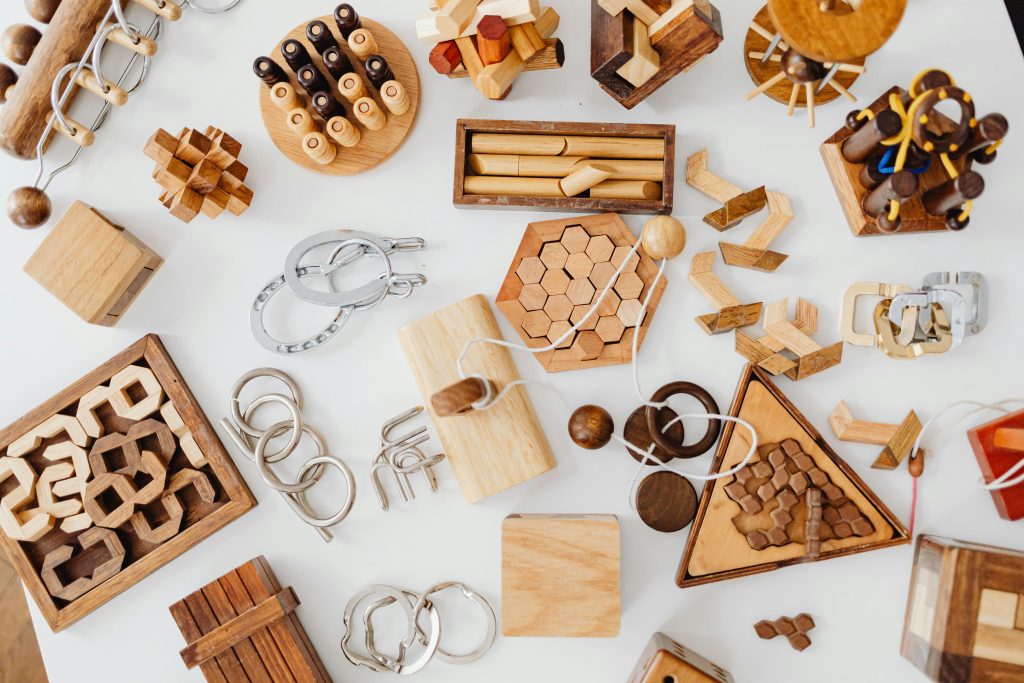
Spatial reasoning means understanding how shapes, spaces, and objects relate to one another.
That sounds fancy, but kids use it all the time. They use it when stacking blocks, solving tangrams, rotating puzzle pieces, reading maps, building LEGO sets, or figuring out how to fit too many snacks into one lunchbox.
A University of Chicago study found that children who played with puzzles between ages 2 and 4 later showed stronger spatial skills at 54 months. The researchers also noted that puzzle play predicted spatial skill even after accounting for factors such as parent education and language input.
The Real-Life Skills Kids Learn From Puzzle Toys
Puzzle toys do more than support academics.
They also help children practice patience, focus, flexible thinking, and emotional regulation. That last one matters a lot.
You have probably seen it: a child gets stuck, sighs dramatically, and looks ready to quit. But then they try again. Maybe they ask for a hint. Maybe they flip the piece around. Maybe they solve it and beam like they just cracked a secret code.
That small win builds confidence.
Over time, kids learn:
- “I can handle tricky things.”
- “I can try a different way.”
- “I do not have to give up right away.”
These are life skills, not just academic ability.
Best Ages for Puzzle Toys
The best puzzle toy depends on age, skill level, and personality.
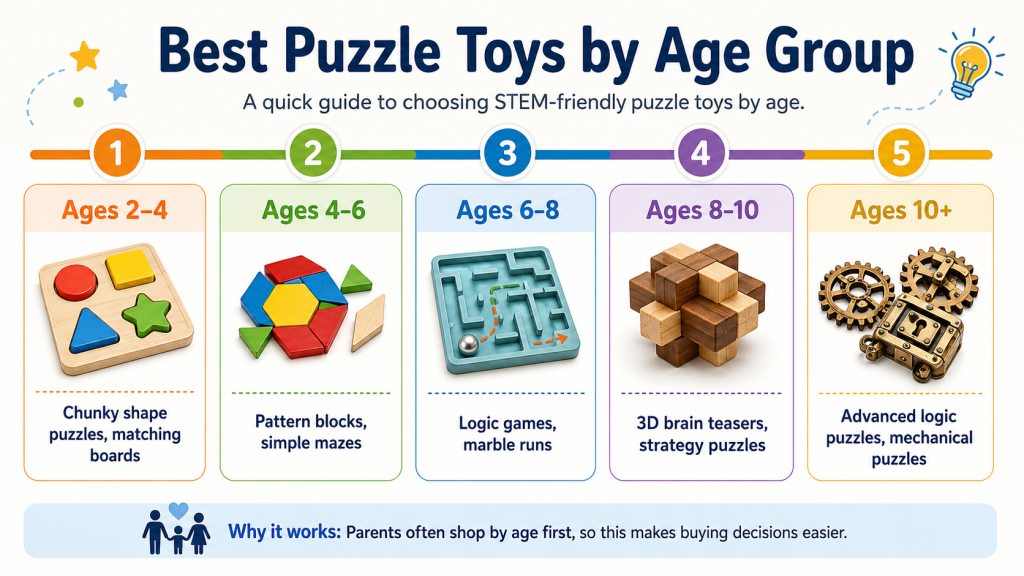
Toddlers usually do best with chunky pieces, large knobs, shape sorters, and simple matching games.
Preschoolers can handle pattern boards, basic mazes, color sorting, and early logic puzzles.
Kids ages 6 to 8 often enjoy brain teasers, beginner marble runs, gear toys, and simple strategy games.
Older kids may like 3D puzzles, advanced logic games, mechanical puzzles, and multi-step building challenges.
Age labels help, but they are not perfect. Some younger kids love hard challenges. Some older kids prefer slow, calming puzzles. Both are completely fine.
How to Choose the Right Puzzle Toys
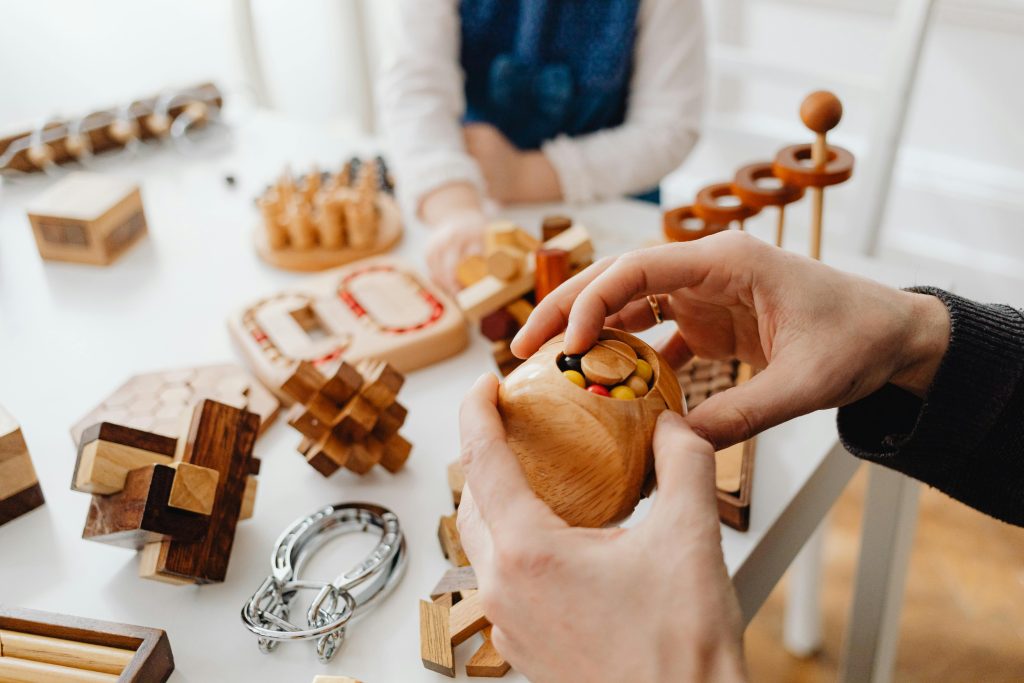
A great toy should sit in the “just challenging enough” zone.
Too easy, and kids get bored. Too hard, and they feel defeated. The sweet spot is a toy that makes them think but still feels possible.
Before buying, ask:
- Will my child understand the basic goal?
- Can this toy grow with them?
- Does it offer more than one challenge?
- Are the pieces durable?
- Can it be played alone or with others?
- Does it match my child’s interests?
If your child loves cars, a traffic jam logic game may work. If they love building, a marble maze may be better. If they love colors and design, pattern blocks are a great starting point.
Best Puzzle Toys for STEM Learning: Amazon Picks
Here are five strong puzzle toys that support STEM learning at home. Each one builds a slightly different skill, so the “best” choice depends on your child.
Educational Insights Kanoodle – 3D Brain Teaser Puzzles
Kanoodle is a compact brain teaser puzzle with 2D and 3D challenges. It is especially good for kids who enjoy quiet, independent play.
The Amazon listing describes Kanoodle as a travel-friendly puzzle game with 200 challenges designed for spatial reasoning, problem-solving, and screen-free entertainment.
Features:
- 2D and 3D puzzle challenges
- Compact carrying case
- 200 challenges
- Good for travel and quiet time
Best for: Kids, teens, and adults who enjoy logic puzzles and brain teasers.
ThinkFun Gravity Maze – Falling Marble Logic Game
Gravity Maze is a puzzle game with a marble run. Kids build towers, test marble paths, and adjust their setup until the marble reaches the target.
Amazon’s listing notes that Gravity Maze includes 9 towers, 3 marbles, a grid, and a target piece, with play that supports construction, imagination, reasoning, and collaborative problem-solving.
Features:
- Marble-run style logic challenges
- 9 towers and 3 marbles
- Hands-on engineering play
- Great for cause-and-effect thinking
Best for: Kids who like building, testing, and seeing instant results.
ThinkFun Rush Hour Traffic Jam Logic Game
Rush Hour is a classic logic game where players slide cars and trucks to clear a path for the red car.
The Amazon listing describes it as a traffic escape puzzle with 40 challenges from beginner to expert, designed to support problem-solving and strategic thinking.
Features:
- 40 challenge cards
- Beginner-to-expert levels
- Compact game board
- Strong planning practice
Best for: Kids who enjoy strategy, cars, and step-by-step thinking.
Learning Resources STEM Explorers Brainometry
Brainometry uses colorful shapes and challenge cards to help kids build visual thinking and pattern skills.
The Amazon listing describes it as a hands-on STEM puzzle that supports critical thinking, mathematical skills, fine motor development, and spatial relationships.
Features:
- Colorful tactile pieces
- Pattern-matching activities
- Fine motor practice
- Designed for ages 5+
Best for: Early elementary kids who enjoy shapes, puzzles, and hands-on math.
Melissa & Doug Pattern Blocks and Boards
This wooden pattern block set is simple, classic, and surprisingly useful for early STEM learning.
Amazon lists the set with 120 multi-colored wooden shape tiles and 5 double-sided puzzle boards. The listing also highlights sorting, stacking, pattern play, and hands-on developmental learning.
Features:
- 120 wooden shape tiles
- 5 double-sided boards
- Pattern, color, and shape play
- Durable wooden design
Best for: Preschoolers and younger kids learning shapes, patterns, colors, and spatial awareness.
Puzzle Toys for Preschoolers
Preschoolers learn best when play feels open and low-pressure.
At this age, puzzle toys should be colorful, sturdy, and easy to understand. Pattern blocks, shape puzzles, matching boards, and simple tangrams are great choices.
You can ask questions like:
- “What shape do you see?”
- “Can you turn it another way?”
- “What happens if we try this piece?”
- “Can you make your own design?”
These small prompts turn playtime into a gentle math conversation.
Puzzle Toys for Elementary Kids
Elementary-age kids are ready for more challenge.
This is when logic games, marble mazes, construction puzzles, and 3D brain teasers become exciting. Kids can follow rules, think ahead, and work through multi-step problems.
However, keep the mood light. If a toy becomes too much like a test, the fun drains out fast.
A helpful trick is to say, “Let’s experiment,” instead of “Solve it.”
That one word shift makes the challenge feel less scary.
Puzzle Toys for Older Kids and Teens
Older kids often enjoy puzzles that feel more grown-up.
Look for advanced brain teasers, mechanical puzzles, 3D models, coding-style logic games, and strategy puzzles. Kanoodle-style games, Rush Hour, and more advanced marble challenges can work well.
For teens, puzzle toys can also be a calm break from screens. They offer focus without notifications, which is basically a tiny miracle.
How Puzzle Toys Support Screen-Free Learning
Screens are not evil. Let’s be honest, sometimes they save the day.
But kids also need hands-on play. Puzzle toys offer a different kind of learning because children can touch, move, rotate, and rebuild.
That physical interaction matters. It helps kids connect ideas with action.
A Stanford DREME article explains that puzzles give young children opportunities to explore early math ideas such as shapes, sizes, and how pieces fit together, all of which support spatial reasoning.
How Parents Can Make Puzzle Play More Valuable
You do not need to hover like a tiny STEM coach.
Actually, too much help can steal the fun. Instead, give gentle support.
Try saying:
- “What have you already tried?”
- “What do you notice?”
- “Can we look at it from another angle?”
- Would you like more time or a hint?”
The goal is not to rescue kids from frustration right away. The goal is to help them stay with the challenge long enough to build confidence.
How to Build a Simple STEM Toy Shelf at Home
You do not need a huge toy collection.
A small, thoughtful STEM shelf can work beautifully. Try including:
- One shape or pattern puzzle
- One logic game
- One building challenge
- One marble or maze toy
- One open-ended creative toy
Rotate toys every few weeks. When an old toy comes back after a break, kids often treat it like a brand-new discovery.
You can also pair puzzle play with seasonal projects. For example, these Christmas STEM activities are a fun way to bring hands-on science and engineering into holiday learning.
Common Mistakes to Avoid When Buying Puzzle Toys
The biggest mistake is buying a toy only because it says “STEM” on the box.
Some toys use the label without offering much real thinking. Look past the marketing and ask what your child actually does with the toy.
Avoid toys that:
- Have only one quick use
- Break easily
- Feel too advanced
- Require constant adult setup
- Offer no replay value
- Create frustration without support
Also, do not buy only what looks impressive to adults. Kids are wonderfully honest. If it does not interest them, it will not get used.
Research-Backed Reasons Puzzle Play Matters
Research supports what many parents and teachers already notice: puzzles can help kids build spatial and math-related skills.
A University of Chicago study on early puzzle play and spatial transformation skills observed 53 children and parents at home and found that early puzzle play predicted preschoolers’ spatial skill development.
Stanford DREME also explains that puzzle play supports early spatial and math learning, noting that spatial reasoning helps children understand math and science concepts.
FAQs About Puzzle Toys
What are the best puzzle toys for STEM learning?
The best puzzle toys for STEM learning include logic games, 3D brain teasers, marble mazes, pattern blocks, tangrams, and strategy puzzles. Look for toys that encourage problem-solving, spatial reasoning, and hands-on experimentation.
What age should kids start using puzzle toys?
Kids can start using simple puzzle toys as toddlers. Large wooden puzzles and shape sorters work well for ages 2–4. Older kids can move into pattern puzzles, marble mazes, logic games, and 3D brain teasers.
Do puzzle toys help with math skills?
Yes, puzzle toys can support early math skills by helping kids understand shapes, patterns, sizes, sequencing, and spatial relationships. These skills can make later math concepts feel more natural.
Are puzzle toys good for screen-free play?
Yes, puzzle toys are excellent for screen-free play. They keep kids engaged through hands-on thinking, building, testing, and problem-solving without needing batteries, apps, or constant adult instruction.
How many puzzle toys does a child need?
A child does not need dozens of puzzle toys. A small mix of 3–5 high-quality options is usually enough. Choose different types, such as one logic game, one pattern toy, one maze toy, and one building puzzle.
Conclusion
The best puzzle toys do more than keep kids entertained. They help children think clearly, solve problems, build patience, and discover that tricky challenges can actually be fun. Whether you choose a compact brain teaser like Kanoodle, a hands-on marble game like Gravity Maze, or classic pattern blocks for early learning, the goal is the same: make STEM feel natural, playful, and possible. Start with one toy that matches your child’s interests, keep the pressure low, and let curiosity lead the way.