Math Puzzles for Kids: Fun Challenges That Build Real Skills
We may earn a commission for purchases made using our links. Please see our disclosure to learn more.
Getting a child to practice math can be tricky when another page of sums feels like more homework. Math puzzles for kids offer a different starting point: a question worth figuring out, a pattern to uncover, or a shape that seems impossible to fit.
You don’t need expensive equipment or advanced math knowledge to get started. A few dice, paper squares, or everyday objects can become challenges that encourage children to test ideas and explain their reasoning.
This guide shares puzzles you can try immediately, ways to match them to different abilities, and practical tips for helping without supplying the answers. You’ll also find a few ready-made games for children who enjoy solving problems independently or with family.
What Makes a Good Math Puzzle for Kids?
A math puzzle gives children a clear goal but leaves something for them to discover. Instead of asking for ten routine answers, it asks them to notice a relationship, choose a strategy, or work backward from clues.
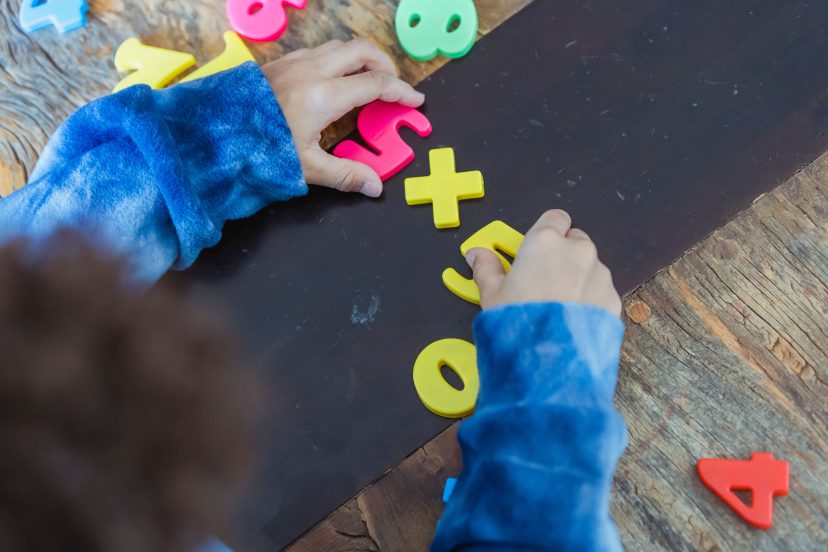
Consider the difference between “What is 4 + 5?” and “Find three different pairs of numbers that total 9.” Both involve addition, but the second invites comparison and experimentation.
Strong puzzles allow more than one approach, provide enough information to make progress, and finish with an answer that can be checked.
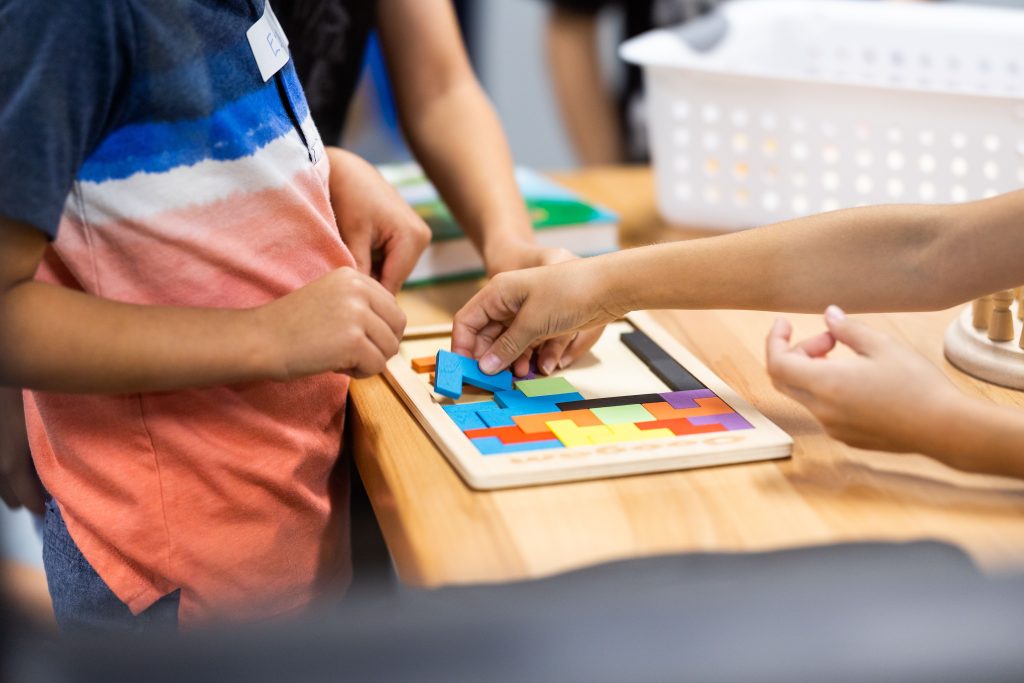
Choosing Puzzles by Age and Skill Level
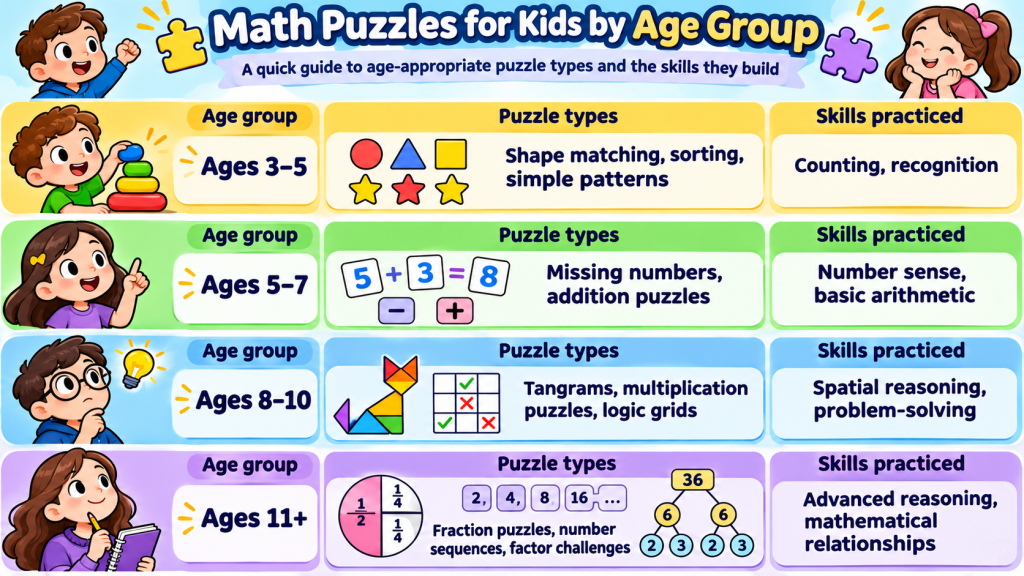
Start with what the child can already do, not just their birthday. Children of the same age may have very different experiences with counting, reading, and mental arithmetic.
| Approximate stage | Useful puzzle styles |
| Preschool | Sorting, matching, simple shape patterns |
| Ages 5–7 | Counting clues, number bonds, basic addition |
| Ages 8–10 | Multiplication patterns, tangrams, beginner logic |
| Ages 11+ | Fractions, factors, multi-step reasoning |
These are flexible starting points, not strict ability limits. If the arithmetic is easy, introduce an extra constraint rather than simply larger numbers.
Counting and Number-Sense Puzzles for Beginners
Let beginners move objects as they think. Put eight buttons or large counters on a table and ask, “Can you make two groups with the same number?” Then ask for two unequal groups.
Try a mystery-number challenge: “I’m greater than 3, smaller than 7, and even. What am I?” The answer is 4 or 6, so add “I’m greater than 5” to make 6 the only answer.
That extra clue teaches an important lesson: a good solution must satisfy every condition.
Addition and Subtraction Puzzles With Missing Numbers
Write 6 + □ = 11 and invite the child to solve it with counters, a number line, or subtraction.
Next, draw three boxes and ask children to place 2, 4, and 6 so that the first two numbers add up to the third. One solution is 2 + 4 = 6.
For a tougher version, provide cards numbered 2, 5, and 7 with a target of 10. Can children use every number exactly once? One solution is 7 + 5 − 2 = 10.
Pattern and Sequence Challenges That Encourage Predictions
Write 3, 6, 9, 12, ? Ask what changes each time. Adding 3 gives 15, but the useful part is explaining the rule rather than announcing the answer.
Arrange one square, two squares, three squares, and ask what the next group should look like.
For older children, try 2, 4, 8, 16, ?, where each number doubles. Challenge them to invent a sequence and provide enough clues for someone else to identify its rule. Some short sequences permit several rules, so discuss alternatives fairly.
Logic Puzzles That Teach Children to Use Clues
Begin with three children—Ana, Ben, and Cal—and three snack choices: apple, banana, and pear. Each child chooses a different snack.
Give these clues: Ana did not choose apple or pear. Ben did not choose pear. Which snack belongs to each child? Ana has banana, Ben has apple, and Cal has pear.
Encourage children to cross out impossible choices before guessing. This method turns a confusing problem into a series of smaller decisions. Older learners can add categories or clues about order.
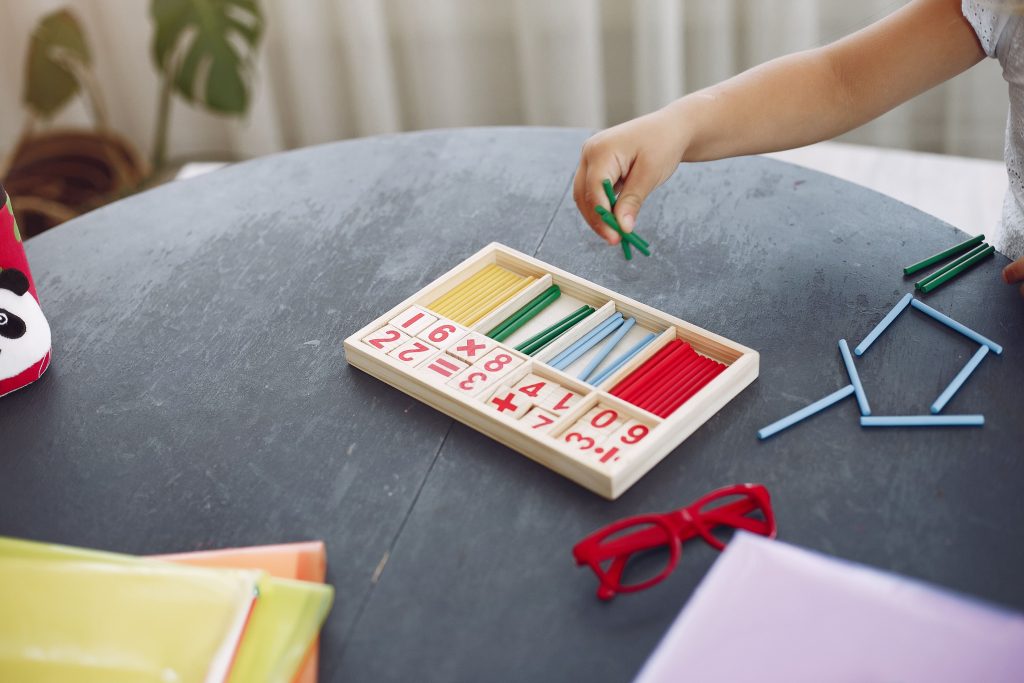
Shape and Tangram Puzzles for Spatial Thinking
Shape puzzles ask children to rotate, flip, combine, and compare pieces. Cut a paper square diagonally to make two triangles. Can they put the triangles back into a square? Can they make a larger triangle instead?
A tangram set adds more pieces and possible outlines. Start with designs that show the boundaries of every piece, then progress to silhouettes with only an outer edge.
Ask children to describe a turn or flip before they move a piece.
Multiplication, Division, and Factor Brain Teasers
Ask: “I have 24 tiles. What different rectangles can I build using all of them?” Possible dimensions include 1 by 24, 2 by 12, 3 by 8, and 4 by 6.
Turn it into a deduction puzzle: “My rectangle has 24 tiles and more than three rows, but fewer than eight. How many rows could it have?” If rows must divide 24 evenly, the answer is 4 or 6.
Ask them to explain why five equal rows won’t work.
Fractions and Measurement Puzzles Using Everyday Objects
Fold two identical paper strips into halves and quarters. Challenge children to cover exactly half of one strip using pieces from the other. Two quarters make one half, provided the original strips are equal lengths.
Try this measurement mystery: “Which three objects on this desk have a combined length closest to 30 centimeters?” Have children estimate first, then measure and add.
Specify whether objects may overlap and how you’ll measure curved items. Children begin to see that measurement involves decisions and evidence, not just reading a number.
How to Make DIY Math Puzzles at Home
Start with a familiar mathematical idea and add one interesting restriction. For example, give a child the numbers 1 through 5 and ask them to arrange three cards that total 9. Let them find several solutions.
Create number mazes on paper grids. Write down the rules and test each challenge yourself before offering it.
For more projects that combine numbers with hands-on investigation, explore these math STEM projects that develop logical thinking. They provide a useful next step when a child wants to build or measure something instead of solving on paper.
Helping Kids Solve Puzzles Without Giving the Answer
Offer a hint that opens a path rather than removing the challenge. “Which clue can you use first?” is more useful than pointing at the correct number.
If a child gets stuck, reduce the problem: use fewer pieces, represent the numbers with counters, or solve a similar easier example together. Then return to the original puzzle.
Praise checking possibilities or spotting a mistake. Avoid turning every activity into a timed contest. A clock can add unnecessary pressure.
What Research Reveals About Mathematical Puzzle Skills
Spatial activities have a measurable connection to mathematics, although that doesn’t mean every puzzle produces the same benefit. In a 2017 classroom intervention study, researchers taught spatial visualization, mental rotation, and orientation to sixth graders over ten weeks. The intervention group improved on spatial and mathematics measures compared with students receiving standard instruction. This supports using spatial tasks deliberately, not treating them as magic shortcuts.
Feelings about math matter too. A 2024 study of 221 first- through fourth-graders found that children performed less accurately when an unfamiliar task was framed as testing “math” ability than when it received neutral framing. The effect was stronger among children reporting more math anxiety or lower math self-concept.
Together, these findings suggest a practical approach: teach strategies explicitly, invite exploration, and keep puzzle sessions low-pressure. They don’t establish that casual puzzle play alone raises grades.
Five Recommended Math Puzzles for Kids and Families
Ready-made games are useful when you want reusable challenges without preparing a new activity each time. These five cover different skills and ages; none should replace direct instruction when a concept is genuinely unfamiliar.
hand2mind MathLink Cubes Numberblocks 1–10 Activity Set
Best for: Preschoolers exploring quantities and number relationships.
Children build Numberblocks characters using interlocking cubes, then work through reusable activity cards. The physical pieces make counting and part-whole relationships visible, which helps before written equations feel comfortable. This is primarily a hands-on learning set rather than a competitive puzzle game, and its many components require organized storage and age-appropriate supervision.
Learning Resources Sum Swamp Addition & Subtraction Game
Best for: Early elementary family practice with addition and subtraction.
Players roll number and operation dice, solve the resulting equation, and move along a swamp-themed board. The rules create repeated opportunities to work with basic arithmetic without needing separate worksheets. It supports two to four players, but children who haven’t learned the operations yet will need guidance rather than being expected to play independently.
ThinkFun Math Dice Jr.
Best for: Short number-combination challenges with a partner.
A twelve-sided die sets the target while five regular scoring dice supply numbers children can add or subtract to reach it. Different combinations invite flexible thinking rather than one memorized method. The compact format is convenient, although children who are still counting every total may prefer untimed, cooperative play first.
Educational Insights Kanoodle Jr.
Best for: Portable, independent shape and logic puzzles.
Six chunky pieces fit into a compact case that doubles as the board. The challenge booklet contains 60 puzzles involving color matching, paths, and walls, giving younger children different ways to practice positioning shapes. It is designed for ages four to seven, but it develops spatial reasoning rather than calculation or multiplication fluency.
Math for Love Prime Climb
Best for: Older children exploring factors and arithmetic strategy.
This colorful board game uses dice, pawns, and arithmetic moves to explore number relationships, including multiplication and division. Its standard rules suit children around age ten and older, with guided or simplified options for younger players. Beginners unfamiliar with multiplication may find the full game demanding.
Frequently Asked Questions About Math Puzzles for Kids
At what age can children start math puzzles?
Children can begin with simple sorting, matching, and shape challenges during the preschool years. Formal written arithmetic isn’t necessary. Follow age guidance and supervise small pieces. A puzzle should require thought but still offer a realistic chance of success.
Are math puzzles better than worksheets?
Neither is universally better. Puzzles are useful for exploring strategies, patterns, and number relationships, while well-designed practice exercises can help children become more fluent with procedures. Use both for different purposes: puzzles to explore ideas and practice to build fluency.
How long should a math puzzle session last?
There is no ideal duration for every child. Try five to ten minutes for a first session and adjust according to interest and difficulty. Longer challenges work when children remain engaged and have opportunities to pause or return later.
Can math puzzles help children who dislike math?
They may make mathematical thinking feel more approachable, especially when puzzles match a child’s interests and avoid public comparison. Don’t promise that games will erase math anxiety or solve persistent learning difficulties. Let children choose from a few manageable challenges, acknowledge their strategies, and provide targeted teaching when a missing skill blocks progress.
Do kids need special math puzzle toys?
No. Paper, pencils, dice, blocks, and safe household objects are enough for excellent number and shape challenges. Commercial games add ready-made rules, graded puzzles, and reusable materials, but they aren’t essential. Before buying, decide which specific skill the child wants to practice and whether a homemade version already meets that need.
Conclusion: Make Math Puzzles Part of Everyday Learning
The most useful math puzzles for kids are neither random brain teasers nor disguised pages of drills. They give children a clear problem, enough clues to begin, and room to try different strategies. Start with counting or missing-number challenges, then introduce spatial puzzles, factors, and multi-step logic as their skills grow.
If you want ready-made options, Sum Swamp supports shared arithmetic practice, while Kanoodle Jr. offers portable shape challenges. Prime Climb fits older learners who enjoy strategy and number relationships. None is necessary for a successful puzzle session, though.
Pick one puzzle that matches a child’s current skills, let them explain their thinking, and adjust the next challenge based on what they actually found difficult.