Kids Science Experiments at Home: A Practical Guide for Curious Families
We may earn a commission for purchases made using our links. Please see our disclosure to learn more.
A child does not need a laboratory coat or a room full of equipment to think like a scientist. A clear cup, paper towel, a few coins, or a patch of sunlight can start a useful investigation. Still, many parents hesitate because they expect complicated instructions, expensive kits, or a kitchen covered in foam.
This guide makes kids science experiments at home easier to plan. You will learn how to choose age-appropriate activities, supervise them safely, turn demonstrations into real investigations, and select tools that match your child’s interests. The goal is not a perfect result. It is a child who asks better questions, notices details, and feels confident trying again.
Why Kids Science Experiments at Home Matter
Hands-on science makes invisible ideas easier to see. Instead of only hearing that air takes up space, a child can trap air inside an upside-down cup. Rather than memorizing that plants need light, they can compare seedlings grown in different places.
The best kids science experiments at home also create conversation. Predictions, surprises, and failed attempts invite children to explain what changed and why. That discussion turns a five-minute activity into meaningful learning.
Start With Safety, Not Spectacle
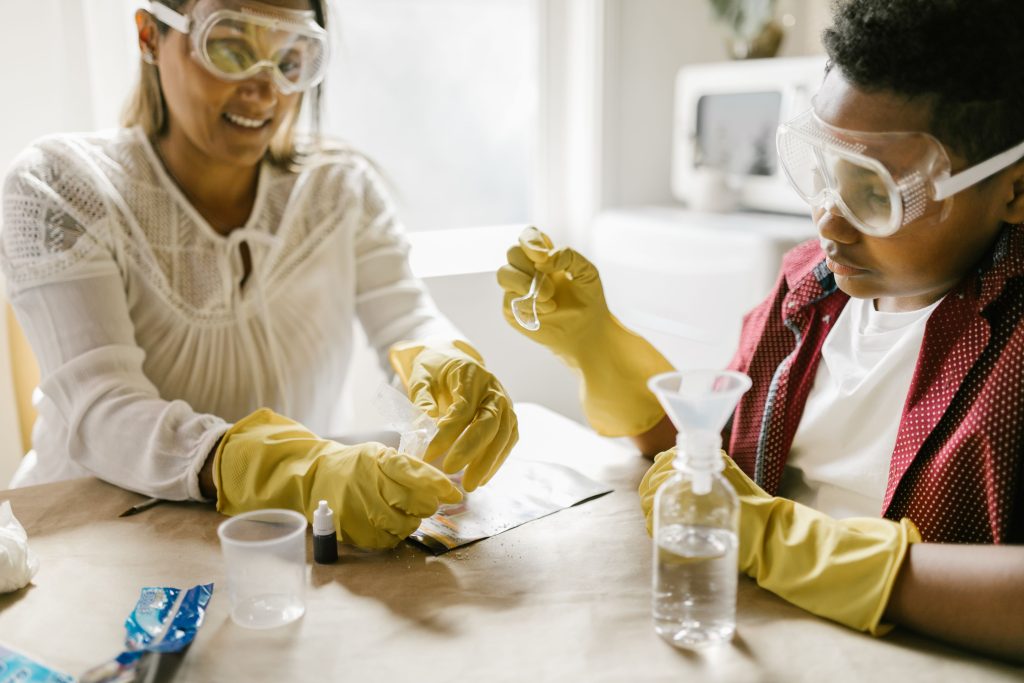
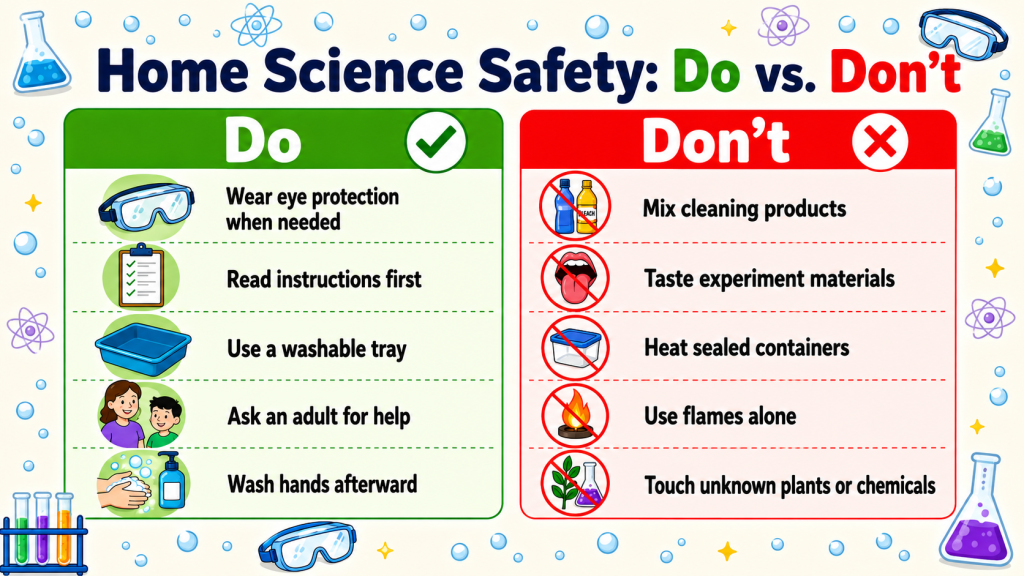
Choose activities that fit the child’s age, reading ability, and impulse control. An adult should handle sharp tools, hot water, flames, strong magnets, batteries, and irritating substances. Never mix household cleaners, taste experiment materials, or heat a sealed container.
The American Chemical Society’s science safety tips recommend reading directions first, tying back hair, using specified protective equipment, keeping food away, washing hands, and cleaning the work area.
Build a Simple Home Science Station
Kids science experiments at home need no permanent laboratory. A washable tray can contain spills and move from the kitchen table to the patio. Stock it with clear cups, measuring spoons, droppers, craft sticks, a ruler, tape, paper towels, and a notebook.
Keep these items separate from cooking utensils after they touch nonfood materials. Set out only what the activity needs. Less clutter makes directions easier to follow and cleanup far less daunting.
Match Experiments to Age and Attention Span
Preschoolers usually learn best through short activities involving pouring, sorting, color, texture, sinking, and floating. Children ages six to eight can predict, count results, and draw observations. Older elementary learners can measure precisely, repeat trials, and change one variable at a time.
Age labels are not guaranties; they are just starting points. Consider small-part responsibility, patience, and the ability to follow steps. For a hesitant learner, begin with a ten-minute activity that creates a visible result.
Use the Scientific Method Without Making It Feel Like Homework
Keep the process conversational: ask a question, predict, test, observe, and discuss. Then ask what your child would change next time. One sentence or a quick drawing is often enough for younger learners.
When your child is ready for a fair test, these scientific method experiments for kids show how to form a hypothesis and compare results. Change only one factor, such as ramp height, while keeping the others consistent.
Easy Chemistry Experiments With Household Materials
Chemistry activities show how materials interact. Compare how quickly sugar dissolves in warm and cool water, watch color travel through paper towels, or combine baking soda and vinegar in an open container. Oil-and-water mixtures also prompt useful questions about density and mixing.
For stronger kids science experiments at home, measure ingredients, predict the outcome, and repeat with one change. Supervise closely and ask what evidence shows that something changed.
Physics Activities Using Motion, Air, and Water
Kids science experiments at home can explore physics with ramps, toy cars, paper airplanes, foil boats, or balloons. Children can compare ramp heights, test airplane designs, or add pennies to foil boats until they sink.
Mark a starting line, use the same measuring method, and run several trials. Children quickly see that one surprising result may be an exception rather than a dependable pattern.
Biology and Nature Experiments for Everyday Learning
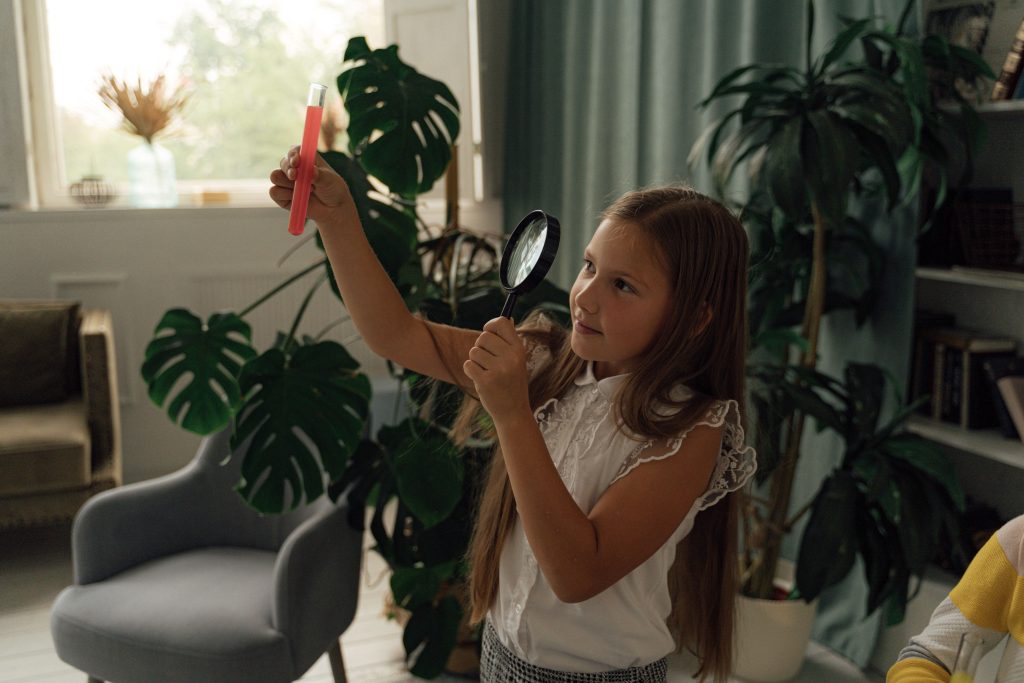
Germinate seeds in clear bags, compare leaves by shape, observe cut flowers moving colored water, or record insects visiting a safe outdoor area. A magnifying glass reveals leaf veins, soil particles, feathers, and fibers.
Longer kids science experiments at home teach patience. Photograph a seedling daily or measure it at the same time. Handle living things gently, wash hands after touching soil, and leave unfamiliar plants, insects, and fungi alone.
Engineering Challenges That Encourage Persistence
Engineering asks children to design within limits. Build the tallest paper tower, an index-card bridge, a cardboard-tube marble run, or a container that protects a toy during a short drop. Give a clear goal and limited materials, then let the child choose the design.
When something collapses, ask which part bent, slipped, or carried too much weight. The weak point becomes useful evidence for the next version.
How to Guide Without Taking Over
Adults often see the solution before children do. Instead of correcting immediately, ask, “What do you notice?”, “What stayed the same?”, or “How could we test that?” These prompts support thinking without supplying the answer.
Step in for safety, serious frustration, or inaccessible tasks. Otherwise, let children pour, measure, record, and rebuild. A crooked project assembled by its young designer can teach more than a polished model built mainly by an adult.
Research-Backed Benefits of Hands-On Science
The 2022 National Academies report on science and engineering in preschool through elementary grades found that young children can meaningfully investigate, use data, construct explanations, and design solutions. It also reported that elementary classes averaged roughly 20 minutes of science per day, only a few days each week, based on a 2018 national survey.
The National Association for the Education of Young Children links active inquiry with vocabulary, problem-solving, communication, and reflection. The National Science Teaching Association likewise supports regular hands-on investigations connected to real situations.
However, evidence does not show that one kit automatically improves grades. The value of kids science experiments at home depends on age fit, repetition, thoughtful questions, and adult support.
Recommended Products for Kids Science Experiments at Home
A useful product should remove practical barriers without doing all the thinking for the child. These six options cover preschool tools, chemistry, electronics, microscopy, and broad experiment variety.
Learning Resources Primary Science Lab Activity Set
Best for: Preschoolers and first-time experimenters
This 22-piece set includes child-sized tools such as a beaker, funnel, eyedropper, tweezers, goggles, test tubes, and ten activity cards. It gives younger children a manageable way to practice pouring and observing. Most activities still require household materials, and an adult should guide setup and cleanup.
Thames & Kosmos Kids First Science Laboratory
Best for: Families wanting structured preschool activities
Designed for ages three and up, this set combines durable laboratory-style tools with ten guided experiments. The illustrated activities help adults introduce early measuring, mixing, and observation without planning everything from scratch. Its scope is intentionally simple, so curious older children may outgrow the included investigations quickly.
4M Kitchen Science Kit
Best for: Small spaces and budget-conscious chemistry beginners
This compact kit guides children through six activities, including lemon-powered electricity, secret writing, and a vinegar rocket. It suits families who want recognizable household science without storing a large box. Several ingredients must be supplied separately, and the recommended age of eight and up makes it unsuitable for unsupervised younger siblings.
Elenco Snap Circuits Jr. SC-100 Electronics Exploration Kit
Best for: Kids who enjoy reusable electronics projects
More than 30 snap-together components support over 100 projects, including alarms, lights, and sound circuits. Because the pieces connect without soldering, children can rebuild repeatedly and see how circuit changes affect the result. It requires two AA batteries and focuses on electronics rather than chemistry, biology, or outdoor investigation.
NATIONAL GEOGRAPHIC Mega Science Lab
Best for: Older children who want broad experiment variety
This multi-topic kit includes 45 hands-on activities involving earth science, chemistry, and science demonstrations, plus 30 bonus activities using common household materials. The range helps children sample several interests before choosing a specialty. However, breadth replaces depth, and families must provide supplies for many bonus projects.
How to Choose the Right Science Kit or Tool
Start with the child, not the biggest box. Check age guidance, small-part risks, required supervision, consumables, storage needs, and whether the instructions explain the science instead of merely revealing a result.
For kids science experiments at home, favor reusable tools. Choose a short guided kit for a hesitant beginner. Above all, match the subject to existing curiosity. A child fascinated by bugs may use a microscope far more than a chemistry set with twice as many activities.
Kids Science Experiments at Home FAQs
What Are the Easiest Kids Science Experiments at Home?
Try sink-or-float testing, color walking through paper towels, melting ice under different conditions, seed germination, or a paper-airplane distance test. Each uses familiar supplies and produces an observable result. Choose one question, keep the setup small, and discuss what happened instead of rushing through several demonstrations.
What Age Can Children Begin Doing Science Experiments?
Children can begin supervised observation and cause-and-effect play during the preschool years. Suitable activities include sorting natural objects, mixing colors, pouring water, and predicting which items float. Adults should control hazards and simplify directions. More independent measuring, recording, and variable testing usually becomes practical during the elementary years.
Do I Need a Science Kit?
No. Many worthwhile kids science experiments at home use cups, water, paper, tape, coins, kitchen ingredients, and outdoor observations. A kit helps when it supplies specialized tools, clear sequencing, or reusable components that are inconvenient to gather separately. Buy one when it supports a genuine interest, not because the box advertises a large activity count.
How Can I Reduce Mess in Experiments?
Use a washable tray, measure ingredients beforehand, and keep towels and a waste bowl nearby. Smaller quantities usually demonstrate the same idea with less cleanup. Move foamy, watery, or soil-based work outdoors when possible. Finish by sorting reusable tools, discarding materials correctly, wiping the surface, and washing hands.
What Should I Do When an Experiment Does Not Work?
Do not quietly fix it. Check the directions, measurements, material freshness, and variables. Record what happened, adjust one factor, and repeat the test. An unexpected result can teach observation, troubleshooting, and fair testing more effectively than a demonstration that works perfectly on the first attempt.
Final Recommendation for Kids Science Experiments at Home
The best kids science experiments at home fit the child’s age, interests, attention span, and available supervision. Start with a low-mess activity and a clear question, then encourage predicting, measuring, observing, and trying again. A preschooler may benefit from the Learning Resources set, while an older builder may stay engaged with Snap Circuits. Children drawn to living things may prefer the AmScope microscope.
Do not judge a resource by the experiment count on its box. Begin with materials you already own, notice which questions keep returning, and choose a reusable tool that helps your child explore those questions more deeply.