Top 10 Hydraulic Robot Arms
We may earn a commission for purchases made using our links. Please see our disclosure to learn more.
Hydraulic Robot Arms turn fluid pressure into visible movement, making them useful STEM kits for curious learners. These builds show how syringes, tubing, levers, joints, and grippers work together. I compared Amazon US availability, hydraulic design, build difficulty, movement, attachments, materials, age guidance, and value. Your best choice depends on build difficulty, movement, materials, and theme.
Quick Comparison
| Product | Best for | Key feature | Main limitation | Price category | Overall recommendation |
| Teach Tech Hydrobot | Overall | Six-axis water hydraulics | Longer assembly | Mid-range | Strong all-rounder |
| Pathfinders Arm | Beginners | Wooden construction | Simpler movement | Mid-range | Friendly first build |
| 4M 4106 | Budget | Compact hydraulic gripper | Basic controls | Budget | Low-cost introduction |
| SMILESSKIDDO 3-in-1 | Attachments | Three end tools | Lengthy build | Mid-range | Versatile project |
| 4M Mega Hydraulic Arm | Large model | 18-inch build | Needs setup supplies | Mid-range | Great display project |
| MUKIKIM NASA Canadarm | Space fans | Four-axis NASA theme | Specialized theme | Premium | Strong themed choice |
| PATHFINDERS Hydraulics 4-in-1 | Multi-project learning | Four water-powered builds | Not arm-only | Mid-range | Great for broader hydraulics |
| Walfront Wooden Arm | Makers | Beech-wood structure | Manual fitting | Budget | Good craft crossover |
| Thames & Kosmos Mega Cyborg Hand | Wearable hydraulics | Hydraulic fingers | Not tabletop arm | Mid-range | Specialized pick |
| FoxiSteam Wooden Arm | Compact build | Three lever controls | Smaller design | Budget | Neat desk project |
1. TEACH TECH Hydrobot Arm Kit — Best for Overall STEM Learning
Overview: This water-powered arm is a complete traditional robotics build for older kids and teens who want mechanics rather than coding.
Key Features: Six axes; 270-degree base rotation; lever controls; removable gripper; suction attachment; no batteries.
Pros: Broad movement, clear hydraulic principles, two pickup options.
Cons: More involved assembly than beginner kits.
Best For: Families, STEM clubs, and learners around age 12+.
Verdict: Its reach, articulation, and visible hydraulic control make it the most balanced choice for serious hands-on learning.

2. PATHFINDERS Hydraulic Robotic Arm — Best for Beginners
Overview: PATHFINDERS uses an unfinished wooden structure and straightforward hydraulic controls, making the mechanics easy to inspect.
Key Features: Wooden construction; water-powered motion; gripper; rotating base; assembly-focused design.
Pros: Approachable build, tactile materials, visible mechanisms.
Cons: Movement is less elaborate than six-axis plastic kits.
Best For: First-time builders, families, and classroom projects for roughly ages 8–14.
Verdict: Choose it when learning the mechanism matters more than maximizing movement. The wood format adds maker appeal.

3. 4M Hydraulic Robot Arm Model 4106 — Best Budget Option
Overview: This compact 4M kit keeps things simple: assemble a working arm, add water, and operate a mechanical gripper.
Key Features: Hydraulic power; no electricity; working gripper; assembly parts; illustrated instructions.
Pros: Simple concept, lower-cost entry, manageable footprint.
Cons: Fewer advanced controls than larger kits.
Best For: Younger beginners and gift buyers wanting a simple hydraulics introduction.
Verdict: It keeps the core lesson clear and accessible without adding electronics or an oversized parts count.

4. SMILESSKIDDO 3-in-1 Hydraulic Robot Arm — Best for Attachment Variety
Overview: This 220-piece kit stands out because one hydraulic arm can use different tools for different grabbing tasks.
Key Features: Four-jaw grab, suction cup, tongs, water-powered operation, no motors or batteries.
Pros: Multiple end effectors, good replay value, substantial assembly challenge.
Cons: The multi-hour build may frustrate impatient beginners.
Best For: Kids 8+ who enjoy longer construction projects and experimenting after assembly.
Verdict: Interchangeable tools make it more flexible than single-gripper kits and encourage comparisons between gripping methods.
5. 4M KidzLabs Mega Hydraulic Arm — Best for a Larger Build
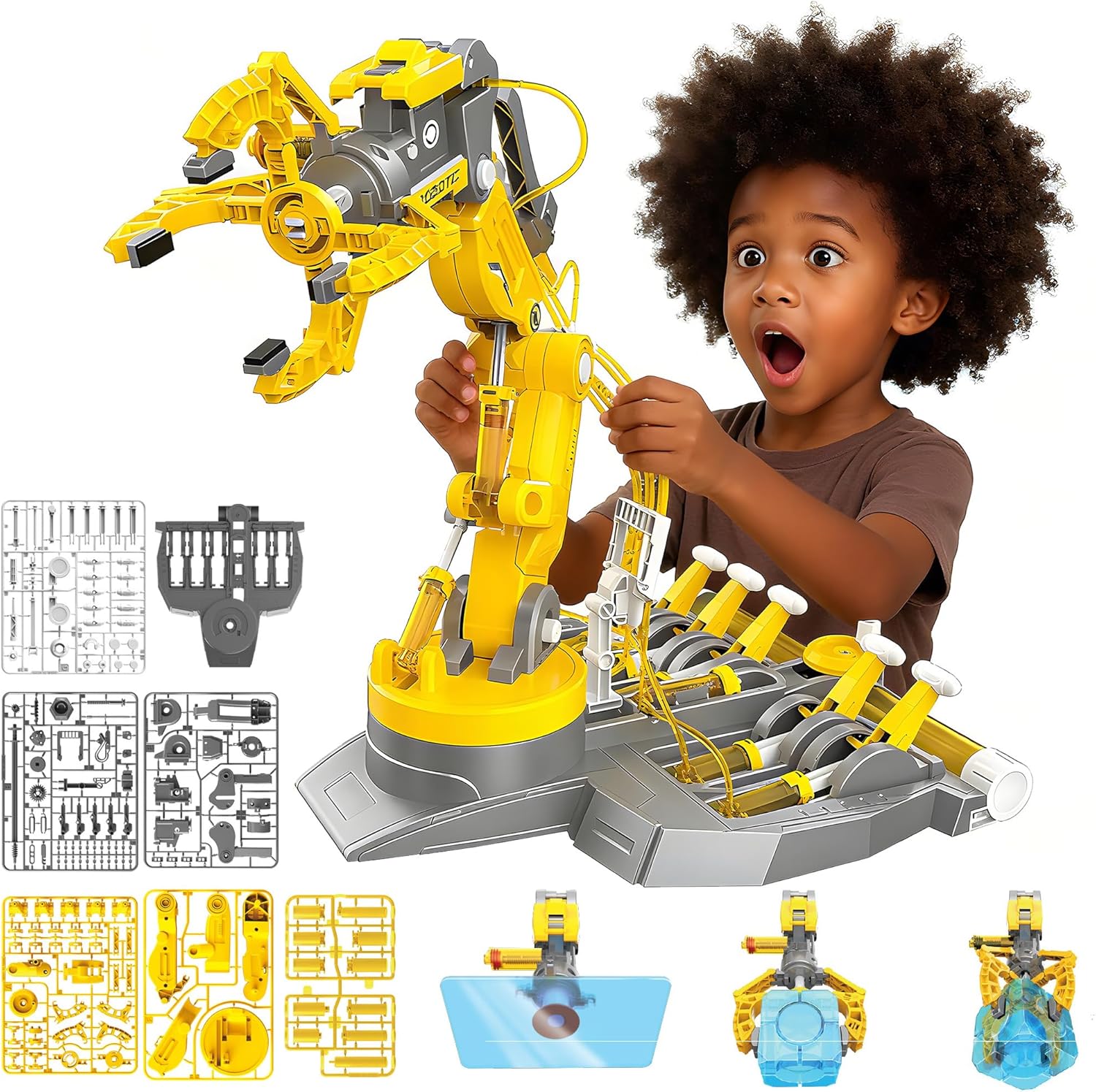
Overview: The newer KidzLabs Mega creates an approximately 18-inch water-powered arm with four controls and a functional gripper.
Key Features: Multi-axis movement; four controls; eight syringe assemblies; power gripper; battery-free operation.
Pros: Large finished model, visible tubing, strong science-project appeal.
Cons: Requires a screwdriver and setup items not supplied.
Best For: Science fairs, home demonstrations, and builders wanting a larger model.
Verdict: Its scale makes hydraulic movement easy to observe, explain, and demonstrate.

6. MUKIKIM NASA Future Explorers Canadarm — Best Premium Themed Kit
Overview: This NASA-themed build connects hydraulic mechanics with robotic arm systems used in space exploration.
Key Features: 108 pieces; four axes; hydraulic controls; astronaut and satellite accessories; 40-page educational booklet.
Pros: Strong theme, guided learning material, useful demonstration accessories.
Cons: Costs more than simpler hydraulic kits.
Best For: Space enthusiasts, homeschool lessons, and children age 8+ who enjoy themed projects.
Verdict: The Canadarm context turns the mechanism into a broader engineering lesson instead of a stand-alone construction toy.

7. PATHFINDERS STEM Kit – Hydraulics 4-in-1 — Best for Multi-Project Hydraulic Learning
Overview: This wooden set expands beyond one arm, letting builders create four water-powered machines, including an excavator arm.
Key Features: Four build options; excavator arm; crane; scissor lift; platform lifter; battery-free hydraulics.
Pros: More project variety, learning value, visible hydraulic mechanics.
Cons: It is not a dedicated robotic-arm-only kit.
Best For: Kids age 8+ who want to compare several hydraulic mechanisms.
Verdict: Its broader project range makes it useful for understanding how hydraulic principles directly apply across different lifting and arm mechanisms.
8. Walfront Hydraulic Wooden Robotic Arm Kit — Best for Wooden-Model Makers
Overview: Walfront combines a natural wood frame with syringe-driven hydraulics, bridging model making and basic robotics.
Key Features: Beech-wood parts; eight syringes; hoses; battery-free movement; DIY assembly components.
Pros: Distinct wooden construction, visible mechanism, maker appeal.
Cons: Wooden parts can require careful alignment.
Best For: Teens, adults, and patient young makers who enjoy mechanical models.
Verdict: It teaches hydraulics without a conventional plastic science-kit feel.

9. Thames & Kosmos Mega Cyborg Hand — Best Specialized Hydraulic Build
Overview: This wearable hydraulic hand is not a tabletop arm, but it teaches closely related fluid-power, joint, and gripping principles.
Key Features: 203-piece build; hydraulic pistons; adjustable fit; left- or right-hand configuration; no motors or batteries.
Pros: Highly interactive, wearable, direct mechanical feedback.
Cons: It lacks a rotating arm base.
Best For: Learners interested in biomechanics, prosthetics, or wearable mechanisms.
Verdict: Your fingers directly control the mechanical hand, making hydraulic motion immediate.

10. FoxiSteam 3D Wooden Hydraulic Robotic Arm — Best Compact Wooden Project
Overview: FoxiSteam is a wooden puzzle-style arm built around direct lever control and simple hydraulic movement.
Key Features: Three control levers; laser-cut wooden pieces; hydraulic grabbing and rotation; hand-powered operation; no batteries.
Pros: Compact format, decorative finish, accessible controls.
Cons: Less articulation than large six-axis systems.
Best For: Desk projects, casual makers, and buyers preferring wood over molded plastic.
Verdict: It blends puzzle building and functional hydraulics without needing much space.

How to Choose the Best Hydraulic Robot Arms
Start with build difficulty and age fit. Younger beginners may prefer PATHFINDERS or 4M 4106, while Teach Tech and larger kits suit patient builders who can follow longer sequences. Age labels matter because small parts and tool use may require supervision.
Compare movement and controls. More axes mean more ways to rotate, raise, extend, and position the gripper, but they also increase assembly complexity. If the goal is understanding fluid pressure, a simpler arm can be enough.
Consider end effectors. A standard claw handles lightweight objects, suction cups suit smooth surfaces, and kits such as SMILESSKIDDO let you compare several gripping approaches.
Materials and workspace matter too. Plastic kits commonly use fitted components, while wooden arms add model-making and may require careful alignment. Larger arms need more storage and operating room.
Finally, check power and included parts. Most arms here move with water and need no motor, although specialized products may use batteries for unrelated extras. Confirm current age guidance, tools, dimensions, support, and seller information before ordering.
If you want a simpler way to explore joints and gripping before tackling a hydraulic build, StemSparkLab’s DIY robot hand activity is a useful companion project.
Frequently Asked Questions About Hydraulic Robot Arms
1. Do hydraulic robot arm kits need batteries?
Usually not for arm movement. Most educational kits use water-filled syringes and tubing to transmit force. An optional light or accessory may still need batteries.
2. Are Hydraulic Robot Arms good for beginners?
Yes, when the kit matches the builder’s age and patience. Beginners often do better with fewer parts before moving to multi-axis designs.
3. What can these kits lift?
They are learning models, not load-bearing machines. Capacity varies, so follow the manufacturer’s limit and use lightweight test objects.
4. Are wooden or plastic hydraulic arms better?
Neither is automatically better. Wood emphasizes model making and visible structure; plastic often supports more molded joints or attachments.
5. How do you maintain a hydraulic STEM arm?
Keep tubing seated, wipe up water, avoid forcing joints, and store the model where levers and hoses will not be crushed. Follow instructions for air bubbles or refilling.
Final Verdict
For most buyers, the TEACH TECH Hydrobot Arm Kit is best overall because its six-axis design offers the richest conventional arm experience. 4M Model 4106 is the best budget option, while the MUKIKIM NASA Canadarm is the best premium choice. PATHFINDERS Hydraulic Robotic Arm is best for beginners, and Thames & Kosmos Mega Cyborg Hand is the specialized pick for wearable hydraulics.
Before ordering, compare specifications, confirm dimensions and age suitability, review current warranty or support details, and check the latest Amazon.com product information and seller availability today.