Top 10 Base-Ten Blocks
We may earn a commission for purchases made using our links. Please see our disclosure to learn more.
Base-Ten Blocks make place value visible by letting children build, trade, group, and compare ones, tens, hundreds, and thousands. They suit elementary students learning number sense, regrouping, and operations. Choosing the right set matters because piece counts, materials, storage, and teaching aids vary considerably. I compared current Amazon.com options by set size, material, age guidance, portability, included learning tools, classroom usefulness, and value, without treating review counts as the deciding factor.
The products below cover personal practice, small groups, full classrooms, quiet spaces, and teacher demonstrations. None was selected simply for popularity; the goal is to match the block format and included materials to the way you actually teach or learn.
That variety matters because a home learner may need only a compact kit, while a teacher managing groups needs enough units and rods to prevent sharing bottlenecks. The right format can make explanations quicker and practice focused.
Quick Comparison of Base-Ten Blocks
| Product | Best for | Key feature | Main limitation | Price category | Overall recommendation |
| Learning Resources Starter | Overall use | 141 pieces, book | Needs storage | Mid-range | Versatile |
| Learning Resources Interlocking | Regrouping | Connecting pieces | Slower sorting | Mid-range | Hands-on |
| Learning Resources Smart Pack | Budget | Compact 121 pieces | One flat | Budget | Practical |
| hand2mind Blue Plastic | Classrooms | Large class kit | Bulky | Premium | Group-ready |
| hand2mind Green Foam | Quiet rooms | Soft foam | Less rigid | Premium | Quiet |
| edxeducation 121-piece | Visual learning | Four colors | Fewer rods | Budget | Clear |
| Simply Magic 131 PCS | Beginners | Complete progression | Non-interlocking | Mid-range | Simple |
| TOMMYHOME Set | Guided practice | Writing mat | Needs workspace | Mid-range | Structured |
| stochastic box Set | Activities | Cards and mat | Extra pieces | Mid-range | Flexible |
| Simply Magic Magnetic | Demonstrations | Magnetic pieces | Specialized | Mid-range | Visible |
1. Learning Resources Base Ten Starter Set — Best for Overall Use
Overview: This plastic starter set serves small groups learning place value and operations, with broader piece quantities than compact packs.
Key Features: 100 units; 30 rods; 10 flats; one thousand cube; 36-activity Base Ten book; designed for ages six and up.
Pros: Washable plastic; generous quantities; useful across several skills.
Cons: Less portable than smaller packs.
Best For: Teachers, homeschoolers, and tutors wanting one versatile set.
Verdict: The balanced contents make this the strongest general-purpose choice.

2. Learning Resources Interlocking Base Ten Starter Set — Best for Regrouping Models
Overview: These connecting blocks let learners build stable number models, making regrouping more physical than with loose pieces.
Key Features: 141 pieces; 100 units; 30 rods; 10 flats; one thousand cube; 96-page activity book.
Pros: Interlocking design; extensive activity book; strong tactile feedback.
Cons: Connecting pieces can slow rapid sorting.
Best For: Learners who enjoy construction-style math practice.
Verdict: It excels when stable models support understanding.

3. Learning Resources Base Ten Blocks Smart Pack — Best for Budget Learning
Overview: This compact set covers essential ones, tens, and hundreds work without classroom-scale quantities, making storage and transport simple.
Key Features: 121 pieces; 100 units; 20 rods; one flat; activity guide; resealable storage bag.
Pros: Compact; easy to organize; affordable category position.
Cons: Only one hundred flat.
Best For: Individual practice, tutoring, and homeschool lessons.
Verdict: It delivers core manipulatives with minimal bulk.

4. hand2mind Blue Plastic Base Ten Blocks Complete Set — Best for Classrooms
Overview: This large plastic collection is designed for group instruction, with enough manipulatives and supporting materials for classroom rotations.
Key Features: 644 blocks; 25 place-value mats; activity resource; storage containers; blue plastic construction.
Pros: Large capacity; durable plastic; organized teaching aids.
Cons: Premium cost; substantial storage footprint.
Best For: Teachers running centers or group lessons.
Verdict: Its scale is the main advantage for shared classrooms.

5. hand2mind Green Foam Base Ten Blocks Complete Set — Best for Quiet Classrooms
Overview: This classroom kit uses soft foam instead of hard plastic, reducing clatter when many students handle pieces together.
Key Features: 644 blocks; 25 place-value mats; activity book; storage containers; soft foam construction.
Pros: Quiet handling; classroom quantity; included organization.
Cons: Foam feels less rigid than plastic.
Best For: Shared rooms where noise control matters.
Verdict: It offers classroom scale with softer, quieter manipulatives.

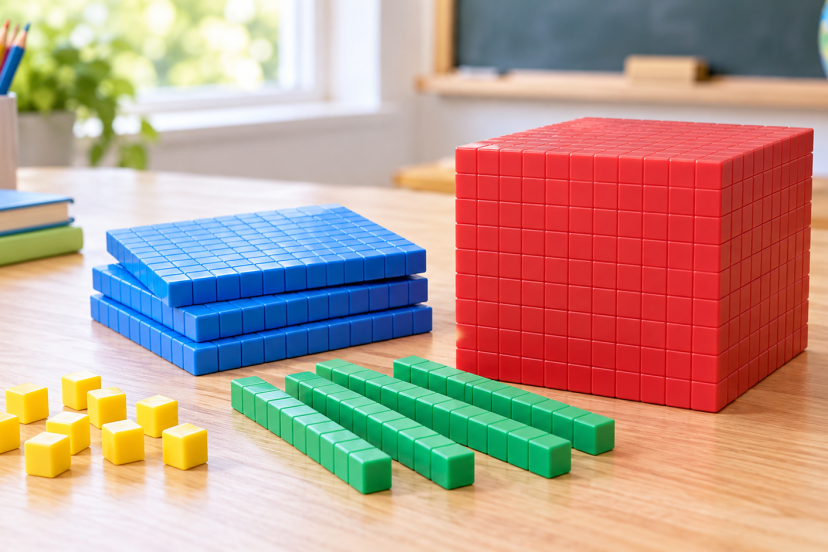
6. edxeducation Base Ten Blocks Set — Best for Color-Coded Place Value
Overview: edxeducation uses a separate color for each place value, giving visual learners an extra cue during guided instruction.
Key Features: 121 pieces; 100 yellow units; 10 green rods; 10 blue flats; one red cube; one-centimeter units.
Pros: Clear color coding; proportional pieces; storage container.
Cons: Fewer rods than some starter sets.
Best For: Visual learners and color-led instruction.
Verdict: Its color system makes value differences especially easy to describe.

7. Simply Magic 131 PCS Base Ten Blocks for Math — Best for Beginners
Overview: This straightforward plastic set introduces the complete progression from ones through thousands without interlocking or magnetic features.
Key Features: 100 units; 20 tens rods; 10 hundred flats; one thousand cube; storage; learning guide.
Pros: Complete progression; useful quantities; simple storage.
Cons: Loose models can shift when bumped.
Best For: Children starting hands-on place-value lessons.
Verdict: The uncomplicated format keeps attention on number relationships.

8. TOMMYHOME Base Ten Blocks with Place Value Chart — Best for Guided Practice
Overview: TOMMYHOME pairs standard blocks with a writable place-value mat, connecting physical models with written number work.
Key Features: 100 units; 20 rods; 10 flats; one cube; erasable place-value mat; storage box.
Pros: Supports concrete-to-written practice; complete progression; storage included.
Cons: The mat needs desk space.
Best For: Homework, tutoring, and guided exercises.
Verdict: The writing mat gives structured practice an extra step.

9. stochastic box Base Ten Blocks Plastic 143 pcs — Best for Activity-Based Practice
Overview: This kit adds practice cards and a write-wipe mat to standard blocks, giving adults prompts for repeat lessons.
Key Features: Units, rods, flats, and thousand cube; write-wipe mat; activity cards; number cards; portable storage.
Pros: Multiple practice formats; reusable materials; portable storage.
Cons: More accessories require organization.
Best For: Families and tutors wanting guided activities.
Verdict: The accessory mix makes repeated practice easier to structure.

10. Simply Magic 131+4 PCS Jumbo Colorful Magnetic Base Ten Blocks — Best for Whiteboard Teaching
Overview: These oversized magnetic blocks make place-value trades visible during board demonstrations, unlike ordinary tabletop-only sets.
Key Features: 100 units; 20 rods; 10 flats; one cube; four magnetic place-value headings; laminated EVA foam.
Pros: Board-ready; visible; color-coded; reusable headings.
Cons: Less suited to individual desk work.
Best For: Whole-class and intervention demonstrations.
Verdict: It is the strongest specialized option for magnetic-board modeling.

How to Choose the Best Base-Ten Blocks
Start with learner count. One child usually needs far fewer pieces than a classroom group. More rods and flats make regrouping, subtraction, and larger-number work easier, while a thousand cube shows the complete relationship from ones through thousands.
Material changes the experience. Plastic is rigid and easy to wipe. Foam is lighter and quieter. Interlocking pieces hold constructions together, while magnetic versions work best on demonstration boards.
Check proportions and included values before accessories. Consistently scaled units, rods, flats, and cubes help children see why ten smaller pieces equal one piece at the next place value. Color coding can provide another useful visual cue.
Then consider teaching aids. Mats organize columns, books provide lesson ideas, cards offer prompts, and storage prevents small units from disappearing. If your child responds well to tactile math, these LEGO math activities provide another hands-on way to reinforce counting, operations, arrays, and fractions.
Storage deserves attention too. Unit cubes are small and easy to lose, so a lidded container or resealable bag is useful between lessons. For classrooms, separate trays can reduce setup time and keep groups supplied. Also check whether replacement pieces are available if classroom use is important.
Finally, follow age guidance and small-parts warnings. Confirm current Amazon details before purchasing because sellers, packaging, included accessories, and availability can change.
Frequently Asked Questions About Base-Ten Blocks
What do Base-Ten Blocks teach?
They make place value visible and can support regrouping, addition, subtraction, multiplication, division, measurement, and later decimal concepts.
How many blocks does one child need?
A set with 100 units plus several rods and flats is a useful starting point. Extra tens and hundreds broaden regrouping practice.
Are foam or plastic blocks better?
Plastic is rigid and traditional; foam is lighter and quieter. Choose according to handling, noise, cleaning, and storage needs.
Are magnetic Base-Ten Blocks worth it?
They are useful for visible board demonstrations. Standard tabletop blocks generally suit individual hands-on practice better.
What age can children start using them?
Several sets here target roughly age six and up. Always follow the specific product’s age guidance and small-parts warning.
Final Verdict
The Learning Resources Base Ten Starter Set is the best overall choice for balanced quantities and guided activities. The Smart Pack is the best budget option. The hand2mind Blue Plastic Complete Set is the best premium classroom choice, while Simply Magic 131 PCS is the easiest beginner option. For specialized teaching, the Simply Magic Magnetic Set stands out for whiteboard demonstrations.
Before buying, compare quantities and learning aids, confirm dimensions and material, review current warranty or support details, and check the latest Amazon.com page for seller, availability, and package information.