Easy Preschool Science Experiments at Home
We may earn a commission for purchases made using our links. Please see our disclosure to learn more.
You do not need a teaching degree or a cabinet full of lab supplies to explore science with a preschooler. A cup of water, a few ice cubes, or a stubborn seed is often plenty.
The most useful preschool science experiments invite children to notice, predict, test, and talk. The result may be a dramatic fizz—or a soggy paper towel that refuses to cooperate. Either way, your child learns that questions can lead somewhere interesting.
This guide shares simple activities, safety tips, research, and tools for playful STEM learning at home.
Why Preschool Science Experiments Matter
Preschoolers already behave like tiny scientists. They drop spoons repeatedly, mix bathwater with everything in reach, and ask “why?” until every adult needs a snack.
Science activities give that curiosity some structure. Children practice observing, comparing results, solving problems, and explaining what happened.
They also learn that a wrong prediction is not a failure. In science, surprises often make the activity more interesting.
Set Up a Simple Science Space at Home
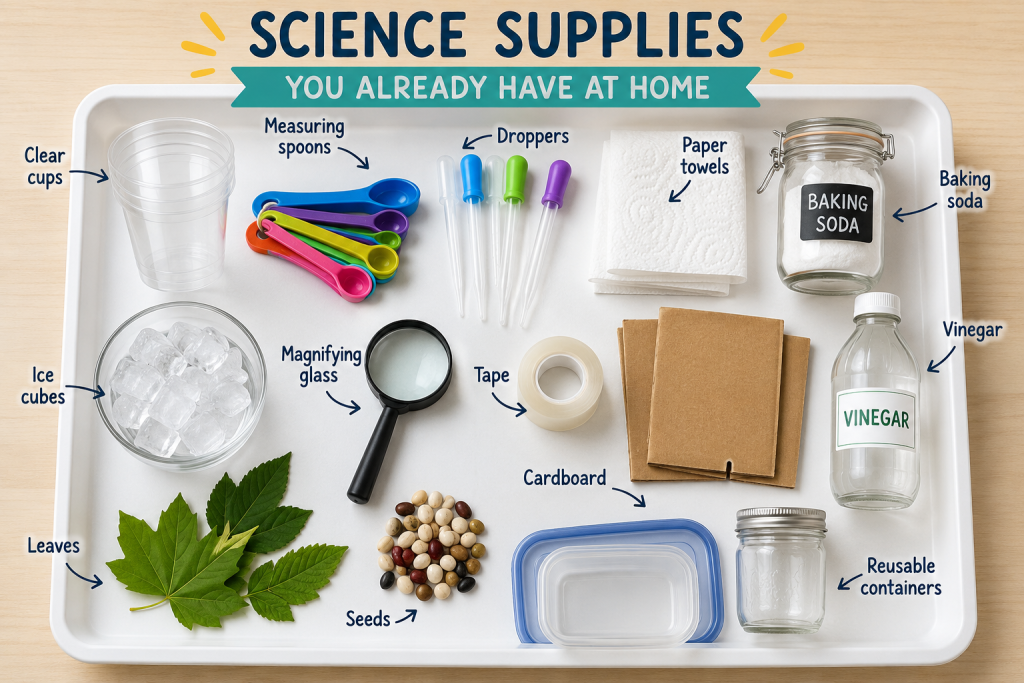
A kitchen table, patio, or washable floor mat works well. Keep a small bin with cups, spoons, droppers, paper towels, child-safe magnifiers, and reusable containers.
Place only the supplies you need within reach. A tray or baking sheet can contain spills and prevent the experiment from becoming an enthusiastic soup made from every object nearby.
Follow Basic Safety Rules
Stay close enough to guide every step, especially when an activity includes small objects, balloons, magnets, glass, hot water, or ingredients that should not be tasted.
Use child-safe materials and follow the age guidance on purchased kits. Wash hands afterward and protect eyes during fizzy reactions.
Children who still mouth objects need larger materials and fewer loose pieces.
Explore Water, Floating, and Sinking
Water experiments offer quick results and require very little preparation. They are especially useful for children who enjoy sensory play.
Make a Sink-or-Float Basket
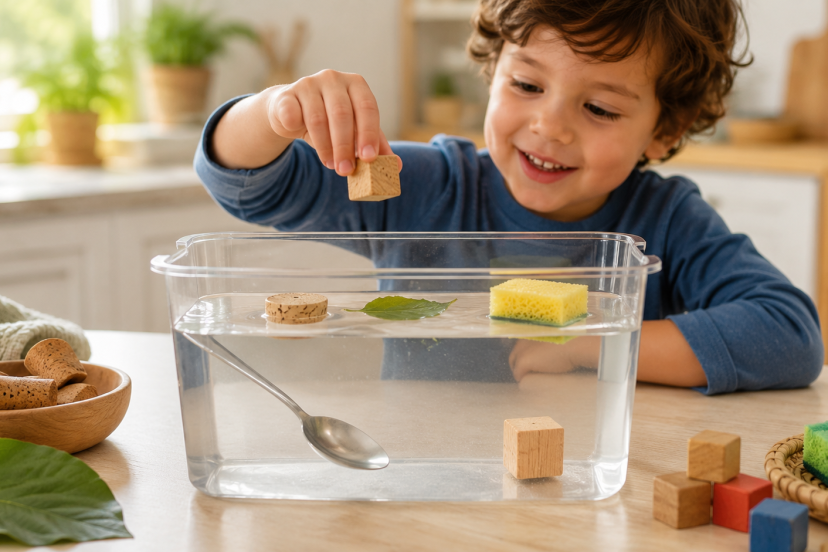
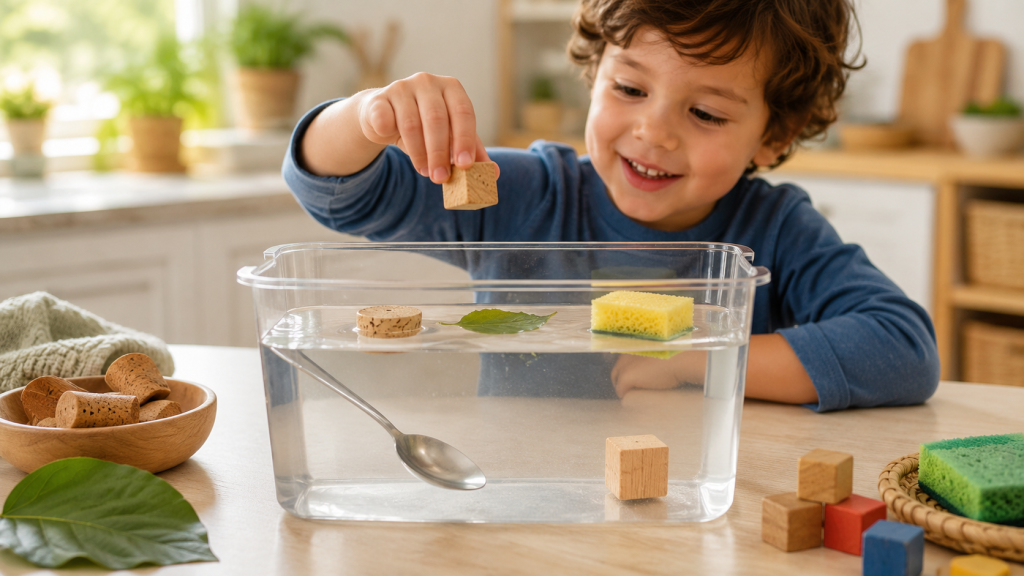
Fill a clear tub halfway with water. Gather a cork, spoon, leaf, block, sponge, and other safe objects.
Ask your child to predict what each item will do before testing it. Then sort the objects into “sank” and “floated” groups.
You might ask, “What do the floating things have in common?” At this age, careful noticing matters more than memorizing a definition of density.
Build a Foil Boat
Shape aluminum foil into a boat. Add coins or counters one at a time until it sinks.
Make another design and test whether it can carry more. Just like that, a basic water activity becomes an early engineering challenge.
Try Colorful Preschool Chemistry
Chemistry may sound far too serious for preschool. However, color mixing and fizzy reactions introduce the idea that combining materials can create a change.
Create Walking Water
Place three clear cups in a row. Add colored water to the first and third cups, leaving the middle cup empty.
Fold two paper towels into strips. Put one end of each strip in a colored cup and the other end in the empty cup.
Water will travel through the paper and meet in the middle. Ask your child which new color might appear, then return later to observe the change.
Make a Gentle Fizzy Reaction
Place a spoonful of baking soda in a shallow cup. Allow your child to add colored vinegar using a dropper.
Try different amounts and compare the fizz. Does more vinegar create a longer reaction? What happens when you use less baking soda?
Keep the cup on a tray unless you enjoy finding purple foam in surprising places.
Investigate Ice and Temperature
Ice gives children something solid that visibly changes. It is a simple way to explore temperature without introducing complicated explanations.
Rescue Toys From Ice
Freeze a few waterproof toys in a container of water. Provide warm water, droppers, spoons, and a little salt.
Let your child test different ways to free the toys. Ask, “Which method seems fastest?” and “Where is the ice changing first?”
This activity builds patience, fine-motor control, and an early understanding of melting.
Hold an Ice-Melting Race
Place equal ice cubes in sunlight, shade, and an indoor spot. Check them every few minutes.
Children can draw the cubes getting smaller instead of measuring them precisely. Afterward, talk about which location caused the fastest change.
Grow Curiosity With Plants and Nature
Outdoor science activities help children understand that science is not limited to bubbling cups. It is happening in gardens, parks, sidewalks, and kitchen windows.
Sprout a Seed in a Clear Bag
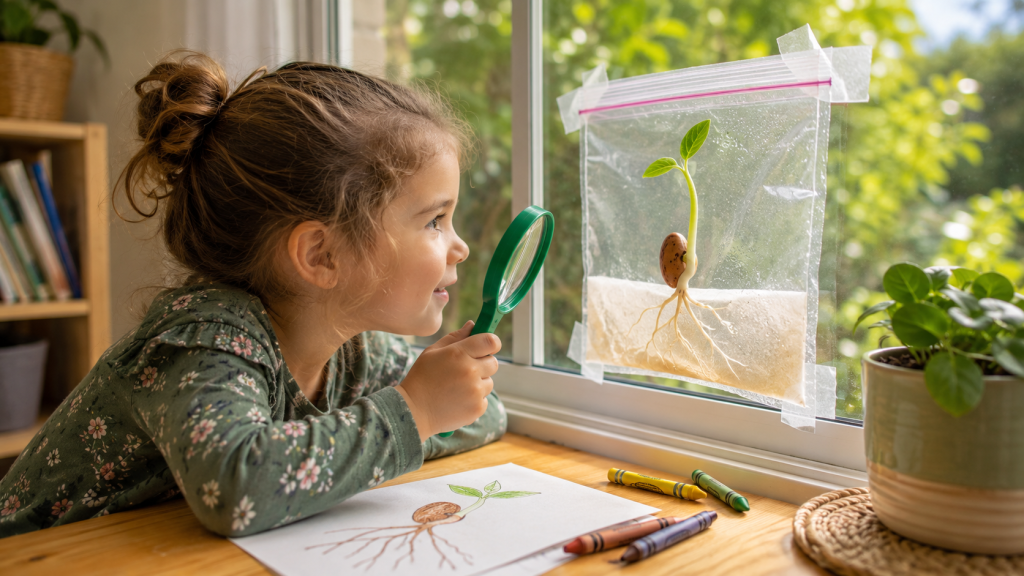
Dampen a paper towel, place it in a resealable bag, and add a bean seed. Tape the bag to a bright window away from harsh, all-day heat.
Observe it daily. Your child can sketch the root and shoot as they appear.
Explain that the seed is taking in water and beginning to grow. Simple explanations are enough. The changing seed will handle most of the storytelling.
Sort Leaves Like a Scientist
Collect fallen leaves, then group them by shape, size, texture, or color.
Let your child invent a sorting rule, even if the categories are “dinosaur-foot leaves” and “everything else.” Classification begins with noticing relationships.
Study Light, Shadows, and Weather
Light and weather experiments encourage children to observe changes that happen over several hours or days.
Track a Shadow
Stand a toy outdoors and trace its shadow with chalk in the morning. Return later and trace it again.
Ask why the shadow moved or changed length. Connect the change to the Sun appearing in a different position in the sky. A full astronomy lecture can wait.
Make a Simple Rain Gauge
Mark measurement lines on a straight-sided plastic container and place it in an open area.
Before it rains, ask your child to predict how high the water might rise. Afterward, compare the actual level with the prediction.
Empty the container once you record the result.
Experiment With Magnets, Motion, and Building
These preschool STEM activities introduce cause and effect while encouraging children to test their own designs.
Go on a Magnet Hunt
Use a large, securely enclosed magnet to test safe objects around the room.
Predict first, then sort the items into magnetic and nonmagnetic groups. Children may discover that “made of metal” does not always mean “sticks to a magnet.”
That unexpected result offers a wonderful reason to keep investigating.
Build a Straw Bridge
Place two cups several inches apart and use straws and tape to make a bridge.
Test it with toy animals, blocks, or another lightweight object. When the bridge bends, ask what could make it stronger.
Your child might add more straws, change their position, or build a support underneath. Each adjustment becomes a new experiment.
Guide the Experiment Without Taking Over
Act as a curious teammate rather than a quizmaster. Offer enough support to keep the activity moving, but leave room for your child’s ideas.
Useful prompts include:
- “What do you notice?”
- “What do you anticipate happening next?”
- “What could we change?”
- How are we going to test the idea?”
Give children time to answer. Their explanation may wander through dinosaurs, pancakes, and gravity first. That winding path helps them organize new thoughts.
Try not to correct every scientific misunderstanding immediately. Instead, ask another question or suggest a test that lets your child gather more evidence.
Connect Experiments to Broader STEM Learning
Science overlaps naturally with technology, engineering, and math. Counting drops introduces quantity. Building a boat develops design thinking. Drawing seed growth creates a record of change.
You can also introduce measurement by comparing which tower is taller, which container holds more water, or how many objects a foil boat can carry.
When your child is ready to explore electricity with close adult supervision, these hands-on circuits for kids offer a useful next step. Keep the focus on making, testing, and noticing.
What Research Says About Hands-On Science
A 2024 study on hands-on science and preschool motivation used a pretest-posttest design with 25 children ages 60–72 months.
Children who participated in hands-on activities showed increased motivation toward science, with gains among both girls and boys. The sample was small, but the findings support giving children regular opportunities to explore real materials.
A 2021 action-research study of inquiry-based early childhood science followed one teacher and 14 five-year-olds through six action cycles.
As the teacher shifted toward guided inquiry, researchers observed stronger engagement, more questions, greater curiosity, and more communication. The study also suggests that adults can improve at guiding science through practice and reflection.
Together, these studies point toward a practical approach: give children real materials, invite questions, and guide the investigation without controlling every move.
Helpful Products for Preschool Science
Household supplies can take you far. Still, durable, child-sized tools can make science at home easier.
Learning Resources Primary Science Lab Activity Set
The Learning Resources Primary Science Lab Activity Set includes lab tools, safety goggles, and activity cards.
Features: Beaker, flask, magnifier, dropper, funnel, test tubes, tweezers, and experiment cards.
Best for: Families, homeschoolers, and preschool classrooms that want one flexible starter kit for pouring, observing, and mixing.
Educational Insights GeoSafari Jr. My First Microscope
The GeoSafari Jr. My First Microscope has a preschool-friendly design for viewing leaves, fabric, rocks, and everyday objects.
Features: Large eyepieces, easy focusing, built-in lighting, and a design made for young children.
Best for: Curious nature lovers who enjoy examining objects up close.
Learning Resources Splashology! Water Lab
The Splashology! Water Lab Science Kit includes 19 pieces and waterproof cards for water experiments.
Features: Flasks, floating pieces, droppers, funnels, and seven guided activities.
Best for: Bathtub play, outdoor water tables, sinks, and preschool sensory stations.
hand2mind Starter Science Lab Test Tubes
The hand2mind Starter Science Lab Test Tubes include flat-bottom tubes, colorful stoppers, a rack, and a cleaning brush.
Features: Six tubes that can stand upright, secure lids, a storage rack, and an activity guide.
Best for: Supervised color mixing, comparing liquids, and simple measuring activities.
Learning Resources Rainbow Reactions
The Learning Resources Rainbow Reactions set focuses on color mixing and visual science activities.
Features: Child-sized lab tools, colored lenses, a beaker, a funnel, a dropper, and ten guided experiments.
Best for: Children age four and older who enjoy colorful, highly visual activities.
Preschool Science Experiments FAQs
What are the easiest preschool science experiments at home?
Try sink-or-float testing, color mixing, melting ice, seed sprouting, or a magnet hunt. These activities use familiar supplies and produce visible results without lengthy instructions.
How long should a preschool science activity last?
Ten to twenty minutes often works well, but follow your child’s attention rather than the clock. Stop while it still feels enjoyable, or revisit a slow experiment later.
How do I explain science to a three-year-old?
Use concrete words tied to what the child can see, touch, or hear. For a fizzy reaction, you might say, “These ingredients made a gas, and the gas created bubbles.”
You can introduce more detailed language gradually as the child becomes familiar with the activity.
What can I use when I do not have a science kit?
Cups, spoons, water, paper, ice, leaves, cardboard, tape, and washable containers cover plenty of early childhood science.
Use what you already own before buying specialty tools. Recycled containers often work just as well as matching laboratory equipment.
What should I do when an experiment does not work?
Treat the result as information. Check the materials, change one part, and try again.
Saying, “That was not what we expected—what could we test next?” models genuine scientific thinking and shows that mistakes do not have to end the activity.
Make Science Part of Ordinary Days
The strongest preschool science experiments are not always the biggest or messiest. They help a child pause, look closely, and feel that their questions matter.
Choose one activity, invite a prediction, and resist explaining everything immediately. A floating sponge, melting ice cube, or sprouting bean can open the door to years of curiosity.
You are not trying to raise a tiny professor by Friday. You are helping a young learner discover that the world is worth investigating.