How STEM Programs for Kids Support Learning
We may earn a commission for purchases made using our links. Please see our disclosure to learn more.
Every parent, teacher, or caregiver knows the famous kid question: “But why?” It often appears right when you finally sit down with coffee. Tiny detectives have excellent timing.
That question is where STEM learning begins.
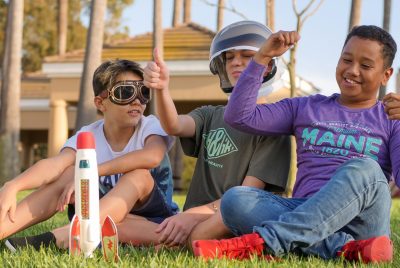
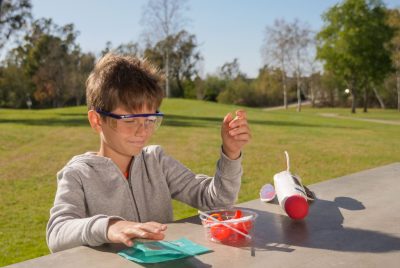
STEM programs for kids take everyday curiosity and turn it into hands-on learning. Instead of only reading facts from a page, kids build, test, compare, wonder, mess up, laugh, fix things, and try again. They learn that science is not just something in a textbook. It is in weather, cooking, toys, bridges, plants, robots, bubbles, and the mysterious way one sock always disappears.
In this guide, you will learn how STEM supports confidence, problem-solving, creativity, and school readiness, plus ways to encourage it at home or in class.
The Reasons Why STEM Learning Is So Effective for Children
STEM refers to science, technology, engineering, and math. That sounds formal, but for children it often looks like play with a purpose.
A child building a block tower is exploring balance. A child mixing safe kitchen ingredients is noticing reactions. A child programming a robot mouse is learning sequencing and logic.
STEM works because it makes learning visible. Kids do not just hear about gravity. They watch a marble roll down a ramp. They do not just memorize measurement. They pour water, count drops, compare sizes, and make guesses.
That learning sticks because it involves hands, eyes, brain, voice, and imagination.
What STEM Programs for Kids Usually Include
Good stem programs for kids vary by age, setting, and goal, but most share the same heart: active discovery.
They may include:
- Simple science experiments
- Engineering challenges
- Beginner coding activities
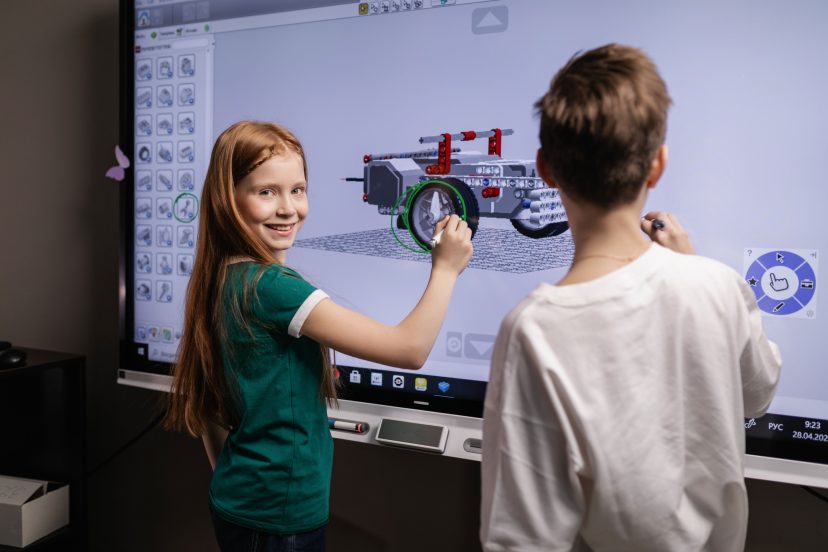
- Robotics projects
- Math games and puzzles
- Weather and nature observations
- Design-and-test tasks
- Team problem-solving
Some programs happen in school. Others happen after school, online, in libraries, or at the kitchen table. The experience matters most.
A strong STEM program gives children something meaningful to investigate. It should invite them to ask questions, test ideas, and explain what they noticed.
The Core Skills Kids Build Through STEM
STEM learning is often connected to future careers, which is fair. Many future careers will include technology, data, design, and problem solving. However, the everyday benefits matter just as much.
Problem-solving
Kids learn to ask, “What else can I try?” instead of giving up after the first wobble, spill, or crash.
Critical thinking
They compare results, look for patterns, and make decisions based on what they observe.
Creativity
STEM is not cold or robotic. A cardboard robot with bottle-cap wheels is creative work, even if it rolls sideways like it had a rough morning.
Communication
Children practice explaining their ideas, listening to others, and working as part of a group.
These skills help beyond science class. They support reading, writing, math, confidence, and everyday decision-making.
How STEM Programs Support Confidence
One of the biggest gifts of STEM is that it makes mistakes useful.
In many school tasks, a wrong answer can feel like a dead end. In STEM, a failed bridge, sinking boat, or toppling tower becomes information. It says, “Now we know what did not work.”
That shift helps perfectionists, quiet learners, and children who feel “not math people.”
When kids test something, improve it, and see progress, they start to believe, “I can figure things out.” That belief is worth a lot.
Choosing Age-Appropriate STEM Programs
The best STEM program is not always the fanciest one. It is the one that fits the child’s age, interests, and confidence level.
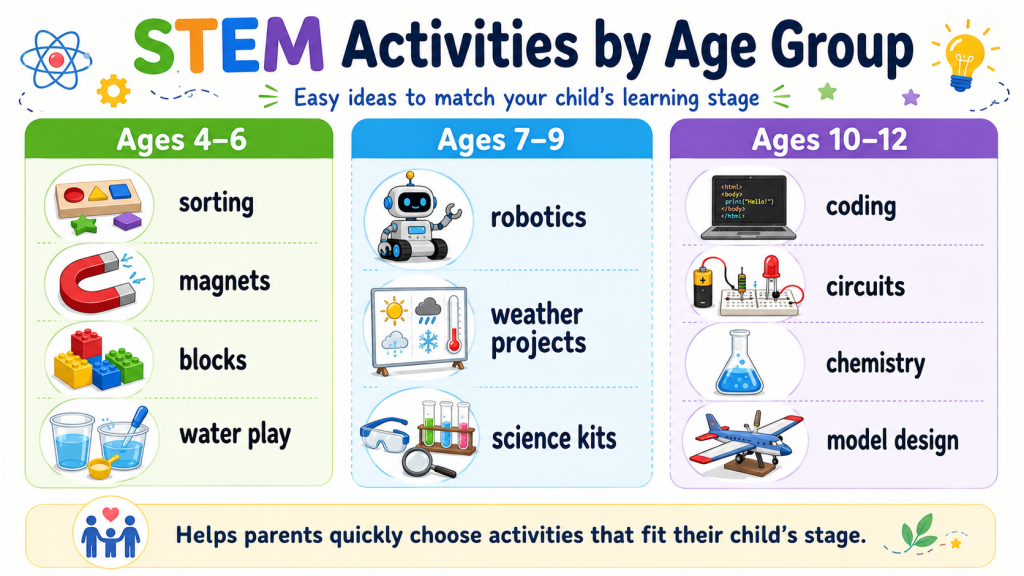
Ages 4–6
Young children do well with playful, sensory-rich activities. Think magnets, sorting, water play, building blocks, nature walks, simple patterns, and screen-free coding toys.
At this age, the goal is exploration, not perfection.
Ages 7–9
Elementary kids often enjoy beginner robotics, weather projects, guided science kits, engineering challenges, and simple experiments with clear steps.
They are usually ready to make predictions and compare results.
Ages 10–12
Older kids may enjoy circuits, coding, chemistry kits, model design, and experiments with multiple steps.
Choose something challenging enough to feel exciting, but not so hard that the adult ends up doing everything.
School, After-School, or At-Home STEM: Which Fits?
There is no single perfect path. Each setting has a different strength.
School STEM programs connect learning to classroom goals. After-school clubs often allow more freedom and teamwork. At-home STEM activities can be casual, affordable, and personal.
Informal learning counts too. Measuring ingredients while baking, comparing leaves on a walk, fixing a loose toy part, or asking why the moon looks different can all become STEM moments.
So yes, the backyard bug hunt counts. So does the rainy-day paper airplane contest. Learning does not always arrive wearing a name tag.
What a Good STEM Activity Looks Like
A strong STEM activity feels like a small adventure with a clear purpose.
Look for activities that include:
- A question or challenge
- Hands-on materials
- Room for trial and error
- A chance to talk about results
- An open-ended next step
Instead of saying, “Build this exact tower,” ask, “Can you build the tallest tower that holds a toy car for 10 seconds?” Suddenly, kids consider height, weight, balance, shape, and stability without a lecture.
Simple STEM Learning Ideas You Can Try This Week
You do not need expensive equipment. Some of the best STEM learning uses things you already have.
Try these simple ideas:
- Build a foil boat and count how many coins it holds.
- Make a paper bridge between two books.
- Determine which design of paper airplane flies the farthest.
- Grow seeds in a jar and track changes.
- Sort the leaves based on their shape, size, or texture.
- Make a daily weather chart.
- Build a ramp and test toy cars.
If your child enjoys weather activities, try this hands-on weather station project for kids. It connects observation, measurement, and real-world science kids can actually see clearly.
How Parents Can Support STEM Without Being Experts
Here is the comforting truth: you do not need to know every answer.
Actually, it can help when you do not.
When a child asks, “Why did that happen?” you can say, “I’m not sure. How could we test it?” That response teaches curiosity and investigation.
Try asking:
- “What do you notice?”
- “What do you think will happen?”
- “Why do you think it changed?”
- “What could we try differently?”
- “How would you explain this to someone younger?”
Your role is not to be a walking answer key. Your role is to keep the curiosity door open.
How Teachers and Clubs Can Make STEM More Inclusive
STEM should feel like it belongs to every child.
That means using examples kids recognize, not only rockets and robots. STEM can include cooking, farming, dance, sports, music, weather, architecture, fashion design, community gardens, video games, and transportation.
A child who loves dance can explore motion and rhythm. A child who loves animals can study habitats. A child who helps a grandparent cook can learn measurement, heat, and chemical change.
Representation matters too. Kids benefit from seeing problem-solvers from many cultures, genders, abilities, and backgrounds.
The quiet child, the artistic child, the active child, the bilingual child, and the child who asks gloriously unusual questions all deserve a place in STEM.
Helpful Amazon STEM Products for Kids
The right tools can make stem programs for kids more engaging. These products are not replacements for curiosity, but they can give kids a helpful place to start.
Snap Circuits Jr. SC-100 Electronics Exploration Kit
This kit introduces circuits through snap-together parts. It works well for kids who enjoy lights, sounds, switches, and cause-and-effect activities.
Features:
- Snap-together circuit pieces
- No soldering required
- Project guide included
- Good introduction to basic electronics
Use case: Best for kids who like gadgets and hands-on building.
Learning Resources STEM Explorers Brainometry
This set supports spatial reasoning and 3D thinking. It works well for kids who enjoy quiet challenges.
Features:
- 3D puzzle challenges
- Colorful shape pieces
- Screen-free learning
- Great for pattern recognition
Use case: Best for kids who enjoy puzzles, building, and logic games.
National Geographic Mega Science Lab Experiments
This science kit offers earth science, chemistry, and classic “wow” experiments. It is fun for kids who like variety.
Features:
- Multiple experiment types
- Volcano, crystal, and chemistry activities
- Extra activity guide
- Good for family science time
Use case: Best for curious kids who love dramatic hands-on experiments.
ThinkFun Gravity Maze Falling Marble Logic Game
This marble maze game blends engineering, planning, and logic as kids build pathways for a marble.
Features:
- Marble maze challenges
- Logic and planning practice
- Hands-on engineering play
- Designed for repeat use
Use case: Best for kids who enjoy construction, puzzles, and trial-and-error thinking.
Learning Resources Code & Go Robot Mouse Activity Set
This screen-free coding toy teaches sequencing and early programming using button commands and coding cards.
Features:
- Screen-free coding practice
- Button-based programming
- Coding cards included
- Friendly for younger learners
Use case: Best for children ready to explore basic coding without an app.
Research-Backed Benefits of STEM Learning
Research supports what many adults see: children can understand meaningful science and engineering ideas when learning is hands-on and well supported.
The National Academies explains that young children are ready for real science and engineering when adults provide good questions, materials, and time to investigate.
A NIH/PMC review also found that hands-on STEM outside the classroom can build school-ready skills, especially through museums, home activities, and playful exploration.
That is why strong stem programs for kids should go beyond worksheets. The best ones help children observe, test, explain, collaborate, and try again.
How to Choose the Right STEM Program for Your Child
Before choosing a program, ask one simple question: What makes this child light up?
Some kids love messy experiments. Some prefer puzzles. Some want robots, nature, or game design. A good STEM choice connects with that spark.
Also consider:
- Age level
- Reading ability
- Attention span
- Group size
- Cost
- Materials needed
- Adult supervision
- Creative freedom
The best stem programs for kids do not make learning feel like a test. They make it feel like an invitation.
FAQs About STEM Programs for Kids
What age should children start STEM programs?
Kids can begin STEM in preschool through building, sorting, observing, exploring, and asking questions. Formal programs often start around ages 4 to 6, but everyday STEM can begin much earlier.
Are STEM programs only for advanced learners?
No. STEM programs can support many learning levels. A good program meets children where they are and gives them room to explore, make mistakes, and grow.
What are the best STEM activities for elementary kids?
Good options include paper bridges, marble runs, coding toys, seed growing, weather tracking, circuits, and safe kitchen experiments.
How do STEM programs help kids in school?
STEM activities support problem-solving, math reasoning, reading comprehension, communication, and teamwork. They also help children connect classroom ideas to real-life situations.
Can kids do STEM without screens?
Absolutely. Many STEM activities are screen-free, including building challenges, nature observations, puzzles, weather charts, circuits, and hands-on experiments.
Conclusion: Help Kids See Themselves as Problem Solvers
STEM learning is not about turning every child into a scientist, coder, or engineer. It is about encouraging children to see themselves as capable thinkers.
The best stem programs for kids give children space to wonder, build, test, revise, and try again. They teach kids that mistakes are not embarrassing. They are clues. They show children that questions are not interruptions. They are the start of discovery.
So begin with one simple activity. Build one wobbly tower. Test one paper airplane. Ask one better question. In that messy “let’s try again” moment, a child may discover that learning is not something that happens to them.
It is something they get to do.