Baby Development Toys Worth Buying for Babies
We may earn a commission for purchases made using our links. Please see our disclosure to learn more.
Shopping for baby development toys can get overwhelming fast. You start out wanting one or two helpful things for your baby, and somehow you end up staring at a glowing plastic contraption that sings, flashes, rattles, and probably knows your tax bracket.
If that sounds familiar, you’re not alone.
A lot of parents want toys that do more than just fill a basket. You want something that supports your baby’s growth, keeps them curious, and maybe buys you enough time to drink half a cup of coffee while it’s still warm. That’s fair.
The good news is this: babies do not need a mountain of stuff. They need a few thoughtful toys, a safe place to explore, and plenty of interaction with you. In this guide, you’ll learn which baby development toys are actually worth buying, how they support early learning, and which real Amazon products make sense for different stages.
Affiliate note: This article includes product suggestions, and I may earn a small commission from qualifying purchases at no extra cost to you.
Why buying baby toys feels so confusing
The baby toy market loves making simple things feel complicated. Everything promises to “boost brain development” or “maximize milestones,” which sounds impressive until you realize your baby is mostly trying to eat their sleeve and kick the air.
That does not mean toys do not matter. They do. But the role of baby development toys is often much simpler than the marketing makes it sound. The right toy helps your baby practice basic early skills like looking, listening, grabbing, tracking, kicking, mouthing, and eventually solving simple little problems. Those small actions are the building blocks for later learning, including early STEM thinking like cause and effect, pattern recognition, and spatial awareness. AAP and child development experts consistently point to play as a powerful support for social, language, motor, and cognitive growth.
What baby development toys actually do
A good developmental toy meets your baby where they are. It does not rush them. It does not try to turn a 4-month-old into a miniature engineer. It simply gives them something meaningful to do with their body and senses.
For newborns, that might be looking at high-contrast patterns. For a slightly older baby, it could be reaching for a rattle, batting a hanging toy, or lifting their head during tummy time. Later, it may look like stacking rings, dropping blocks into a bucket, or turning an object over and over like they’ve just discovered the mysteries of the universe.
That is the real heart of early stem education in babyhood. It is not worksheets or “academic” toys. It is hands-on discovery. The best toys help babies notice patterns, test what happens next, and repeat actions until they make sense. HealthyChildren notes that the best toys match a child’s skills and help them build new ones.
You do not need a house full of toys
This might be the most comforting thing in the whole article: more toys do not automatically mean more learning.
In fact, too many toys can backfire. Babies do better when they can focus. If every inch of the play mat is crowded with noise, lights, textures, and dangling objects, it can get overstimulating fast. A few good infant sensory toys usually beat a giant pile of random ones.
Think about it this way. If you walk into a kitchen with one sharp knife, one solid pan, and one good cutting board, you can make dinner. If you walk into a kitchen with 47 novelty gadgets, you will mostly just wonder where to set anything down.
Babies are not that different.
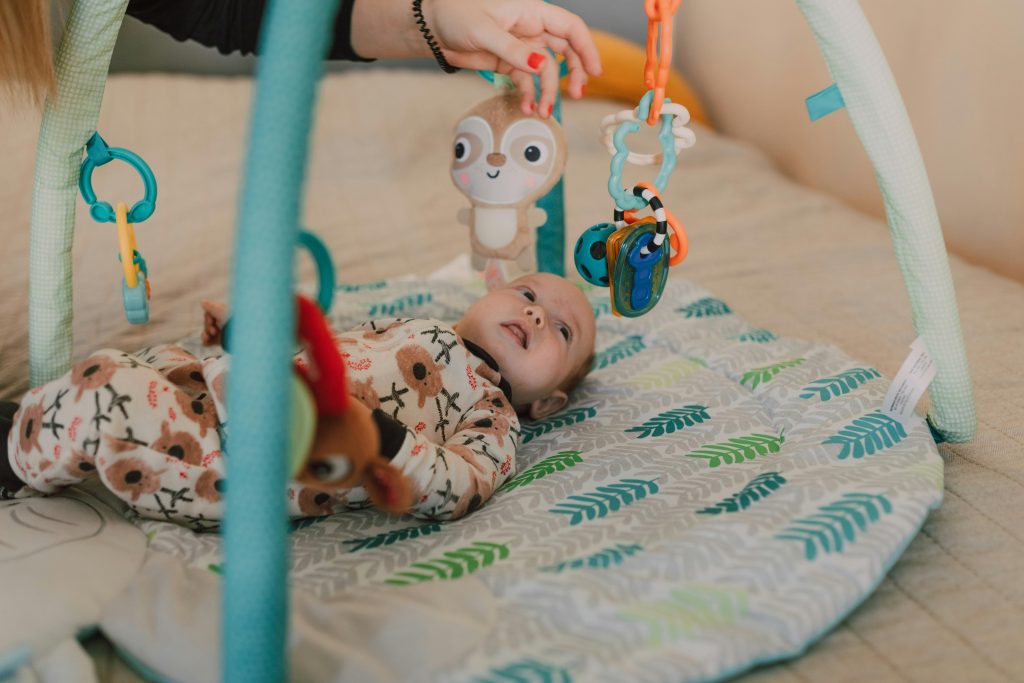
The first kind of toy most newborns notice
Newborns do not see the world the way older babies do. Their vision is still developing, which is why high-contrast baby toys tend to work so well in the beginning. Black-and-white patterns, simple faces, and baby-safe mirrors are often much more interesting to a newborn than pastel toys with tiny little details.
The CDC’s infant milestone guidance encourages activities like placing toys at eye level during tummy time and using mirrors and bright images to support attention and exploration. That is why a simple fold-out mirror or high-contrast card set can do more in the early weeks than a noisy electronic toy with ten settings.
Tummy time toys that earn their keep
Tummy time can be a bit dramatic. Some babies love it. Some act like you’ve personally betrayed them.
Still, it matters.
NIH’s Safe to Sleep program explains that supervised tummy time helps strengthen a baby’s neck, shoulders, and arms, supports motor development, and helps prevent flat spots on the head. By around 2 months, pediatricians recommend about 15 to 30 minutes of total tummy time per day, broken into short sessions.
This is where tummy time toys really help. A mirror, a crinkle book, or a soft activity panel gives your baby a reason to look up, stay interested, and push a little longer. You are not trying to make tummy time magical. You are just making it slightly less offensive.
Toys that help little hands get stronger
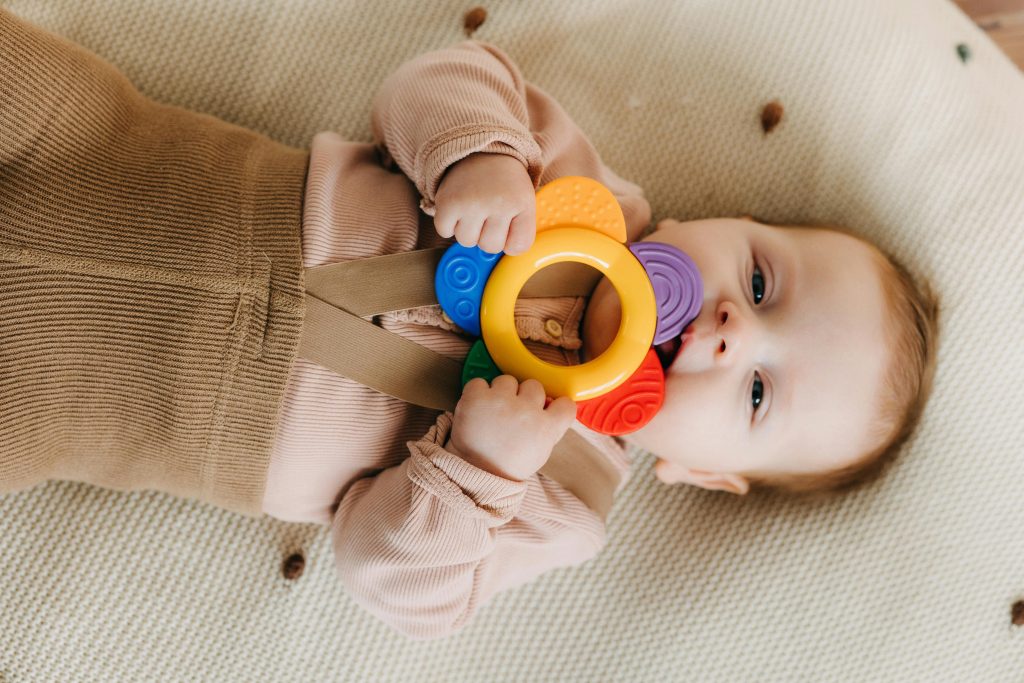
Once babies begin reaching and grasping, the right toy can make a big difference. Lightweight rattles, soft teethers, looped toys, and textured toys are great because they invite babies to hold, shake, mouth, and switch from one hand to the other.
That may look simple, but it is doing real work. Those little gripping and passing motions support fine motor development and hand-eye coordination. The CDC also recommends rattles and mirrors as useful ways to encourage early play and exploration.
If a toy is easy to hold, gentle on gums, and interesting without being chaotic, that is usually a very good sign.
Stacking and sorting toys that teach cause and effect
As babies get older and more coordinated, stacking and sorting toys become more useful. These are the toys that quietly introduce some of the earliest stem education ideas without making a big production out of it.
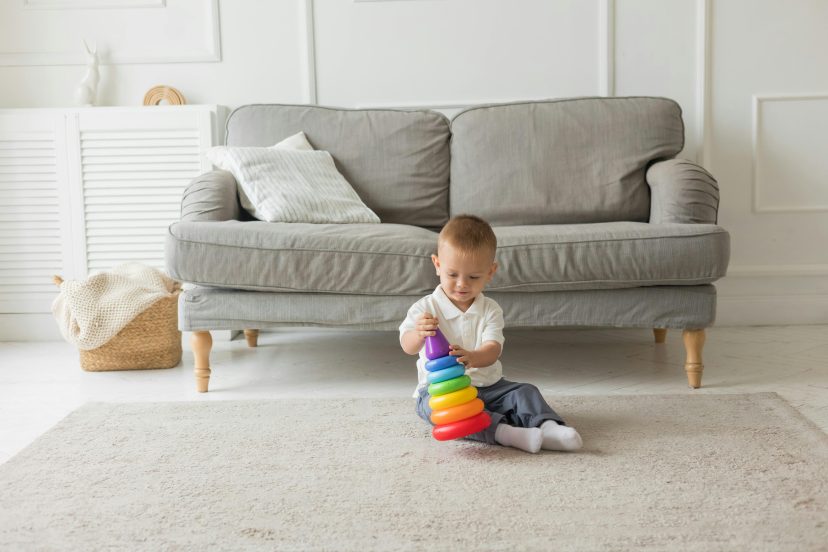
A baby stacks a ring. It falls. They try again. A block goes into the bucket. Then it comes back out. They turn a shape around until it fits. That is not “just playing.” That is early experimentation.
HealthyChildren highlights toys like blocks, shapes, and puzzles as especially helpful for fine motor growth, language, problem-solving, and early math thinking. So if you are looking for baby learning toys that have staying power, classic stacking and sorting toys are hard to beat.
Sensory toys that feel fun, not frantic
Sensory toys can be wonderful. They can also be a lot.
The best sensory toys for babies are usually pretty simple. A gentle crinkle. A safe mirror. A soft bell sound. A few interesting textures. Bright but not blinding colors. Enough to spark curiosity, not enough to feel like a tiny casino.
AAP guidance has repeatedly stressed that toys should support interaction and new skill-building rather than replace real play with screens or constant automated stimulation. In plain English, the toy should invite your baby in, not overwhelm them.
The real secret is still you
Here is the part no packaging can really sell: your baby learns best through interaction with people.
Harvard’s Center on the Developing Child explains that “serve and return” interactions, those back-and-forth moments when your baby coos, stares, gestures, or fusses and you respond, help build brain architecture and support language, social, and emotional development.
So yes, developmental toys for babies can help. But your voice still matters more than any playlist built into a toy. Your smile matters. Your silly commentary matters. The way you copy your baby’s sounds or shake the rattle and wait for them to react matters.
The toy starts the moment. You make it meaningful.
How to choose safe baby development toys
Safety comes first. Always.
Before you buy, check the age recommendation, small parts, cords, loose seams, sharp edges, and battery compartments. HealthyChildren recommends choosing toys that match your child’s stage and reminds parents to watch out for small batteries and loose magnets. The CPSC also stresses following age guidance and keeping small parts away from young children.
A few simple filters can save you trouble:
- Pick toys that fit your baby’s current age, not just the “cute” factor
- Avoid toys with loose pieces or easy-open battery cases
- Skip long cords or strings for infants
- Check toys often for cracks, wear, or loose parts
- Choose durable, easy-to-clean materials whenever possible
5 baby development toys worth considering
Fisher-Price Baby Playmat Kick & Play Piano Gym
This is a strong pick for babies who need a mix of lay-and-play, tummy time, and kicking fun. Amazon lists multiple ways to play, a removable piano, and sensory toys that can be repositioned as your baby grows. It works well for families who want one larger activity toy that stretches across several stages.
Features: musical piano, repositionable toys, tummy time support, newborn-to-toddler versatility
Best for: babies who like movement, kicking, and longer floor play sessions
Baby Einstein Flip for Art High Contrast Floor Activity Mirror
This one is especially useful in the newborn months. Amazon describes it as a tummy time mirror with high-contrast patterns, flashcards, and a baby-safe mirror. It is a smart choice if you want a simple newborn toy focused on visual tracking and floor play rather than noise.
Features: high-contrast visuals, flashcards, foldable mirror, tummy time friendly
Best for: newborns and young infants who are just starting visual exploration
Fisher-Price Baby’s First Blocks & Rock-a-Stack Toy Set
Classic for a reason. Amazon says this set combines sorting blocks with stacking rings and supports hand-eye coordination, dexterity, and early problem-solving. It is especially nice once your baby is sitting more confidently and starting to love repeat-drop-stack-repeat play.
Features: shape sorting, stacking rings, simple storage bucket, classic developmental play
Best for: older babies working on fine motor skills and cause-and-effect play
Manhattan Toy Winkel Rattle & Sensory Teether Toy
The Winkel is one of those toys parents keep recommending because babies can actually hold it. Amazon describes BPA-free teething tubes, a lightweight shape for little hands, and a quiet rattle in the center for auditory stimulation. Great for chewing, shaking, and clutching.
Features: easy-grab loop design, teether material, center rattle, newborn-friendly
Best for: babies who are learning to grasp and babies deep in the “everything goes in my mouth” phase
Tiny Land Montessori Baby Toy Set 0–3 Months Newborn Development Sensory Play Kit
If you want a starter set instead of a single toy, this one covers a lot. Amazon lists a mirror, black-and-white cards, a rolling bell, a play mat, and a bed wrap. That makes it a practical option for parents building an early sensory setup from scratch.
Features: multi-piece play kit, high-contrast cards, mirror, rolling bell, play mat
Best for: new parents who want a ready-made newborn sensory bundle
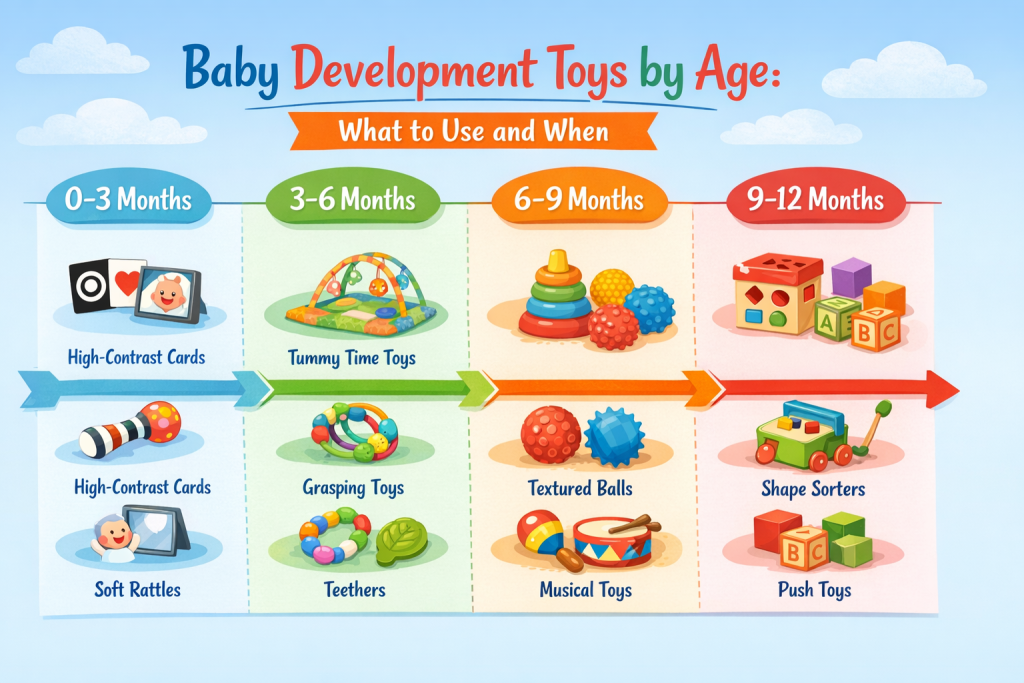
What the research says about play and baby development
The research here is actually pretty reassuring. One AAP clinical report on play and development found that developmentally appropriate play supports social-emotional, language, cognitive, and self-regulation skills while strengthening caregiver-child relationships. Another useful source, this 2018 review on the role of play in child development, concluded that play supports cognitive, emotional, social, and psychomotor functioning and helps build a healthier foundation for the future.
So when you buy baby development toys, the goal is not to “get ahead.” It is to support healthy, hands-on, connected learning in a way that fits your baby’s stage.
Easy ways to get more out of each toy
You do not need a complicated routine. Small habits go a long way.
Try these:
- Put one toy at eye level during tummy time
- Describe what your baby is doing out loud
- Pause after you shake a rattle and wait for a response
- Repeat favorite games instead of constantly switching toys
- Rotate toys every few days so they feel fresh again
And when your baby grows into the toddler years, that same hands-on curiosity can grow into bigger activities like these fun pumpkin STEM activities. It is the same learning pattern, just a slightly messier version. CDC, NIH, and Harvard all point back to responsive play and interaction as the real foundation.
Frequently asked questions about baby development toys
What are the best baby development toys for newborns?
Usually, the simplest ones: high-contrast cards, tummy time mirrors, soft rattles, and safe sensory toys with a few textures. Newborns do best with toys that support visual tracking and gentle exploration.
Do babies really need developmental toys?
They do not need a huge collection, but a few well-chosen toys can support movement, sensory play, and early problem-solving. What matters most, though, is still interaction with a caregiver.
Are Montessori baby toys better than electronic toys?
Not always, but simpler toys often leave more room for real exploration. AAP guidance leans toward toys that encourage interaction and skill-building instead of replacing play with screens or overly automated features.
How many baby development toys should I keep out at once?
A small rotation works best for most families. A few toys at a time is usually enough. That keeps play focused and makes each toy feel more interesting.
When should I stop using a toy?
Once it is damaged, unsafe, clearly too babyish, or no longer interesting in any useful way, it is time to move on. Safety always comes first.
Final thoughts
The best baby development toys are not the ones with the loudest claims. They are the ones your baby can actually use, enjoy, and grow with.
A good toy helps your baby notice something new, try something again, and feel successful doing it. That may look like a tiny head lift during tummy time, a first solid grasp on a rattle, or the very serious concentration of a baby trying to stack one ring on top of another like they are solving world peace.
That is real learning.
So keep it simple. Buy thoughtfully. Follow your baby’s lead. And remember: you do not need to create a perfect playroom to support early stem education. A few smart baby development toys, a little floor time, and a lot of connection will take you much farther than the flashy stuff ever could.