5 Simple Chemistry STEM Activities

We may earn a commission for purchases made using our links. Please see our disclosure to learn more.
Want to make chemistry interesting without buying expensive equipment or dealing with complicated instructions? These five Chemistry STEM Activities use familiar materials to show how substances react, move, separate, and form crystals. They suit family afternoons, elementary lessons, and beginners.
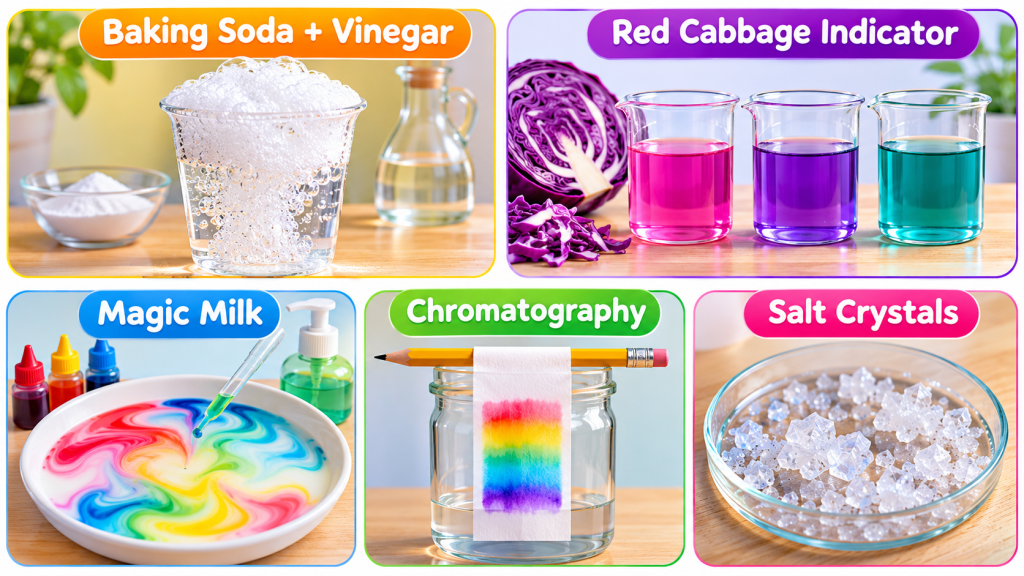
You’ll make a fizzy reaction, test liquids with cabbage juice, create moving colors in milk, separate marker inks, and grow salt crystals. Each project includes supplies, instructions, and the science behind the results. You’ll also learn safe setup and how to investigate results. Adults should supervise children throughout, even when ingredients come from the kitchen. For each project, encourage learners to make a prediction first and explain how their observations support or challenge it.
What Makes an Activity a Chemistry Experiment?
Chemistry studies different substances, their characteristics, and the ways they react with one another. A fizzy mixture can reveal a chemical reaction, while a dissolving or separating experiment shows how materials behave without necessarily creating a new substance.
That distinction matters. Soap moving food coloring across milk is not the same process as vinegar reacting with baking soda, but both reveal useful chemistry concepts. Start with what learners can observe or measure, then develop explanations.
Gather Simple Materials Before You Start
Most activities need clear plastic cups, a tray, measuring spoons, paper towels, and a notebook. The project ingredients are baking soda, white vinegar, red cabbage, lemon juice, milk, food coloring, dish soap, washable markers, coffee filters, salt, and water.
Set out supplies for one experiment at a time. Label cups, use separate droppers, and keep science equipment out of food preparation. You can begin with ordinary household containers; specialized kits are optional.
Set Up a Safe Kitchen Science Station
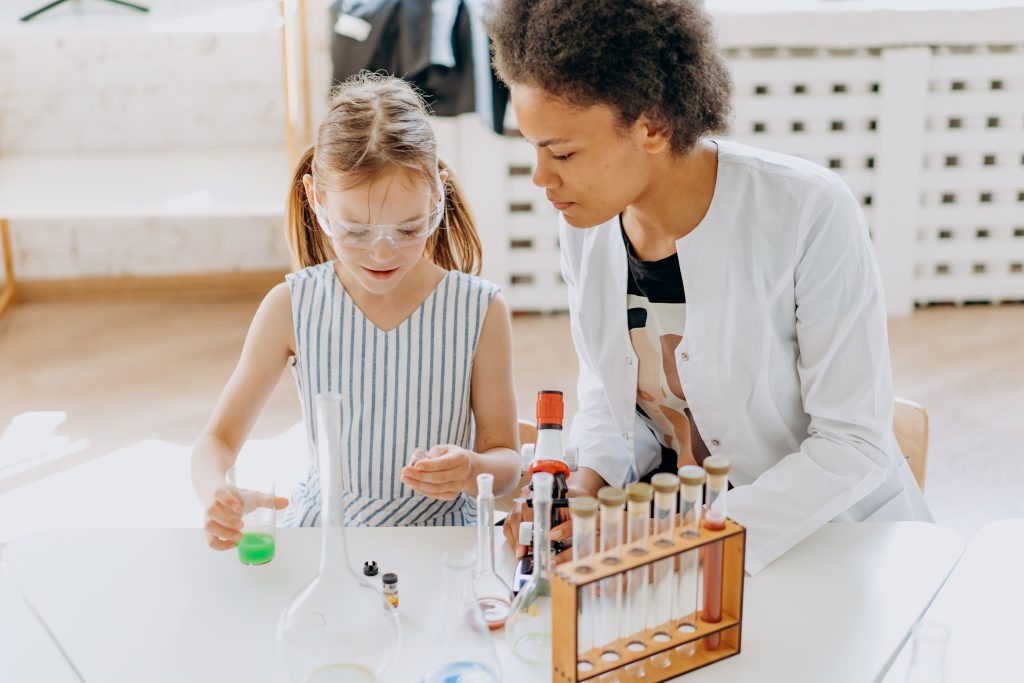
Protect the worktop and keep experiments away from meals and pets. Follow each activity’s safety directions, wear correctly fitting splash goggles, and have an adult handle scissors or warm water.
Never taste experiment mixtures, combine unknown substances, or mix household cleaning products. Avoid bleach, concentrated acids, and pressurized containers. Wash hands and dispose of mixtures appropriately. The American Chemical Society’s science safety rules provide a useful routine for supervised activities.
Activity 1: Make a Baking Soda and Vinegar Reaction
You’ll need: A clear plastic cup, tray, two teaspoons of baking soda, about two tablespoons of white vinegar, and a spoon.
- Set the cup on the tray, then pour in the baking soda.
- Pour in the vinegar slowly, then observe the bubbling.
- Repeat using a fresh cup and a different amount of vinegar. Keep the baking soda quantity unchanged.
What’s happening? Vinegar contains acetic acid, which reacts with sodium bicarbonate in baking soda. The reaction produces carbon dioxide gas, visible as bubbles escaping the liquid. Faster bubbling doesn’t necessarily mean more gas.
Try this: Compare how long bubbling lasts in each trial. Record amounts and predict first. Never cap the reacting container; gas needs a way to escape.
Activity 2: Test Acids and Bases With Red Cabbage
You’ll need: A few red cabbage leaves, room-temperature water, a sealable bag, three clear cups, lemon juice, and baking soda.
- Tear the leaves into small pieces, place them in the bag with some water, and squeeze until the water becomes purple-blue.
- Pour the colored liquid into three labeled cups.
- Add a little lemon juice to one cup, a small amount of baking soda dissolved in water to another, and leave the third unchanged.
What’s happening? Cabbage contains anthocyanin pigments that change color depending on acidity. Lemon juice typically produces pinker tones; a baking soda solution moves the color toward blue-green. The untouched cup acts as a comparison.
Try this: Arrange the cups from most acidic-looking to most basic-looking. Color changes are clues, not precise pH measurements. Test only familiar, adult-approved materials.
Activity 3: Create a Moving Rainbow in Milk
You’ll need: Whole milk, a shallow dish, liquid food coloring, a cotton swab, and dish soap.
- Add enough milk to the dish to fully cover the bottom.
- Add separated drops of different food colors without stirring.
- Touch the center of the milk with a swab dipped in dish soap. Watch the colors spread and swirl.
What’s happening? Soap molecules interact with water and fat, while soap spreading across the surface changes surface tension. These changes create movement that carries the food coloring. This demonstrates molecular interactions, not necessarily a chemical reaction.
Try this: Compare whole milk with a lower-fat variety, using equal amounts of liquid and soap. Use clean dishes between tests. Discard the milk; once soap is added, it is no longer food.
Activity 4: Separate Marker Colors With Chromatography
You’ll need: White coffee filters, washable markers, a pencil, scissors, a clear cup, water, and a clip.
- Cut a filter into a strip and draw a pencil line near its lower end.
- Make a small marker mark on that line and clip the upper end over a cup.
- Add enough water to wet only the bottom of the strip, keeping the ink above the waterline.
- Watch as the moisture rises and the ink spreads into colored bands.
What’s happening? Capillary action draws water upward. Different dye components travel different distances depending on how they interact with the water and paper.
Try this: Compare black washable markers from two brands. Some inks barely separate. Use water-soluble markers, not permanent ink or flammable solvents.
Activity 5: Grow Salt Crystals Through Evaporation
You’ll need: Table salt, water, a spoon, a shallow clear dish, and a safe place to leave it undisturbed.
- Stir salt into a small amount of water until some remains undissolved.
- Let the excess salt settle, then pour the clearer solution into the shallow dish.
- Leave it uncovered where it cannot be knocked over and inspect it each day.
What’s happening? Salt can dissolve in water, but it does not evaporate with the water. As water gradually leaves, dissolved sodium and chloride ions can arrange into solid crystals. Look for square-edged crystals or crusts.
Try this: Compare two equal dishes placed in different safe indoor locations. Record water levels and crystal appearance. Visible crystals may take several days.
Turn Each Demonstration Into a Fair Test
Focus each investigation on one question. Choose a single factor to change, such as vinegar volume or milk fat content, and keep the other conditions as similar as possible.
Record predictions, observations, and explanations. Repeat the test when practical. For a fuller approach to planning investigations, explore these fun science experiments for kids, which connect simple activities with scientific thinking.
Fix Common Problems Without Guessing
Weak fizz may reflect exhausted ingredients; faint cabbage colors may mean diluted indicator. For chromatography, check that the marker is water-soluble and its ink mark sits above the water. If milk colors barely move, start again with a clean dish and fresh soap.
Slow salt crystals need patience, not extra chemicals. Change one condition and record unsuccessful results too.
Adapt Chemistry Activities for Different Ages
Younger children can help predict colors, pour premeasured water, or draw what they observe. Adults handle ingredients for preschoolers. Older children can use graduated containers, compare repeated trials, and explain the difference between a reaction and a physical change.
Match experiments to attention span and safety awareness. For groups, assign roles such as measurer, recorder, and observer so everyone contributes.
Recommended Products for Chemistry STEM Activities
These products serve different needs. Check age guidance and supplies; always supervise.
Learning Resources Primary Science Lab Set (LER2784)
Best for: Younger learners practicing observation and measurement.
The 22-piece set contains plastic test tubes, a flask, beaker, dropper, funnel, magnifier, goggles, and activity cards. The reusable tools suit color tests and pouring. It is a general science starter rather than a chemistry reagent collection, so you’ll need to provide household ingredients and guide the experiments.
Crayola Ultra-Clean Fine Line Washable Markers, 40 Count (58-7861)
Best for: Testing a range of ink colors in paper chromatography.
This set provides 40 assorted washable markers with fine tips for making controlled marks on filter strips. The assortment supports comparisons and art projects. Individual inks may separate differently, and washability alone does not guarantee striking color bands; try several shades and brands.
4M KidzLabs Kitchen Science Kit (3806)
Best for: Compact, guided science using household materials.
The kit includes instructions and materials for six activities, including a vinegar-powered rocket, lemon electricity, and invisible writing. It covers several science concepts in a compact format. Since some activities involve electricity or launching a small object, adults must follow the specific instructions, and additional kitchen supplies are necessary.
Thames & Kosmos Ooze Labs Chemistry Station (642105)
Best for: Children who like tactile experiments and organized equipment.
The 57-piece station supports approximately 20 experiments involving bubbles, slime, color changes, and basic chemistry tools. Clip-on cards keep instructions handy. It takes more storage space than a basic cup-and-tray setup, and supplied chemical materials still require careful handling according to the manual.
National Geographic Amazing Chemistry Set (NGMEGACHEMAR)
Best for: Families seeking varied guided experiments for older beginners.
This set supplies materials for 15 featured projects, including color-changing liquids and crystal activities, plus instructions for 85 additional experiments using household supplies. Reusable tools support further projects. The advertised activity count includes projects requiring extra ingredients, so review the guide and available workspace before choosing a session.
What Research Shows About Hands-On Chemistry Learning
The National Academies’ 2019 report on science investigation and design concluded that inquiry centered on real phenomena can strengthen conceptual understanding and reasoning in grades 6–12. Those findings do not establish equal benefits for younger children.
Practical guidance from the American Chemical Society’s red cabbage indicator activity and Science Buddies’ chromatography instructions emphasizes observing, comparing, and recording evidence. Ask learners what changed and how to test an explanation. Their explanations matter more than creating the biggest reaction. Although the National Academies report addresses secondary-school education, its emphasis on questions and evidence offers a useful framework for adapting these simpler experiences with appropriate guidance.
Frequently Asked Questions About Chemistry STEM Activities
What is the easiest chemistry experiment for beginners?
Mixing small quantities of baking soda and vinegar is a straightforward starting point because the bubbling begins quickly and the ingredients are familiar. Use an open plastic cup on a tray, supervise closely, and ask children to identify the gas bubbles. Compare a measured second trial.
Can children do chemistry experiments without a science kit?
Yes. Cups, measuring spoons, water, cabbage, vinegar, soap, and paper filters are enough for many useful investigations. Kits provide tools and instructions but aren’t essential for these concepts. Prioritize a clear question, suitable safety equipment, and adult supervision before buying extras.
Are kitchen chemistry experiments completely safe?
No experiment is risk-free just because it uses familiar ingredients. Vinegar may sting eyes, food coloring can stain, and soapy mixtures must not be swallowed. Wear appropriate goggles, avoid food preparation areas, and supervise. Never substitute bleach or concentrated chemicals for ordinary ingredients.
Is growing salt crystals a chemical reaction?
Usually not. Dissolving table salt in water and recovering it through evaporation are physical changes; the salt’s chemical identity remains the same. Contrast this with fizzing reactions that produce new substances. It also introduces ideas such as solubility, evaporation, and how particles arrange themselves.
How can I make chemistry activities suitable for school?
Choose one observable question, check school safety rules, and prepare identical materials for each group. Give students roles and a simple worksheet for predictions, quantities, and observations. Demonstrate unfamiliar steps first, then let groups compare results. Premeasure for younger pupils; let older students plan variations.
Conclusion: Start With One Clear Chemistry Question
Chemistry STEM Activities need neither expensive gear nor dramatic effects. Start with a quick baking soda reaction if you’re introducing chemical changes, or choose cabbage indicator and chromatography when careful observation is the priority. Milk experiments reveal how soap influences liquids, while salt crystals reward patience and comparison over several days.
A basic tray and household supplies will cover all five projects. The Learning Resources Primary Science Lab Set can help younger learners handle reusable tools; the National Geographic Amazing Chemistry Set offers more guided options for older beginners. Keep materials appropriate, supervise, and ask learners to predict, record, and explain one result.