Math STEM Projects To Inspire Logical Thinking
We may earn a commission for purchases made using our links. Please see our disclosure to learn more.
A child can memorize the formula for area and still struggle to explain why two shapes cover the same amount of space. That’s where Math STEM Projects help: they turn numbers, measurements, and patterns into problems children can investigate with their hands.
Instead of completing another worksheet, learners might design a bridge, predict the next pattern, or test whether a coin toss is really unpredictable. Each activity gives them a reason to make a claim, check the evidence, and explain the result.
These projects work at home, in classrooms, and in homeschool lessons. Most use inexpensive supplies, and each can be adjusted for different ages. Below, you’ll find practical challenges, ways to make the thinking visible, and a few reusable tools that earn their place on a learning shelf.
Why Math STEM Projects Develop Logical Thinking
Logical thinking means using information to reach a conclusion that follows from the evidence. That might mean spotting a pattern or explaining why a proposed solution fails.
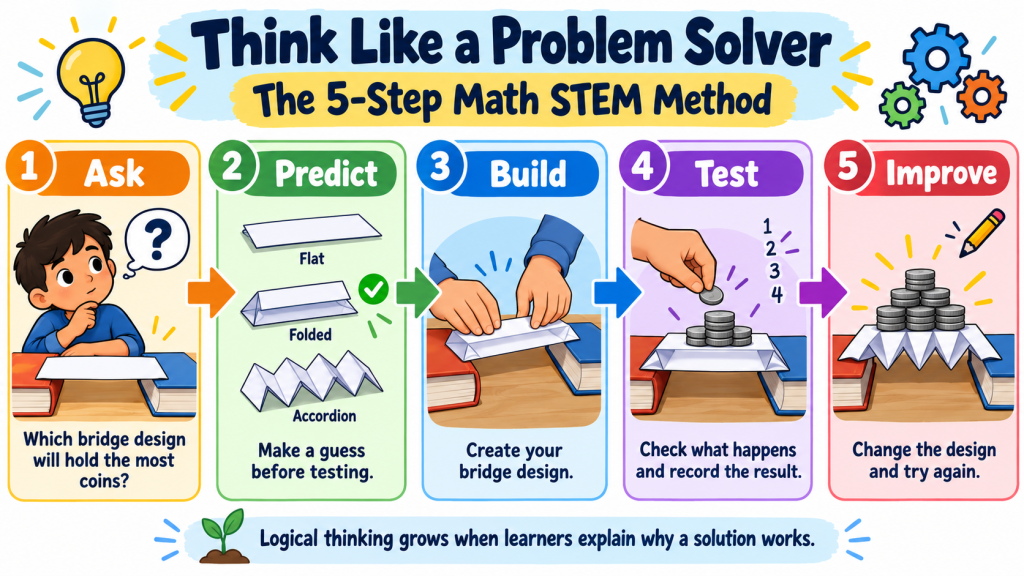
Hands-on challenges create opportunities for this reasoning. Children predict what a design will do, test it, and compare the outcome with their prediction. The crucial part is explaining why.
Ask questions such as “What stayed the same?” and “Can you prove that another way?” These prompts deepen the investigation.
Match Each Challenge to the Learner’s Math Skills
Start with a concept the learner partly understands, then introduce one unfamiliar decision. A beginner who recognizes shapes might copy a pattern before inventing a symmetrical version. Someone comfortable with multiplication might calculate material costs for a model building.
Choose materials that won’t overwhelm the task. Use large shapes for young children, graph paper for older learners. Supervise scissors, rubber bands, and small parts.
State one testable question before starting. “Which arrangement uses the fewest tiles?” gives a clearer purpose than “Make something mathematical.”
Build a Paper Bridge and Compare Its Strength
Gather two books, identical sheets of paper, a ruler, and coins. Set the books a fixed distance apart and ask learners to make a bridge using just one sheet. Test a flat bridge, then try folded and rolled designs.
Add coins gradually and count how many each version supports. Record the span, paper type, and load so comparisons are fair. A stronger result applies to that test, not every possible bridge.
For a related construction challenge, explore STEM activities with popsicle sticks and compare how materials influence design choices.
Create Mirror Art to Investigate Symmetry
Fold a sheet of paper vertically and draw half a butterfly, robot, or geometric pattern along the crease. Open it and challenge the learner to complete the other half as a mirror image.
Use a small mirror on the fold as a checking tool. Count how many squares or triangles appear on each side, then identify corresponding points at equal distances from the center line.
Increase the difficulty by drawing several shapes that look symmetrical but contain one misplaced detail. Finding the error means testing the rule.
Use Tessellations to Find Repeating Rules
Cut identical paper squares, triangles, and regular hexagons, or use reusable pattern blocks. Ask learners to cover a page with one shape without leaving gaps or overlapping pieces.
When a tiling works, describe its repeating arrangement. Ask why regular pentagons cannot tile a flat surface by themselves in the same simple edge-to-edge way. Investigate the angles where tiles meet.
Next, predict the twentieth color of a two-color pattern without counting every tile.
Make Fraction Models That Can Be Compared
Draw two identical paper strips. Divide one into halves and the other into fourths, keeping the total lengths equal. Lay one half beside two fourths to show that different fractions can represent the same amount.
Then challenge learners to make one whole using three different combinations. Ask them to explain their result with words, a drawing, and a numerical equation.
Equal-sized wholes are essential: comparing one half of a small strip with one fourth of a larger strip can obscure the intended relationship. Then try unfamiliar denominators.

Turn Measurement Into an Estimation Challenge
Choose five objects around a room and estimate their lengths before measuring with the same ruler. List the guesses and measurements, then calculate each difference. Beginners can identify the closest guess.
Next, build a simple balance using a ruler supported at its center and two identical cups suspended at equal distances. Compare objects using equal-sized counters as informal weights; keep the setup low and steady.
Discuss why the balance needs equal arm lengths. Connect measurement to fair comparisons.
Test Probability With Coins and Dice
Ask whether heads will appear exactly five times in ten fair coin tosses. Record ten tosses and compare the result with the prediction. Repeat several groups of ten and combine the results.
Explain that a fair coin has a one-in-two probability of heads on each independent toss, but a short sequence need not split evenly. Likelihood is not a guarantee.
For an extension, roll two dice and tally their sums. Learners may discover that seven appears more often than two because more combinations produce it.
Plot a Treasure Hunt Using Coordinates
Draw a grid and mark its horizontal and vertical axes with numbers. Hide several paper “treasures” at locations such as (2, 4), then give directions that specify the horizontal coordinate first.
Have a partner plot each point and check whether the locations match. Add obstacles and ask for a route that uses the fewest horizontal and vertical moves, without diagonal shortcuts.
Older learners can calculate distances or describe reflections across an axis. Coordinates make navigation errors visible.
Design a Room Using Scale and Area
Give learners graph paper and a pretend room measuring four meters by three meters. Let one square represent half a meter, then draw the room as an eight-by-six-square rectangle.
Add a bed, table, and storage using measurements that follow the same scale. Calculate the floor area and check whether furniture can fit without overlapping or blocking the doorway.
Prioritize measurements, sensible assumptions, and revisions over artistic perfection.
Write a Logic Maze With Simple Algorithms
Create a grid maze on paper, then write commands such as “move forward one square” and “turn right.” One learner writes instructions while another follows them exactly, without correcting ambiguous directions.
When the traveler reaches the wrong square, identify which instruction caused the problem. Rewrite the command sequence and test again. This is debugging: finding and correcting a mistake in an ordered process.
For older students, add a condition such as “if the next square is blocked, turn left.” No device is needed.
Recommended Products for Math STEM Projects
These five tools serve different purposes. Choose one that fills a genuine gap rather than buying a complete collection.
Learning Resources STEM Explorers MathLink Builders
Best for: Beginner building, spatial reasoning, and counting.
This 100-piece set includes interlocking cubes in ten colors and a guide with building challenges. Learners can construct models, investigate symmetry, and compare quantities using the same pieces. The cubes support open-ended designs beyond the included prompts, although younger hands may need help connecting and separating them.
hand2mind Rainbow Fraction Tower Cubes, Set of 51
Best for: Visualizing fractions and equivalent parts.
The color-coded interlocking pieces represent a whole and common fractional units through twelfths. Learners can stack pieces to compare sizes and build equivalent amounts without relying only on written symbols. This is especially useful for elementary fraction lessons, but the bars do not replace practice explaining the relationships mathematically.
ThinkFun Math Dice Jr.
Best for: Short, social number challenges.
Players roll a twelve-sided target die and combine five scoring dice using addition or subtraction. The scoring track encourages learners to compare different ways of reaching a number. It works well for basic arithmetic practice with another player, although children who are still learning to add may benefit from adult support.
Math for Love Prime Climb
Best for: Older learners exploring number relationships.
Prime Climb uses a colorful numbered board, dice, and arithmetic moves to make factors and operations part of a strategy game. It offers more challenging decisions than a basic counting activity and suits families who enjoy playing together. Multiplication and division knowledge helps; beginners may find the pace demanding.
ThinkFun Gravity Maze – Falling Marble Logic Game
Best for: Spatial reasoning, problem-solving, and independent logic challenges.
ThinkFun Gravity Maze challenges learners to arrange colorful towers so a marble reaches its target. With 60 progressively difficult puzzles, it encourages logical reasoning, spatial awareness, and planning. Designed for ages eight and up, this hands-on STEM game offers an engaging way to practice problem-solving, although it focuses more on logic than traditional arithmetic.
What Research Reveals About Hands-On Mathematics
The Education Endowment Foundation’s guidance on manipulatives and representations explains that physical objects can help children connect visible arrangements with mathematical ideas. It also emphasizes a limitation: moving blocks around is not enough unless an adult helps link the model to numbers, diagrams, and explanations.
The Foundation’s 2025 discussion of effective manipulative use similarly describes multiple educational purposes for hands-on tools, rather than promising that any toy automatically improves achievement.
For example, after arranging twelve cubes into three rows of four, ask learners to write 3 × 4 = 12 and explain why four rows of three use the same quantity. The learning comes from connecting representations and reasoning, not from the equipment alone.
Frequently Asked Questions About Math STEM Projects
What are the easiest Math STEM Projects for beginners?
Start with sorting shapes, making repeating patterns, or estimating and measuring classroom objects. These activities need little preparation and make the mathematical question visible. Give beginners a clear model first, then change one condition. For example, ask them to extend a color pattern before inventing a different one.
What age is appropriate for hands-on math projects?
Preschool learners can investigate counting, matching, and simple shapes with large, suitable materials and close guidance. Elementary learners can explore fractions, measurement, and graphs, while older children can tackle scale, probability, and algorithms. Mathematical readiness and the parts involved matter more than a single universal age cutoff.
How long should a math STEM activity last?
A short activity can be worthwhile if it includes a prediction, an attempt, and a discussion of the result. Ten to twenty minutes may suit a simple pattern challenge, while bridge building or model design may take longer. Stop when focus declines, then return later to test an improved idea.
Do math STEM projects require expensive kits?
No. Paper, rulers, coins, string, and recycled boxes can support substantial mathematical exploration. Specialized tools are useful when they make repeated investigations easier, such as rearranging fraction pieces or building shapes on geoboards. Buy according to the specific concept being studied, not the number of pieces advertised.
How can I tell whether a child is thinking logically?
Ask the child to predict an outcome, explain a choice, and describe what the result shows. Look for statements such as “These two designs used the same number of squares” or “My first guess was wrong because I measured from the wrong mark.” A clear explanation is more informative than a perfect-looking finished project.
Conclusion: Start With a Question Worth Testing
The most useful Math STEM Projects give learners a mathematical decision to make. A paper bridge makes comparison meaningful; a coordinate map tests precision; a fraction model turns equivalence into something visible. Choose a challenge that fits the learner’s current understanding, and make space to predict, record, and revise.
You don’t need a collection of expensive supplies. Paper and measuring tools can take you far. If you want a reusable starting point, MathLink Builders suit open-ended construction, while Rainbow Fraction Tower Cubes help with a specific concept that often feels abstract.
Begin with one clearly stated problem, then ask the learner to show how they know their answer makes sense. That explanation is the most valuable result of the project.