
5 Circuit Crafts For Kids Using Copper Wires

We may earn a commission for purchases made using our links. Please see our disclosure to learn more.
A few pieces of copper wire, a small battery, and an LED can turn an ordinary craft into a science lesson children can see. Circuit Crafts For Kids work well because the electricity powers something familiar: a card, robot, picture, or tiny house. Instead of only hearing that electricity needs a complete path, children build that path and fix it when the light stays dark. This guide covers five approachable copper-wire projects, useful materials, battery-safety habits, and product options for different learners. You will also see what research says about hands-on circuit activities and how to adjust each project by age.
Why Copper Wire Works So Well for Beginner Circuits
Copper conducts electricity well, bends easily, and makes the path of a circuit visible. Insulated hookup wire is usually easier to manage than loose strands because children can route it around cardboard or paper while limiting accidental contact.
For Circuit Crafts For Kids, solid-core wire holds its shape neatly, while stranded wire flexes more. Either can work when the ends are stripped carefully and an adult handles cutting or stripping as needed.
Materials You Need for Circuit Crafts For Kids
Start with insulated copper wire, low-voltage batteries in suitable holders, LEDs, tape, cardboard or heavy paper, scissors, and craft supplies. Some builds also benefit from small switches or alligator-clip leads.
If you are new to the topic, this guide to introducing circuits for kids through hands-on activities can explain batteries, wires, switches, open circuits, and closed circuits before you begin.
Safety First: Keep These Projects Low-Voltage
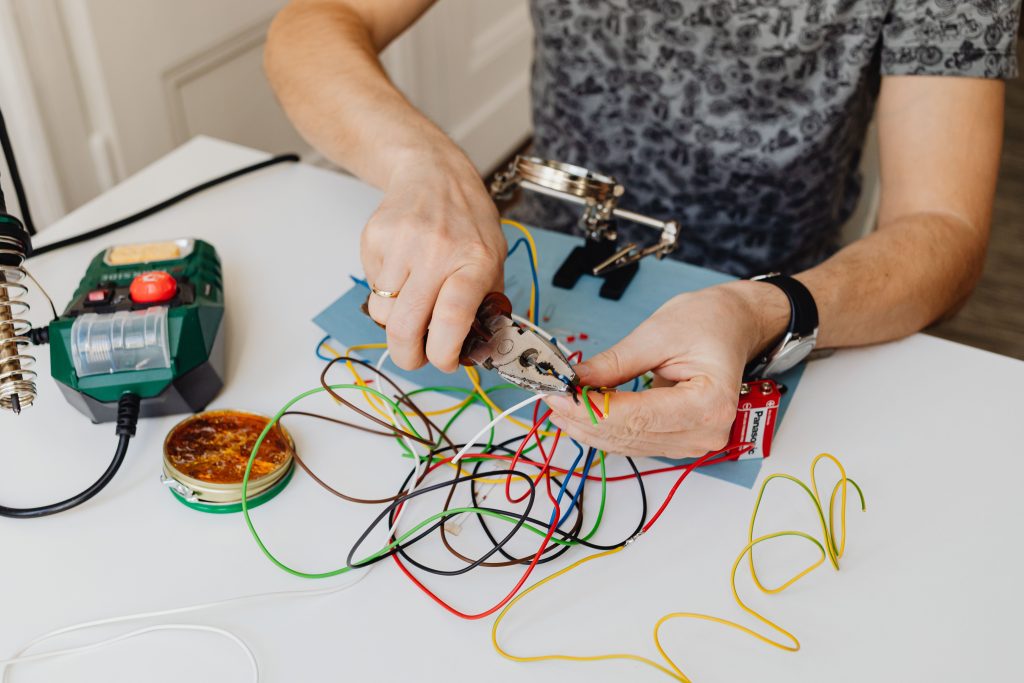
Use battery-powered circuits intended for educational projects, and never connect a homemade craft circuit to a wall outlet. Adults should supervise wire cutting, stripping, and small batteries.
Coin and button batteries need special care because swallowing one can cause severe internal injury. The U.S. Consumer Product Safety Commission advises keeping them away from young children. Use secure holders, account for every battery after the activity, and store spares out of reach.
How to Explain a Simple Circuit Before You Build
A circuit needs a power source, a conducting path, and a component that uses electrical energy. A train-track analogy works well: if the track has a gap, the train cannot complete the loop.
Disconnect one wire, then reconnect it so children can see the difference. With LEDs, explain polarity too. If the LED is backward, it usually will not light.
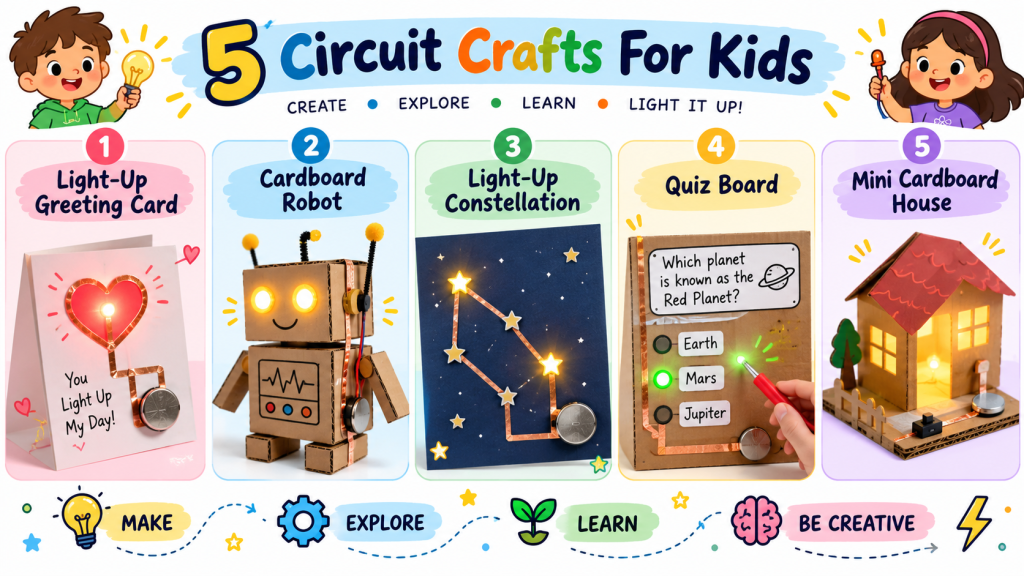
Circuit Craft #1: Make a Light-Up Greeting Card
Fold cardstock into a card and choose one spot for an LED. Route two copper wires from the battery area to the LED, keeping the conductors separate. Secure the LED leads, then connect the battery.
This is one of the easiest Circuit Crafts For Kids to personalize. Children can draw a birthday candle, rocket window, firefly, or star around the light. The result makes a closed circuit meaningful because the artwork only lights when the electrical path is complete.
Circuit Craft #2: Build a Cardboard Robot With Glowing Eyes
Cut a robot from cardboard and poke two holes for LEDs. Run copper wires along the back to a battery holder, taping them flat so exposed sections do not cross.
Among Circuit Crafts For Kids, the robot is especially easy to adapt. Younger children can focus on LED orientation and a simple circuit. Older children can compare series and parallel arrangements. Decorating the robot after the lights work keeps the engineering connected to the creative goal.

Circuit Craft #3: Create a Light-Up Constellation
Draw a constellation on dark cardstock or thin cardboard and choose one or two stars to illuminate. Poke holes for LEDs and hide the copper-wire path on the back. Place the battery holder behind a flap or small cardboard pocket.
This version of Circuit Crafts For Kids blends astronomy with conductivity, polarity, and circuit continuity. Keep the wiring simple enough to follow at a glance.
Circuit Craft #4: Make a Question-and-Answer Quiz Board
Write questions in one column and matching answers in another. Behind the board, connect each correct pair with separate copper wires. A test lead with a battery and LED can touch one question and one answer; the LED lights when the correct pair closes the circuit.
For classroom Circuit Crafts For Kids, the hidden wiring turns the project into a puzzle and rewards careful route planning, labeling, and testing.
Circuit Craft #5: Add a Working Light to a Mini Cardboard House
Build a small room from a cereal box, cardstock, or corrugated cardboard. Mount an LED in the ceiling and run copper wires to a battery holder. Add a simple switch by leaving a controlled gap that a metal contact can bridge.
The house makes the circuit easy to relate to: a light with an on/off control. Once it works, children can redesign the switch or add another room.
Troubleshooting When the Circuit Does Not Work
Check the battery orientation, LED direction, and whether stripped wire ends touch the metal terminals. Then look for loose joints, broken wire, or exposed conductors touching where they should not.
Troubleshooting is part of Circuit Crafts For Kids, not a sign that the activity failed. Change one thing at a time instead of guessing. Follow manufacturer instructions for any component with specific voltage or resistor requirements.
Recommended Products for Circuit Crafts For Kids
These options suit different ages and ways of learning, from guided circuit building to creative computing.
SNAP CIRCUITS Jr. SC-100 STEM Electronics Kit, 100+ Projects, Ages 8+
Best for: First-time electronics learners who want many guided builds
This kit uses color-coded snap-together components and offers more than 100 projects without soldering. Its structured format suits learners who like clear instructions before inventing their own builds. It is less craft-focused than loose copper-wire projects, but it can build familiarity with circuit components before children move to individual wires and LEDs.
Playz Circuit Board for Kids, Educational Science Kits for Kids Age 8-12
Best for: Children who enjoy step-by-step experiments
The Playz kit includes more than 25 experiments involving lights, sound, magnetism, and radio concepts, supported by an illustrated guide. That range suits children who want structured variety. Because it is a dedicated experiment kit, families focused mainly on open-ended craft projects may prefer a smaller set of loose electrical components.
Makey Makey STEM Kit from Joylabz, Educational Science Kits, 1000s of Engineering and Computer Coding Activities, Hands-on Technology Learning Fun, Engineering Kits for Kids, STEM Kits
Best for: Creative computing and interactive-object projects
Makey Makey lets conductive objects act as keyboard or mouse inputs. The kit includes the board, USB cable, alligator clips, connector wires, and a visual guide. It goes beyond basic LED circuits, making it a better fit for children ready to combine physical making with coding, sound, games, or interactive digital projects.
SNAP CIRCUITS Beginner SCB-20 STEM Electronics Toy for Kids Ages 5-9
Best for: Younger children who need a simpler starting point
Designed for ages 5–9, this beginner kit uses snap-together parts and illustrated project guidance. The format reduces the fiddly work loose wires can create for small hands while introducing basic circuit ideas. It is useful as a first step, although an adult should still supervise and connect the snap-based models to real-world wires and components.
National Geographic Circuit Kit for Kids with 60 Projects for Ages 8-12
Best for: Visual learners who enjoy varied project outcomes
This kit offers more than 60 circuit projects with effects such as lights, a fiber-optic display, and a levitating ball. Video instructions provide another way to follow the builds. Its variety can help sustain interest, although it is more structured than building freely with cardboard, copper wire, batteries, and individual components.
| Product | Best for | Learning style |
| SNAP CIRCUITS Jr. SC-100 | Guided beginners | Step-by-step building |
| Playz Circuit Board | Experiment fans | Structured investigation |
| Makey Makey | Creative computing | Interactive making |
| SNAP CIRCUITS Beginner SCB-20 | Younger learners | Simplified building |
| National Geographic Circuit Kit | Visual learners | Varied projects |
What Research Says About Hands-On Circuit Learning
Evidence specific to Circuit Crafts For Kids is still developing. A 2026 study in The Journal of Educational Research involved 137 children ages 3–6 and 11 educators in Greece. Children who enriched drawings with paper circuits showed stronger results on the study’s targeted STEAM measures than children making conventional drawings. Because the research was quasi-experimental and context-specific, it does not prove that one craft improves every STEM skill.
A 2023 Journal of Science Education and Technology study with learners ages 15–16 found that paper circuits better supported some ideas about circuit layout and design than breadboards. The study was exploratory and involved older students, so the findings should be applied cautiously to younger children.
The National Academies’ 2023 PK–5 science and engineering guidance emphasizes opportunities for children to investigate, design, decide next steps, and refine their thinking. That supports a practical approach: demonstrate enough to keep the activity safe, then let children make choices and troubleshoot.
Safety remains separate from learning benefits. The U.S. Consumer Product Safety Commission’s button- and coin-battery guidance warns that swallowed button or coin batteries can cause immediate, severe injury, which is why secure battery storage and adult supervision matter during craft activities.
Ways to Extend the Activity for Different Ages
For younger children, use one LED, one battery holder, and short pre-stripped wires. Let them focus on making and breaking the circuit while an adult handles preparation.
These Circuit Crafts For Kids can scale with age. Older children can add switches, multiple LEDs, buzzers, or another circuit branch. They can sketch a wiring plan, predict results, and explain why a failed circuit did not work.
FAQs About Circuit Crafts For Kids
What age is appropriate for Circuit Crafts For Kids?
Simple supervised circuit crafts can suit elementary-age children when the components match their developmental level. Younger children need close adult help with small parts, wire preparation, and batteries. Older children can handle more planning and troubleshooting. Always follow the age guidance and safety instructions supplied with each kit or component.
Can kids use bare copper wire for circuit crafts?
Bare wire conducts electricity, but insulated wire is usually easier to control because exposed sections cannot accidentally touch along the whole length. Strip only the small portion needed at each connection. That keeps the circuit neater and reduces accidental short circuits. Adults should handle stripping for children who are not ready to use the tool safely.
Do LEDs always need a resistor?
Not always. It depends on the power source, LED specifications, and the rest of the circuit. Many loose LEDs require current limiting when the source can supply too much current. Follow the LED or kit manufacturer’s instructions rather than guessing. If a project specifies a resistor, do not omit it simply to shorten the build.
Why does my LED work only when I flip it around?
An LED is a diode, so current is intended to flow through it in one direction. Polarity therefore matters. If the battery and LED are connected in reverse, the LED usually stays off. Flipping it around is a useful first test before you start taking the entire project apart.
What is the easiest circuit craft for a beginner?
A single-LED light-up card is usually the simplest starting point because the path is short and easy to see. It also leaves room for drawing and decorating, so the activity still feels like a craft. Once that works, a cardboard robot or miniature house is a natural next step.
Final Thoughts on Circuit Crafts For Kids
The best Circuit Crafts For Kids keep the electrical idea visible, the wiring manageable, and the creative goal interesting enough that children want to solve problems. A light-up card is the easiest place to begin, while the robot, constellation, quiz board, and cardboard house apply the same closed-circuit idea in different ways.
For children who prefer guided builds, SNAP CIRCUITS Jr. SC-100 offers a structured introduction. Younger learners may find SNAP CIRCUITS Beginner SCB-20 easier to approach. When building from loose parts, use low-voltage battery power, supervise small components carefully, and keep the first circuit simple. Start with one successful light, then add complexity as the child’s confidence grows.