
5 Fun Magnet STEM Activities For Kids That Teach About Force & Motion

We may earn a commission for purchases made using our links. Please see our disclosure to learn more.
Magnets make invisible forces easy to notice. A paper clip moves without being touched, two magnets push apart, and a toy car follows a magnet held ahead of it. Magnet STEM Activities For Kids turn simple materials into hands-on lessons about force and motion.
If you are teaching at home, planning a classroom activity, or simply trying to answer a child who keeps asking why magnets “stick,” these experiments give you a practical place to start. You do not need complicated equipment or a long science lesson.
This guide covers five activities, ways to adjust them, key safety rules, and magnet tools for different learners. The aim is to help kids predict, test, measure, and explain what they observe instead of simply watching a demonstration.
Why Magnets Make Force and Motion Easy to See
Force can sound abstract until something moves. Magnets make that change visible without direct contact, opening an easy discussion about attraction, repulsion, direction, and distance.
Ask, “What happens if I move the magnet farther away?” That turns watching into investigating.
Stemsparklab’s physics for kids through play guide connects magnets with ramps, friction, gravity, and other everyday physics ideas.
What Kids Learn From Magnet STEM Activities For Kids
Good Magnet STEM Activities For Kids go beyond “magnets stick to metal.” Children discover that some materials respond strongly and that distance or orientation changes magnetic interactions.
They also practice predicting, observing, comparing results, and explaining evidence. Younger kids can use push and pull; older learners can add attraction, repulsion, magnetic field, and force.
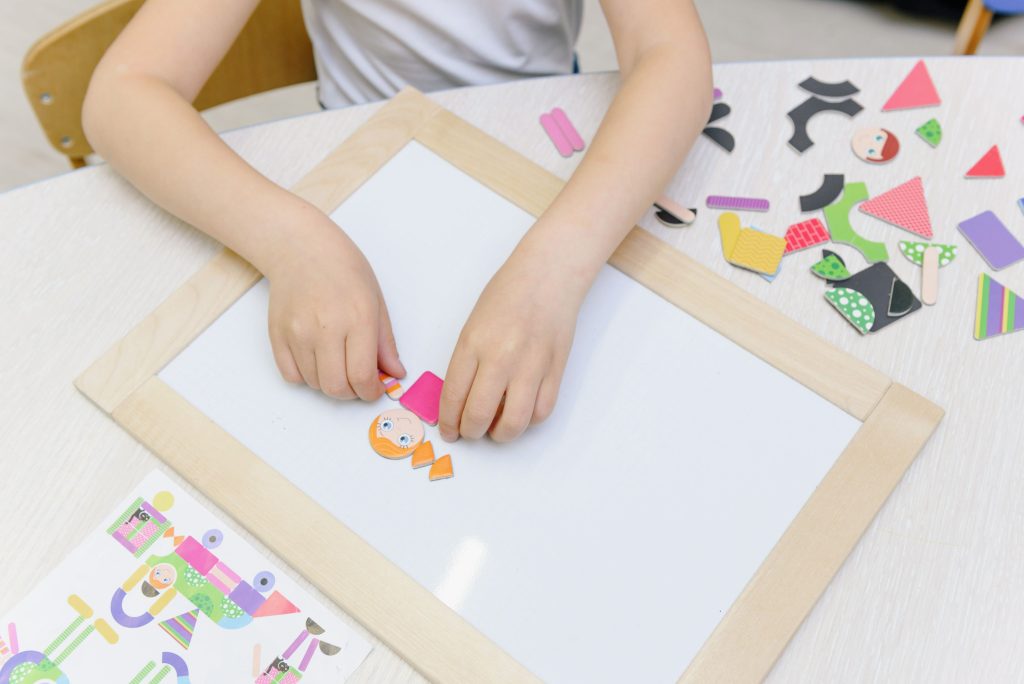
Activity 1: Guide a Paper Clip Through a Magnetic Maze
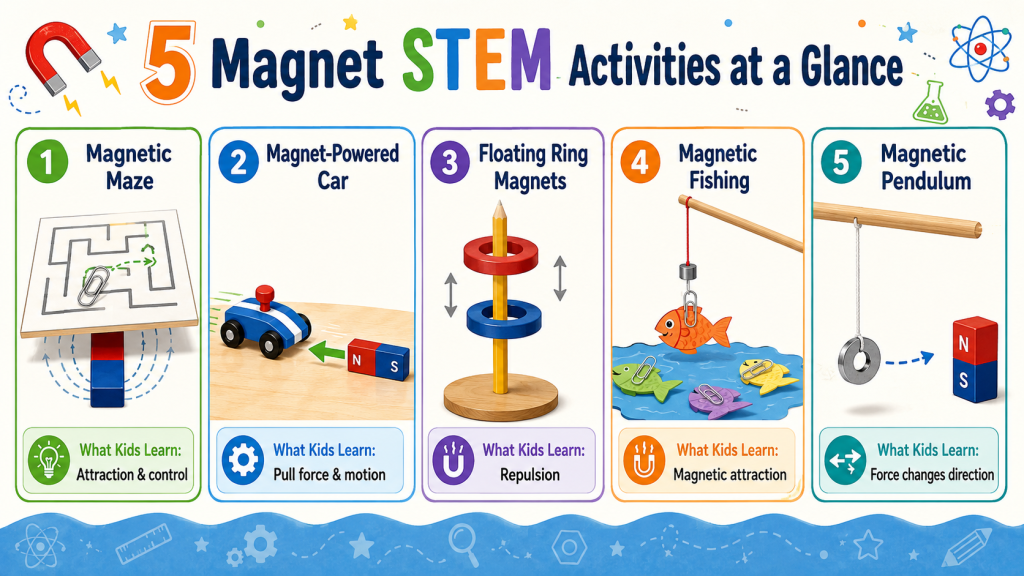
Draw a maze on cardstock. Put a steel paper clip on top, then move an enclosed magnet underneath so the clip travels without being touched.
Next, add another paper layer or narrower turns. Ask whether the magnet works as well through the thicker barrier, then measure the greatest distance at which the clip still moves. This makes the activity useful for exploring distance.
Activity 2: Build a Magnet-Powered Toy Car Challenge
Attach a steel paper clip or washer to a lightweight toy car. Hold a magnet ahead and move it forward so the car follows.
Then test tile, cardboard, and a towel while keeping the car and magnet unchanged. Children can compare how friction changes the motion.
Activity 3: Make Ring Magnets “Float” With Repulsion
Stand a pencil or smooth wooden dowel upright in modeling clay. Slide on a large ring magnet, then add another with like poles facing each other. The upper magnet should be pushed upward and appear to float.
Among Magnet STEM Activities For Kids, this is one of the clearest ways to show repulsion. Measure the gap, flip the upper magnet, and compare what happens. If possible, add another ring magnet. The activity also shows that magnets do not always pull together; orientation matters.
Activity 4: Turn Magnetic Fishing Into an Engineering Test
Cut fish shapes from cardstock and attach a steel paper clip to each. Make a fishing rod from a craft stick, string, and an enclosed magnetic wand.
Then change the design: add a second paper clip, lengthen the string, or cover the fish with paper. Ask which setup is easiest to lift and why. For older learners, that simple game becomes an engineering investigation involving distance, load, and magnetic attraction.
Activity 5: Make a Magnetic Pendulum Change Direction
Tie a large steel washer securely to string and suspend it so it swings freely. Start it moving gently, then bring a magnet near one side of its path without letting the magnet touch the washer.
Move the magnet and repeat. Older children can mark magnet positions underneath. The key idea: force can change an object’s direction, not only start or stop motion.

Turn Each Activity Into a Real STEM Investigation
An investigation asks, “What changes if we alter one thing?” Choose one variable—distance, orientation, paper thickness, surface, or number of paper clips—and keep the rest as consistent as possible.
Use three prompts: “I predict…,” “I observed…,” and “I think this happened because….” Younger children can draw. If results surprise them, ask what they could test next.
How to Adjust Magnet Activities by Age
For younger kids, keep activities short, visual, and closely supervised. Wands, sorting games, mazes, and fishing are easier to manage than projects with many loose components.
Middle elementary learners can measure distance and repeat trials. Older children can design a magnetic vehicle course or explain a failed design.
Safety Rules for Magnet Play
When setting up Magnet STEM Activities For Kids, active adult supervision matters. The U.S. Consumer Product Safety Commission warns that swallowed high-powered magnets can attract through internal tissue and cause severe injuries. CPSC was still issuing magnet-ingestion product warnings in 2026, including an August 27, 2026 warning involving magnetic building blocks. See the 2026 CPSC magnet warning
Follow the manufacturer’s age range, inspect toys for cracks or missing magnets, and keep loose small magnets away from young children. Stop using a toy if a magnet becomes exposed or goes missing.
If you suspect a magnet was swallowed or inhaled, CPSC magnet safety guidance advises seeking immediate medical attention.
Research-Backed Reasons These Activities Support Science Learning
The Next Generation Science Standards 3-PS2-3 guidance asks third-grade students to investigate cause-and-effect relationships involving magnetic interactions. Its guidance explains that magnetic forces can act without contact and that their effects depend on the objects, their distance apart, and magnet orientation.
Broader inquiry research supports the predict-test-explain approach. A 2010 inquiry-based science research synthesis by Minner, Levy, and Century analyzed 138 studies from 1984 to 2002. The researchers reported a positive overall trend for inquiry-based science instruction, especially when students actively reasoned from evidence and drew conclusions from data (Journal of Research in Science Teaching, 2010).
Hands-on work is not automatically better learning. What matters is the structure: ask, predict, test, compare evidence, and explain. Magnet STEM Activities For Kids fit that pattern naturally.
Recommended Products for Magnet STEM Activities For Kids
You do not need a commercial kit, but the right tools can make repeat experiments easier. These six options suit different ages, group sizes, and learning styles.
| Product | Best for | Main advantage |
| Learning Resources Magnetic Wands | Younger explorers | Simple wand format |
| Learning Resources Super Magnet Lab Kit | Groups | 119-piece variety |
| 4M Magnet Science Kit | Guided projects | 10 experiments and games |
| 4M Anti Gravity Kit | Levitation fans | Focused motion projects |
| MAGNA-TILES Classic 32-Piece Set | Builders | Open-ended construction |
| Thames & Kosmos Magnetic Science | Older learners | 33 experiments |
Learning Resources Magnetic Wands | Educational Kits, Science Experiment Tools, Preschool Toys, Homeschool Supplies, 6 Pieces, Ages 3+
Best for: Younger children and simple magnet hunts
This set has six colorful magnetic wands with magnets enclosed in plastic and is listed for ages 3+. The wand shape suits sorting, paper-clip mazes, and beginner attraction tests. Six pieces make sharing easy for siblings or small groups. Its main limitation is simplicity: you will need to supply your own experiment prompts and extra objects.
Learning Resources Super Magnet Lab Kit – 119 Pieces, Ages 5+, STEM, Toys for Kindergartner, Science Learning Activities for Kids, Back to School Supplies, Teacher Supplies
Best for: Homeschool groups and classroom stations
This 119-piece set includes chips, seven wands, magnetic marbles, bar magnets, ring magnets, horseshoe magnets, storage, and an activity guide. The variety supports side-by-side comparisons and group work. It is listed for ages 5+, but the many small components mean adults should keep the set organized and supervise closely.\
4M Magnet Science Kit – 10 Magnetic Experiments & Games (over 25 pieces to Build & STEM Learn From) – Power the Racer with a Magnet, Levitate a Magnet, Magnetic Yacht & Fishing, Boys & Girls, Age 8+
Best for: Families wanting guided projects
This age-8+ kit centers on 10 experiments and games, including a magnetic racer, fishing activity, compass-style project, and levitation concepts. It suits children who prefer instructions and a clear goal rather than loose materials. Because several projects require assembly, younger learners may need more adult help than they would with a simple wand.
4M Kidzlabs Anti Gravity Magnetic Levitation Science Kit – Maglev Physics Stem Toys Educational Gift for Kids & Teens, Girls & Boys (3686)
Best for: Older kids fascinated by levitation
Designed for ages 8+, this kit explores magnetic force through projects such as floating a pencil, levitating a screw, and building a maglev-style model. Its focused theme works well for kids already curious about repulsion and motion. However, it offers less variety than a general magnet lab if you want many different experiment types.
MAGNA-TILES Classic 32-Piece Magnetic Construction Set, The Original Magnetic Building Brand
Best for: Open-ended builders
This 32-piece set contains magnetic squares and triangles for open-ended construction and is recommended by the manufacturer for ages 3+. Children can build structures while noticing which edges connect and how designs respond to pushes and pulls. Because it is primarily a construction toy, adults should add prediction and comparison questions when the goal is explicit magnet science.
Thames & Kosmos Magnetic Science | 33 STEM Experiments | Ages 8+ | Learn About Earth’s Magnetic Poles | Discover How Invisible Magnetic Fields Work | Full-Color 48-Page Manual
Best for: Older children who want deeper science
This age-8+ set offers 33 experiments involving magnet shapes, magnetic fields, Earth’s magnetic poles, and an electromagnet. It suits children who enjoy structured work across several sessions. The trade-off is complexity: younger learners may find a simple wand or basic activity kit easier to begin with.
How to Choose the Right Magnet Kit or Tool
Start with age, supervision, and learning style. Free explorers may prefer wands or building tiles; children who want instructions may prefer a guided kit.
Groups benefit from multiple tools and storage. At home, prioritize tools that support several Magnet STEM Activities For Kids.
Frequently Asked Questions About Magnet STEM Activities For Kids
What age can kids start learning about magnets?
Preschoolers can explore magnets with age-appropriate materials and adult supervision. Test what a wand attracts, move a paper clip through a maze, or sort objects. Follow product age guidance and avoid loose, small, high-powered magnets around young children.
What household items work well for magnet experiments?
Steel paper clips, washers, cardstock, cardboard, string, toy cars, and rulers work well. Test items first because not every metal responds strongly. Avoid sharp pieces, damaged magnetic toys, electronics, magnetic-stripe cards, and anything that a strong magnetic field could damage.
How do magnets teach force and motion?
Magnets let children observe a push or pull without direct contact. An object may start moving, change direction, or resist another magnet. By changing the distance between objects or flipping a magnet around, children can compare attraction and repulsion and connect those changes with motion.
Do I need to buy a kit for Magnet STEM Activities For Kids?
No. An enclosed magnet, paper clips, cardboard, string, and a few household objects are enough for several Magnet STEM Activities For Kids. Kits help when you want different magnet shapes, materials for a group, guided instructions, or specialized projects such as magnetic levitation.
How can I make a magnet activity educational without making it feel like homework?
Ask one question before the activity and one afterward. “What do you think will happen?” invites prediction; “What changed?” encourages explanation. Add a quick drawing or measurement when useful. A worksheet is not necessary every time; conversation and repeated testing can carry the learning.
Final Recommendation: Keep Magnet STEM Activities For Kids Simple and Curious
The best Magnet STEM Activities For Kids are not necessarily the ones with the most equipment. They are the ones that make children predict, test, and wonder why the result changed. Start with a paper-clip maze or magnetic fishing for low-prep learning. Add the car or ring-magnet challenge when your child is ready to compare distance, direction, and motion.
For guided projects, the 4M Magnet Science Kit is an approachable age-8+ option, while Thames & Kosmos Magnetic Science offers more depth for children who want a longer sequence of investigations. Whatever you use, choose age-appropriate materials, supervise magnet play closely, and keep the focus on questions children can actually test.