
How to Choose a STEM Activity That Kids Will Actually Learn From
We may earn a commission for purchases made using our links. Please see our disclosure to learn more.
Finding a STEM activity is easy; finding one that suits your child, your space, and your available time is harder. A project can look impressive yet become frustrating when the instructions are too advanced, the materials are fussy, or an adult ends up doing most of the work. The best choices invite questions and leave room for children to test their own ideas.
This guide explains how to choose, adapt, and guide hands-on STEM learning at home or in a classroom. You will learn what makes an activity educational, when a kit is worth buying, which products fit different learners, and what research says about play, engineering practices, and early STEM education.
What Makes a STEM Activity Worth Doing?
A worthwhile STEM activity combines making with thinking. A child who builds a paper bridge, tests its strength, and changes the design is observing, measuring, comparing, and solving a problem—not simply crafting.
The result matters less than the reasoning. Look for opportunities to predict, change one factor, notice evidence, or improve a design. The challenge should feel reachable while still leaving something for the learner to figure out.
Start With the Child, Not the Subject
Instead of beginning with robotics or chemistry, begin with an existing interest. An animal lover might design a waterproof toy shelter. A sports fan could measure bounce height.
This approach lowers resistance and reveals STEM in familiar places. Cooking involves measurement and chemistry; gardening introduces biology and systems. Notice what the learner already asks about, then choose a STEM activity that gives that curiosity somewhere practical to go.
Match the STEM Activity to Age and Attention Span
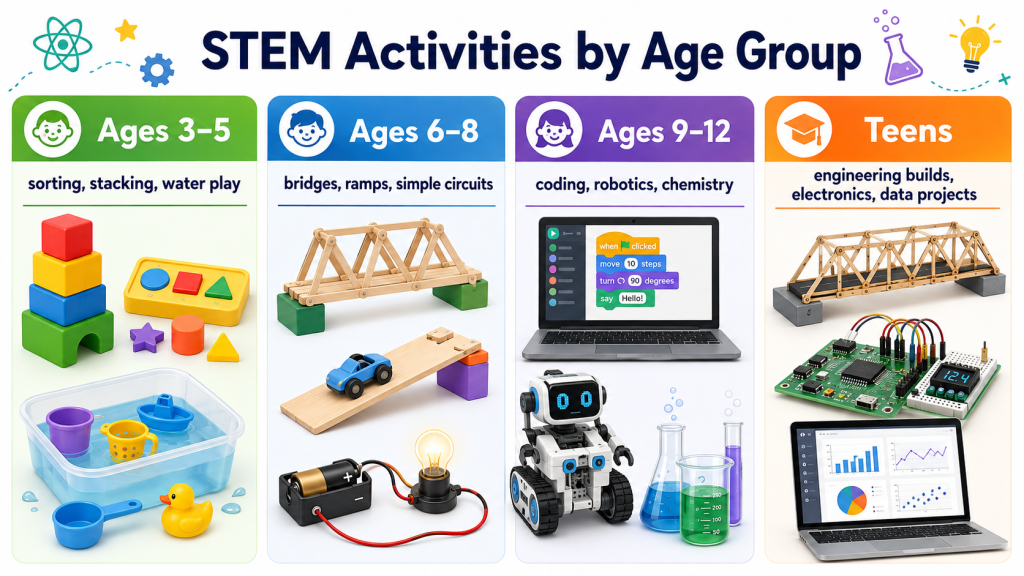
Age labels help, but reading ability, dexterity, confidence, and experience matter too. Preschoolers usually benefit from short explorations with large materials and visible changes. Elementary learners can add measurements and repeated trials, while older children may enjoy constraints, data tables, and multi-session builds.
Consider timing as carefully as difficulty. An overnight result may delight a patient observer but disappoint someone who needs immediate feedback.
Choose a Clear Question or Challenge
A strong activity can be expressed in one sentence: Which bridge holds the most coins? How can we slow a marble on a ramp? A clear question gives children a reason to make decisions instead of merely following steps.
Ask for a prediction before testing, then invite more than one possible solution. Even a small choice—shape, material, height, or number of supports—creates ownership and turns a demonstration into a genuine STEM activity.
Use the Engineering Design Cycle
The engineering process is a loop: ask, imagine, plan, build, test, and improve. Children do not need to memorize the vocabulary; they need permission to revise.
After the first test, ask what worked, what failed, and what should change. A collapsed tower supplies information about balance and structure. Treating failure as evidence helps children see that the design needs work—not that they are “bad” at STEM.
Build STEM Learning With Everyday Materials
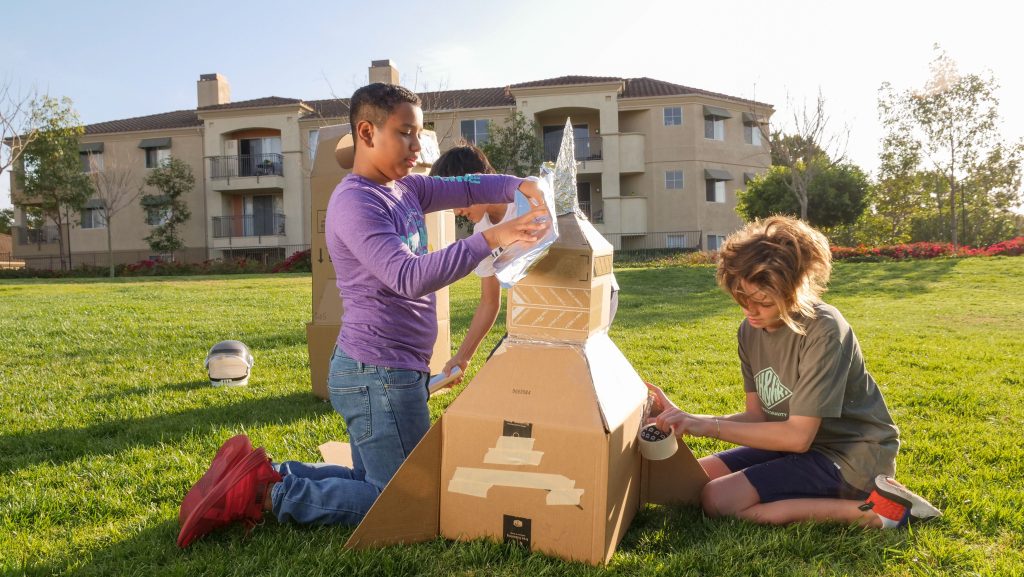
Cardboard, paper, cups, foil, string, tape, craft sticks, and recycled containers can support rich investigations. Because these materials are inexpensive, children can rebuild freely instead of protecting one precious model.
Keep a small bin with a ruler, child-safe scissors, tape, markers, measuring cups, and a notebook. Supervise any STEM activity involving batteries, heat, sharp tools, small parts, or substances that should not be tasted.
When a STEM Kit Is Worth Buying
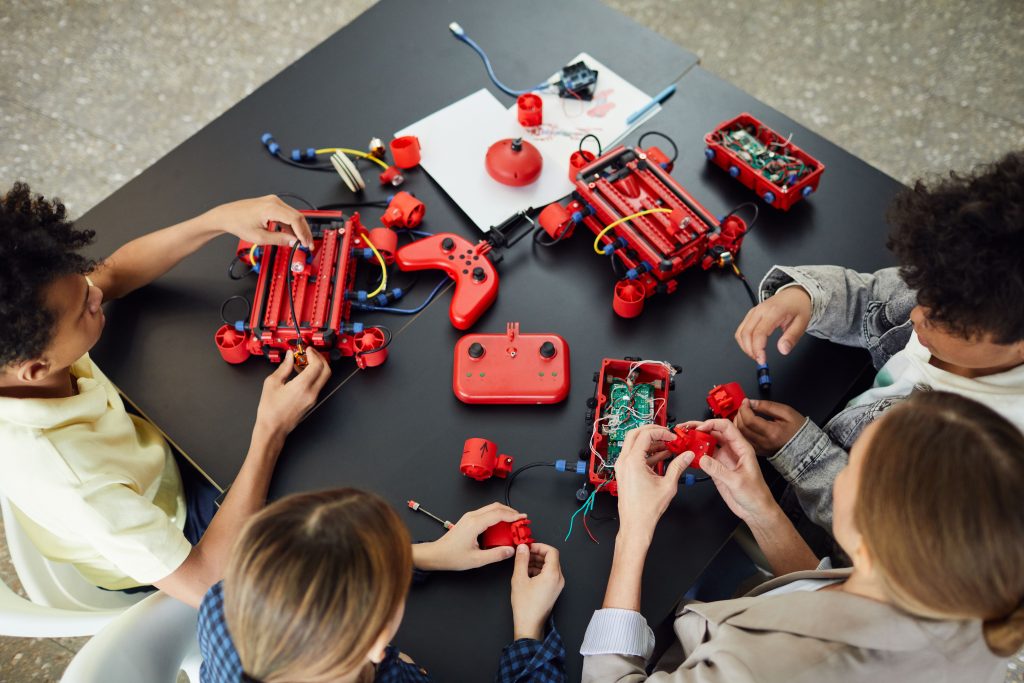
A kit earns its place when it supplies hard-to-source parts, organizes a technical topic, or supports repeated use. Electronics, coding robots, mechanical models, and packaged science materials can shorten setup and help beginners start confidently.
Check whether the kit teaches a transferable idea or only produces one object. Also note hidden needs such as batteries, devices, household ingredients, replacement consumables, storage space, and adult help.
Recommended Products for a STEM Activity at Home
These options cover electronics, coding, chemistry, logic, mechanics, and space science. Each suits a different learner, so compare age, interests, space, and desired adult involvement before choosing a STEM activity kit.
| Product | Best fit | Key consideration |
| Snap Circuits Jr. SC-100 | Beginner electronics | Batteries sold separately |
| Mega Science Lab | Broad science variety | Consumables need replacing |
| Botley 2.0 | Screen-free early coding | Initial adult setup |
| Kids First Coding & Robotics | Shared story-based learning | Many pieces |
| Gravity Maze | Compact logic practice | Puzzle-led format |
| LEGO Technic Earth and Moon | Older space enthusiasts | Guided display model |
Snap Circuits Jr. SC-100 Electronics Exploration Kit, Over 100 Projects, Full Color Project Manual, 28 Parts, STEM Educational Toy for Kids 8+
Best for: Beginner electronics without soldering
Color-coded, snap-together components let children assemble circuits from a manual without loose wires or solder. The set includes 28 parts and supports more than 100 guided projects, giving beginners quick visual feedback. Its structure is approachable, although two AA batteries are separate and exploration stays within the available components.
National Geographic Mega Science Lab with 75 Experiments for Kids 8-12
Best for: Families wanting broad science variety
This collection spans Earth science, chemistry, and science-magic activities, with 45 experiments using included materials and 30 more using household supplies. It suits siblings or children who enjoy changing topics. Many activities consume materials, however, and an adult should review preparation and supervision needs before each session.
Learning Resources Botley 2.0 The Coding Robot Activity Set | STEM Toy, Robots for Kids, Early Programming Robot Kit, Screen Free Coding for Kids 5-7, Elementary and Homeschool Essentials
Best for: Young children learning screen-free coding
Botley 2.0 uses a handheld programmer, coding cards, obstacles, and floor pieces to introduce sequences and navigation without an app. The 78-piece set makes commands physically visible, which suits early elementary learners. It requires five AAA batteries, and younger users may need help organizing their first challenges.
Kids First Coding & Robotics | No App Needed | Grades K-2 | Intro To Sequences, Loops, Functions, Conditions, Events, Algorithms, Variables | Parents’ Choice Gold Award Winner | by Thames & Kosmos
Best for: Story-driven, parent-guided coding
This set teaches coding through model building, code cards, and six story-based adventures rather than software. Its 30 lessons connect sequences, loops, conditions, and related ideas to physical actions. The large piece count and guided format make it better for shared sessions than quick, independent play.
ThinkFun Gravity Maze – Falling Marble Logic Game – Challenging STEM Toy for Kids 8-12 – Gravity Marble Maze – Brain-Building Fun – Educational Gift – Boosts Critical Thinking & Problem Solving
Best for: Compact, reusable logic practice
Gravity Maze asks players to arrange towers so a marble reaches its target, combining spatial reasoning with cause and effect. It is compact, repeatable, and easier to store than a large construction set. Because its challenges have intended solutions, it offers less open-ended investigation than loose building materials.
LEGO Technic Planet Earth and Moon in Orbit Building Set, Outer Space Birthday Gift for 10 Year Olds, Solar System Toy for Imaginative, Independent Play, Room Décor for Boys & Girls, 42179
Best for: Older builders interested in space and mechanics
A hand crank moves the Earth and Moon around the Sun, while printed details indicate months and lunar phases. The model connects careful construction with visible mechanics and astronomy discussion. It rewards patient builders, although it is mainly a guided build and needs display or storage space afterward.
How to Guide Without Taking Over
Manage safety, provide materials, and ask questions instead of fixing the design. Try: “What do you notice?” “Which part could change?” or “How could we test that?”
Give help in layers: restate the goal, point to evidence, offer a small hint, and demonstrate only when a tool requires it. A quiet pause can be useful; solving every problem immediately removes the child’s chance to discover the loose connection or unstable support.
Make the Learning Visible With Simple Reflection
Reflection can be a photo, sketch, measurement table, or short voice note. Ask the learner to finish: “I thought ___, but I noticed ___.”
For a structured investigation, record the question, prediction, variable, result, and next step. Once a child can state a question and prediction, these scientific method experiments for kids can help turn curiosity into a repeatable testing routine.
Research-Backed Benefits and Important Limits
The Next Generation Science Standards’ science and engineering practices emphasize asking questions, planning investigations, analyzing evidence, designing solutions, and communicating information. That supports a STEM activity in which children make decisions and revise ideas rather than only follow directions.
The American Academy of Pediatrics’ 2018 clinical report on play, reaffirmed in 2025, describes play as important for healthy development and highlights adult-child interaction. Playful projects can encourage conversation, persistence, and collaboration, but one activity cannot guarantee broad academic gains.
Evidence for integrated early STEM is promising but still limited. A 2021 review of early-childhood STEM education identified 11 empirical studies. A 2023 preschool STEM review included 19 studies and called for more research on outcomes and inclusive participation. Choose rich experiences, but treat dramatic product promises cautiously.
Common STEM Activity Mistakes to Avoid
Do not make the finished result more important than the process. Chasing a picture-perfect robot or bridge often causes adults to take over.
Avoid explaining everything before the child observes anything. Also, when comparison matters, change one variable at a time. Keeping the paper and launch point consistent while altering one airplane feature makes the test more informative, even if it is not a formal experiment.
Adapt Activities for Different Learners and Spaces
Adjust the format without removing the central challenge. Use photos or oral explanations instead of writing, offer pre-cut materials, enlarge small diagrams, or add a partner when fine-motor demands block the science.
In small homes, choose tray-based experiments, tabletop puzzles, paper circuits, or models that pack into one box. For groups, rotate builder, tester, recorder, and materials roles so every child contributes.
Frequently Asked Questions About a STEM Activity
What Is an Easy STEM Activity for Beginners?
Try a paper bridge challenge. Give the child paper, tape, two supports, and coins. Ask them to build a bridge, predict how many coins it will hold, test it, and improve the design. It uses inexpensive materials, gives immediate feedback, and can be simplified or extended for different ages.
How Much Time Should a STEM Project Take?
For young children, 10 to 30 minutes of active exploration may be enough, while older learners may enjoy a 45-minute session or multi-day build. Engagement matters more than the clock. Break longer projects into planning, building, and testing sessions, and stop before productive struggle becomes fatigue.
Do STEM Activities Need All Four Subjects?
No. One project does not need equal amounts of science, technology, engineering, and mathematics. A bridge challenge may emphasize engineering and measurement, while a dissolving test emphasizes science. What matters is that the learner asks questions, uses evidence, solves a problem, or applies ideas across several steps.
Are STEM Kits Better Than Household Materials?
Neither is automatically better. Household materials encourage creativity, repeated trials, and low-cost experimentation. Kits make electronics, robotics, or specialized models easier to access. Choose a kit when its parts or structure add genuine value; otherwise, cardboard, tape, cups, or paper may support deeper decision-making.
How Can I Tell Whether My Child Learned Anything?
Listen for changes in explanation. Can the child describe what happened, connect a change to a result, or suggest a better next design? Photos, sketches, measurements, and brief before-and-after predictions also reveal learning. A successful result is pleasant, but improved reasoning after an imperfect result is often more informative.
Final Recommendation: Choose Curiosity Over Complexity
The best STEM activity is not necessarily the largest kit or most dramatic experiment. Choose a challenge that matches the learner’s interests, offers an achievable next step, and leaves room to predict, test, and improve. Everyday materials are often enough; a kit earns its place when it provides hard-to-find parts or makes a technical topic approachable.
For young screen-free coders, Botley 2.0 offers visible cause and effect. For older children curious about circuits, Snap Circuits Jr. SC-100 provides structured entry points. Whatever you choose, ask questions instead of supplying answers. Start small, watch what holds the child’s attention, and let the next STEM activity grow from the questions that remain.