How to Build a DIY Weather Balloon for Kids

We may earn a commission for purchases made using our links. Please see our disclosure to learn more.
A Weather Balloon project can turn an ordinary afternoon into a lesson about air pressure, temperature, wind, engineering, and data. The challenge is choosing a version that suits your child’s age and your access to safe launch space. A small tethered demonstration works for many homes or classrooms, while a free-flying high-altitude mission requires adult leadership, legal research, recovery planning, and specialized equipment.
This guide covers project choice, payload building, sensors, lift, testing, and data analysis. It also includes product suggestions and trusted planning videos. The aim is to help kids ask a question, collect evidence, and explain what happened.
What a Weather Balloon Project Teaches Kids
A balloon flight joins several STEM subjects. Children can predict temperature changes, estimate wind drift, compare mass and lift, and graph readings. They also see engineering as iterative: a container may need to be lighter or a camera angle adjusted.
Keep the question narrow. Younger children might track temperature, while older students can compare predicted and actual routes.
Choose Between a Tethered Demo and a Free Flight
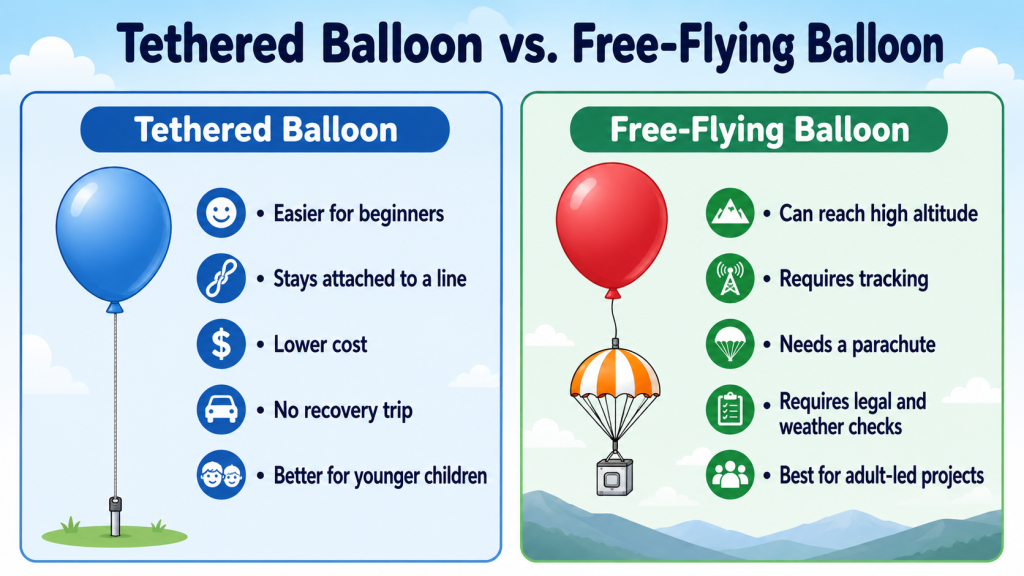
A tethered Weather Balloon stays attached to a strong line at controlled height. It suits families and elementary classrooms because it avoids a distant recovery mission.
A free flight may reach the stratosphere and travel far. It needs a parachute, tracker, route prediction, suitable weather, and legal checks. Adults manage it while children help design, observe, and analyze.
Safety and Legal Checks Before You Build
Never launch near airports, power lines, highways, crowds, storms, or restricted airspace. In the United States, unmanned free balloons fall under 14 CFR Part 101; requirements depend on the flight and payload.
Use helium, not flammable hydrogen. An adult must transport, secure, and operate the cylinder. Compressed gas creates pressure and oxygen-displacement hazards, so work with excellent ventilation, keep the cylinder upright and restrained, and stop if conditions become unsafe.
Materials and Tools You Will Need
Gather a meteorological balloon, helium, lightweight payload box, cord, swivels, tape, cable ties, labels, gloves, and a digital scale. A free flight also needs a suitable parachute and reliable tracking.
Choose only sensors that answer the question. Temperature, pressure, humidity, position, and a camera are useful, but each adds mass. Younger children can first practice observations with a simple weather station project.
Plan and Build the Payload Box
Use a compact foam container to cushion electronics. Weigh it empty, then cut only the openings needed for sensors, a camera, antennas, and cord.
Secure every component. Put heavier items low and centered, reinforce attachment points, and label the Weather Balloon payload with contact information plus a note that it is a harmless science project. Avoid sharp edges and loose decorations.
Add Sensors, a Camera, and a Tracker
A data logger gives the project scientific value; a tracker supports recovery. Shield an external temperature sensor from direct sunlight and warm electronics. Secure a camera independently and keep its view clear.
Cellular trackers may report only after returning to coverage. For free flight, investigate radio or satellite tracking and licensing rules. Use fresh batteries, protect connections, and record device IDs before sealing the box.
Rig the Balloon, Parachute, and Flight Line
A typical free-flight order is balloon, line, parachute, more line, then payload. Keep cords separated and use swivels where appropriate to limit twisting. Match the parachute to the finished payload mass and intended descent rate.
Tie dependable knots and pull-test every connection. For a tethered activity, use a rated reel and gloves, and never wrap line around a hand or body part.

Measure Lift and Fill the Balloon
Do not fill by appearance. Calculate the total suspended mass, including payload, parachute, line, tracker, and fasteners. Then determine the free lift needed for the chosen ascent rate using the balloon supplier’s guidance or an established calculator.
While an adult adds helium slowly, measure upward pull with a hanging scale or test weight. Work in a sheltered area, close the neck as directed, and recheck the rig.
Ground-Test and Launch the Project
Rehearse before launch day. Turn on every device, confirm timestamps, test tracking, record a camera clip, and run the system long enough to expose problems. Weigh and photograph the finished Weather Balloon assembly.
On launch day, review weather and the predicted route. Assign adults to the cylinder, balloon, payload, and checklist. Release only when the line is clear and the site is safe; children can call out checks and record launch time.
Recover the Payload and Analyze the Data
Plan recovery before release. Carry charged phones, maps, permission details, water, sturdy shoes, and a backup route. Never enter private property without consent, stop on a dangerous shoulder, or climb trees or utility structures.
After retrieval, copy the files. Let children graph temperature, pressure, altitude, or distance and compare results with predictions. Weather Balloon data gaps may reveal battery, placement, or communication problems.
Research-Backed Weather Balloon Facts
The National Weather Service upper-air program (accessed 2026) says radiosondes usually launch twice daily and measure pressure, temperature, humidity, and GPS-derived wind. Its radiosonde factsheet says a typical sounding lasts over two hours, can exceed 35 kilometers, and may drift over 300 kilometers. A calm-looking free flight therefore needs tracking and recovery planning.
A 2023 peer-reviewed field-education study in Puerto Rico involved 12 undergraduates in preparing, launching, monitoring, and interpreting radiosonde flights. The authors reported engagement and interest in atmospheric-science careers. However, it was not a controlled trial, so it supports authentic participation as a promising teaching method rather than proving one universal outcome.
Recommended Weather Balloon Products
Verify current specifications, payload limits, and local rules before purchase or launch.
| Product | Best use | Main consideration |
| Nballoon 300 g balloon | Adult-led outdoor flight | Single-use latex |
| Meteorological parachute | Controlled descent | Must match payload |
| Elitech RC-5+ logger | Temperature data | Temperature only |
| Tracki Mini GPS Tracker | Cellular recovery aid | Subscription and coverage |
| Etekcity luggage scale | Measuring neck lift | Setup tool, not a sensor |
| Thames & Kosmos weather station | Younger learners | Ground-based kit |
Nballoon Professional Weather Balloon For Meteorological Investigation Aerial Video Holiday Party Decoration Entertainment Toys Huge Balloons (120 inch/300g)
Best for: Adult-led outdoor builds
This 300-gram latex balloon offers a dedicated meteorological option rather than a party balloon. Its larger format suits projects needing lift and a planned burst-and-descent sequence. However, it is single-use, requires controlled helium filling, and belongs only in a researched, adult-managed launch.
Meteorological Parachute For Weather Detection Weather Sounding High Altitude Research Heavy Payload Recycle Heavy Payload Protection Payload 200g-10000g
Best for: Payload descent and recovery
This purpose-made parachute gives builders a more suitable recovery option than an improvised plastic sheet. Choose the canopy according to completed payload mass and intended descent rate. The listing covers several payload ranges, so confirm the exact variation before ordering and test the packed rig on the ground.
Elitech RC-5+Digital PDF USB Temperature Data Logger Reusable Recorder Refrigerator Thermometer 32000 Points High Accuracy
Best for: Simple temperature experiments
The RC-5+ stores up to 32,000 temperature readings and creates reports through its built-in USB connection. Students can produce a clear graph without constructing a custom electronics stack. It does not measure pressure, humidity, or altitude, so combine its data with a separate position or altitude record when required.
Tracki Mini GPS Tracker, Subscription Required, Cancel Anytime – Universal Compact 4G LTE Tracker for Vehicles (Tracker + 6M Subs.)
Best for: Recovery in cellular areas
This compact tracker can send location updates over a cellular network and weighs about 1.26 ounces, making it useful after landing. It needs an active subscription and dependable coverage. Because service may disappear at altitude or in remote terrain, do not use it as the sole locator for a demanding flight.
Etekcity Luggage Scale, Travel Essentials, Digital Suitcase Weight Scales for Travel Accessories, Hanging Baggage Scale with hook, 110 Pounds, Battery Included, Silver
Best for: Measuring balloon neck lift
This handheld hanging scale provides a simple way to check upward pull during filling. Its hook and digital display are easier for a team to read than improvised weights. The capacity greatly exceeds many student payloads, and the device is a setup tool rather than a calibrated atmospheric instrument.
Thames & Kosmos Weather & Climate Lab STEM Experiment Kit, 5-in-1 Meteorology Station w/Wind Vane, Compass, Rain Gauge, Anemometer & Thermometer for Ages 6+, Includes Stake for Outdoor Use
Best for: Younger children and no-launch settings
This ground kit combines a wind vane, compass, rain gauge, anemometer, and thermometer in one outdoor station. It helps children practice repeatable observations when a launch is impractical. It cannot sample the upper atmosphere or record a flight path, so use it for foundational weather study rather than flight data.
Frequently Asked Questions About a Weather Balloon
How high can a homemade Weather Balloon go?
A free-flight balloon may reach the stratosphere, but altitude depends on balloon size, helium volume, payload mass, conditions, and material limits. Do not rely on altitude claims alone. Use lift calculations, a flight predictor, current aviation rules, and suitable recovery equipment.
Can children fill the balloon with helium?
Children can observe measurements and record data, but an informed adult should handle the cylinder, regulator, and filling. Compressed gas can injure people if equipment tips, leaks, or is misused. Secure the cylinder upright, work with excellent ventilation, follow supplier instructions, and never allow anyone to inhale helium.
Do I need permission to launch one?
Rules vary by country, location, payload, airspace, and flight design. In the United States, review 14 CFR Part 101 and contact the appropriate aviation authority when required. Obtain landowner permission for the launch site and recovery access; owning the equipment does not permit entry to private property.
What can I use instead of a GPS tracker?
A low tethered activity may not need tracking because the payload remains attached. Free flights require a dependable recovery plan. Radio beacons, satellite communicators, and cellular trackers differ in coverage, licensing, mass, and subscription needs. More demanding projects commonly use independent backup methods rather than trusting one device.
Which version is the simplest for beginners?
Start with a tethered balloon carrying no payload or a very light thermometer, then measure lift and observe movement at different heights. A ground weather station is another useful first step. Both teach prediction and data recording without the airspace checks, long-distance recovery, and tighter timing of a free flight.
Final Recommendation: Build a Weather Balloon Project That Fits Your Team
The best Weather Balloon project is one your group can run safely, legally, and thoughtfully. Younger children can use the Thames & Kosmos station or a short tethered demonstration. Older students with experienced adult support may progress to a logger, parachute, tracker, and planned free flight.
Choose the research question before buying equipment, keep the payload light, and include tracking and recovery in the original design. Most importantly, do not let launch-day excitement rush the checklist. Begin with a ground test, verify every connection, and cancel when conditions are uncertain. A modest project with clean data and a safe recovery teaches far more than an ambitious flight that was not fully prepared.