
The Best Winter STEM Activities For Kids
We may earn a commission for purchases made using our links. Please see our disclosure to learn more.
Winter can be a lot with kids.
You’ve got cabin fever, messy energy, and that familiar “I’m boooored” soundtrack on repeat—right when you’d love something that feels fun and secretly builds real skills.
That’s where Winter STEM Activities For Kids come in. Think of them like little “curiosity heaters” for your home: simple projects that keep hands busy, brains engaged, and moods surprisingly calmer.
In this guide, you’ll get doable winter science experiments, engineering challenges, and tech-free coding ideas—plus a short Amazon tools section and a research-backed credibility boost.
Affiliate note: This article includes Amazon affiliate links; if you purchase through them, I may earn a small commission at no extra cost to you.
The “Cozy Lab” Setup: Make Winter STEM Happen
Before we jump into experiments, let’s make it easy for Future You.
A simple winter STEM bin (15 minutes, tops)
Toss these into a shoebox or small tote:
- plastic cups + spoons
- tape, rubber bands, paper clips
- cotton balls, foil, cardboard scraps
- food coloring (optional), salt, baking soda
- a cheap ruler + a marker
The magic rule: one question per activity
Instead of “Let’s do science,” try:
- “What do you think will happen if…?”
- “How could we make this stronger?”
- “What would you change next time?”
That one question turns play into real STEM learning without you doing a TED Talk.
Snow Science Without Frostbite: Fake Snow + Snowstorm Jars
No snow where you live? No problem. Winter-themed STEM still works in tropical weather (hello, freezer).
Fake snow you can test
Try one of these:
- Baking soda + shaving cream (soft, moldable, smells like “clean”)
- Cornstarch + conditioner (stretchy, sensory-friendly)
STEM twist: Give kids a “snow quality checklist”:
- Does it pack like a snowball?
- Does it melt? (spoiler: not really)
- Which recipe feels colder?
Snowstorm-in-a-jar (fast and weirdly calming)
You need: jar, warm water, oil, glitter, Alka-Seltzer tablet.
Have your child predict:
- Will glitter sink or float?
- Will the “storm” last longer with more oil?
It feels like a snow globe… but with hypotheses.
Ice Experiments Kids Repeat: Melting Races + Salt Tricks
Ice is basically winter’s science gold. And it’s already in your freezer.
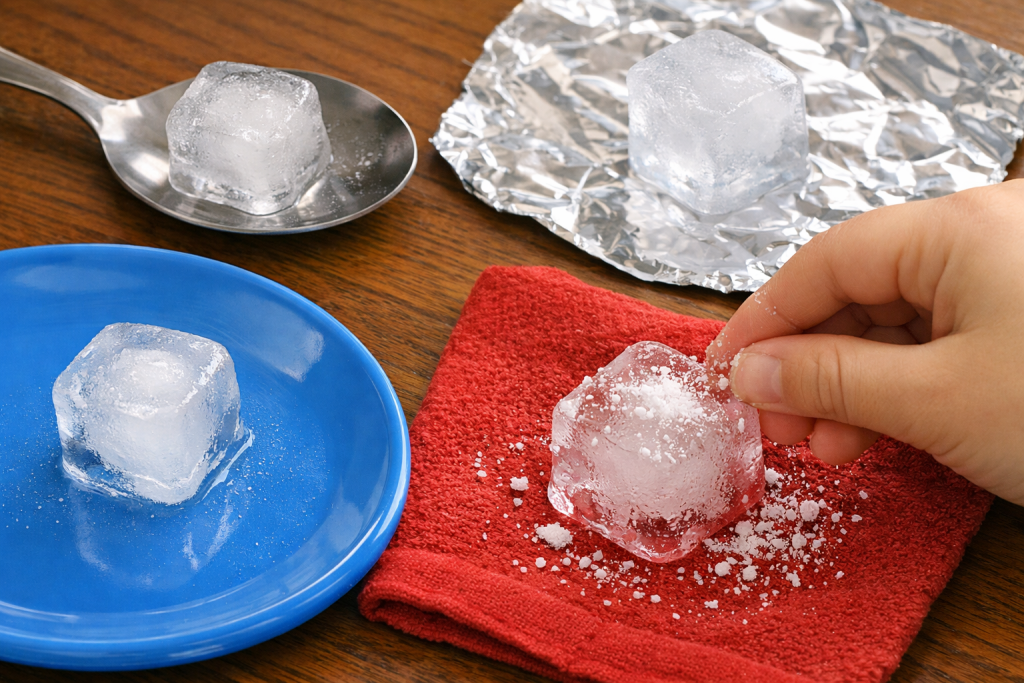
Melting race: “Which melts first?”
Freeze equal ice cubes. Place them on:
- metal spoon
- plastic plate
- towel
- foil
Ask:
- Which surface steals heat fastest?
- What does “cold” actually mean?
Salt + ice = tiny winter magic
Sprinkle salt on an ice cube and watch little tunnels form.
Kid-friendly explanation: Salt messes with how water freezes, so the ice melts differently.
Frozen treasure rescue
Freeze small toys in a container. Kids can “rescue” with:
- warm water
- salt
- a spoon tool (no sharp tools needed)
Engineering goal: Free the toy using the least water (or the fastest time).
Engineering Challenge: Build a Cozy Animal Shelter
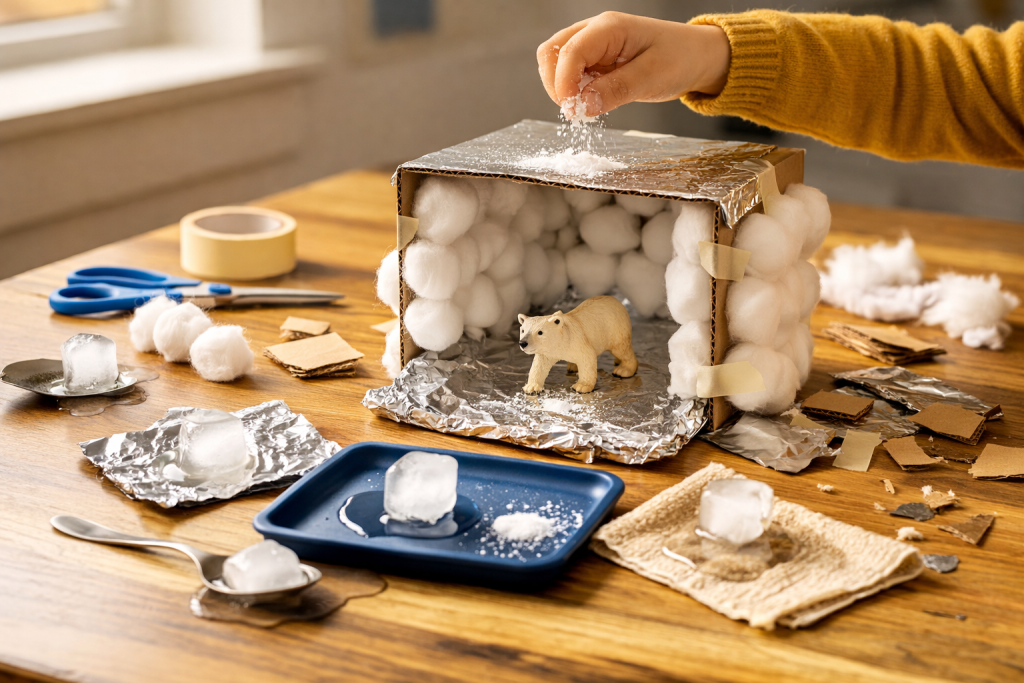
Give kids a pretend client: a tiny polar animal needs a warm home.
Your challenge brief
- The animal must fit inside
- The shelter must survive a “wind test” (fan or you blowing)
- Optional: it must stay warm for 5 minutes
Materials: cardboard, cotton balls, paper, tape, foil, fabric scraps.
Make it feel real
Have them sketch a quick “blueprint” (even a doodle counts). Then build.
Reflection question:
If you rebuilt it tomorrow, what would you change first?
That’s engineering: build → test → improve.
The Insulation Olympics: Which Material Keeps Heat In?
This one is a winter STEM classic because kids can see results fast.
The setup
Put warm (not hot) water in 3–5 identical cups. Wrap each cup in a different material:
- foil
- cotton
- paper
- fabric
- bubble wrap (if you have it)
Wait 10 minutes. Then compare warmth by touch or (better) with a simple thermometer.
Turn it into a mini-competition
Make a scoreboard:
- “Warmest cup winner”
- “Best texture”
- “Most surprising result”
Sneaky lesson: Heat transfer + insulation + comparing variables.
Winter Weather Detectives: Measure, Predict, and Graph
Even if it’s not snowing, winter weather is a science lab that changes daily.
Build a simple weather station at home
Pick one or two:
- Wind direction sock: ribbon on a stick
- Rain gauge: cut bottle + ruler
- Cloud viewer: look at clouds and name shapes (yes, it’s still observation science)
Predict like a mini meteorologist
Each morning, ask:
- “What do you think the weather will do today?”
- “What clues are you using?”
Graph it (without making it feel like math class)
Use a simple weekly chart:
- temperature (or “hot/warm/cool”)
- wind (calm/breezy/windy)
- rain (yes/no)
Kids love seeing patterns—especially when they “catch” the weather being predictable.
Coding Without Screens: Unplugged Winter Algorithms
Coding isn’t the screen. Coding is the thinking.
“Snowflake robot” directions game
Tape arrows on the floor (or draw them on paper):
- forward
- turn left
- turn right
Your child “codes” you to walk to a target (a pillow, a mitten, a stuffed penguin).
Debugging moment:
When you “mess up,” ask them to fix the code. Kids love being the boss engineer.
Pattern coding with beads or buttons
Make a winter pattern:
- blue, white, blue, white
- big button, small button, big button…
Ask:
- “What comes next?”
- “What’s the rule?”
That’s foundational computational thinking, just dressed in cozy clothes.
Kitchen Chemistry: Hot Cocoa Science and Heat Transfer
If winter had a smell, it would be hot cocoa.
Dissolve test: What disappears fastest?
Test in warm water:
- sugar
- cocoa powder
- salt (tiny amount)
Try stirring vs not stirring.
Science talk (simple): Heat + movement help things dissolve faster.
Marshmallow engineering challenge
Give kids mini marshmallows + toothpicks.
Goal options:
- Build the tallest tower
- Build a bridge that holds a small toy
- Build a “snowflake” structure
Quick tip: If toothpicks feel too sharp, use uncooked spaghetti (more forgiving).
Crystal Snowflakes: Grow Patterns You Can Touch
Crystals feel like winter magic, but they’re also pattern science.
The kid-safe-ish version
Many crystal kits are easier (and safer) than DIY chemistry. If you do DIY, keep adult supervision tight and follow product instructions.
What kids can learn without heavy science words
- Crystals grow in patterns
- They form when particles “stack” in a repeating way
- Temperature and time matter
Best question to ask:
“What do you notice about the shape? What repeats?”
That observation skill is the heart of science.
Snowball Physics: Catapults, Launchers, and Trajectories
This is the winter STEM activity that burns energy and teaches physics. Win-win.
Build a simple “snowball” catapult
Use:
- a spoon
- rubber bands
- a small stack of craft sticks (or cardboard strip)
Launch:
- mini marshmallows
- cotton balls
- pom-poms
Turn it into real STEM
Change one thing at a time:
- angle
- launch strength (more/less rubber bands)
- “snowball” weight
Ask:
- “Which goes farthest?”
- “What changed?”
- “What stayed the same?”
That’s experimental design, kid-style.
Winter Nature STEM: Mini Hikes, City Walks, and “Micro-Hunts”
Winter nature doesn’t have to be a forest hike. A sidewalk works. A balcony works. Even a window works.
A simple winter “micro-hunt” list
Find:
- 3 different leaf shapes
- 2 kinds of texture (smooth/rough)
- 1 thing that looks “patterned”
Go small: add a magnifier or microscope
Kids flip when they see ordinary stuff up close—salt grains, fabric threads, tiny dirt crystals.
If you want a kid-friendly guide to choosing the right tool, this microscope for kindergarteners guide breaks it down in plain language.
Quick reflection question
“What did you notice today that you never noticed before?”
That question builds the “scientist brain” more than any fancy worksheet.
STEM for Mixed Ages: Make One Activity Work for Siblings
Got a 4-year-old and an 8-year-old? Same activity, different “missions.”
Easy differentiation that actually works
- Little kids: sort, build, describe, compare
- Big kids: measure, graph, redesign, explain “why”
Example with insulation cups:
- younger child: “Which cup feels warmest?”
- older child: “Which cup kept the most heat after 10 minutes, and why?”
You’re basically running a one-room STEM schoolhouse, and it counts.
Product Picks: 5 Finds for Winter STEM Activities For Kids
These are popular, practical tools that make Winter STEM Activities For Kids easier to run (and easier to clean up).
1) Snap Circuits Jr. SC-100 Electronics Exploration Kit
Short description: A hands-on intro to circuits where pieces snap together (no soldering, no stress).
Features:
- build 100+ projects (lights, sounds, simple circuits)
- clear project manual
- sturdy snap parts
Best for: kids who love “how does this work?” toys; great winter indoor STEM.
2) Learning Resources Primary Science Lab Activity Set
Short description: A kid-sized science tool set that instantly makes experiments feel “real.”
Features:
- child-friendly lab tools (droppers, flasks, tweezers, etc.)
- activity cards for guided play
- durable, easy-to-clean pieces
Best for: preschool–early elementary kids doing winter science experiments at home.
3) National Geographic Mega Crystal Growing Kit
Short description: Crystal-growing that feels like a winter wonderland project—without you hunting down supplies.
Features:
- multiple crystal grows + display stand
- instructions + learning guide
- high “wow factor” with clear steps
Best for: kids who love rocks, patterns, and “science that turns into treasure.”
4) Learning Resources Botley The Coding Robot 2.0 Activity Set
Short description: Screen-free coding practice that feels like play, not homework.
Features:
- step-by-step coding challenges
- obstacle-course style play
- builds sequencing + problem-solving
Best for: kids who like puzzles, mazes, and “make it move” challenges during winter downtime.
5) Thames & Kosmos Kids First Chemistry Set
Short description: Gentle, beginner-friendly chemistry with real tools and guided experiments.
Features:
- kid-appropriate lab equipment
- experiment manual with clear steps
- supports safe, structured exploration
Best for: families who want kitchen-chemistry fun with a little more direction.
Research-Backed: Why Hands-On Winter STEM Builds Real Skills
You don’t need a lab coat to teach STEM well. What you need is hands-on time, good questions, and space for trial-and-error.
Kids are capable of real STEM thinking (even when they’re little)
A National Academies summary on early STEM learning notes that there’s compelling evidence young children already have strong STEM-related abilities—like reasoning, problem-solving, and explaining how the world works—and that experiences should build on those strengths early.
Recommended read: early STEM learning evidence for young children (National Academies, 2017)
Hands-on science taps into natural curiosity (and that’s the whole point)
The National Research Council’s landmark report emphasizes how science learning grows when teaching builds on children’s curiosity and uses meaningful tasks and experiences—not just facts.
Recommended read: guidance on how children learn science through experience (National Research Council, 2007)
Translation for real life:
When your kid predicts, tests, fails, and tries again during winter STEM activities for kids… they’re practicing the same thinking patterns scientists and engineers use every day.
FAQs
How do I do Winter STEM Activities For Kids if we don’t get snow?
Use freezer ice, “fake snow” recipes, and winter themes (penguins, insulation, cold weather). The learning comes from testing and comparing—not the weather outside.
What are the best Winter STEM Activities For Kids for ages 3–5?
Go for quick, sensory-friendly wins: fake snow, melting races, marshmallow builds, and simple sorting/pattern games. Keep steps short and let them repeat.
What are easy Winter STEM Activities For Kids with stuff I already have?
Ice cubes, salt, paper, tape, cups, and cotton balls can power half this list. Start with melting races, insulation tests, and a spoon catapult.
How long should a winter STEM activity take?
Aim for 10–25 minutes. If they’re locked in, keep going. If not, stop while it’s still fun (that’s how they come back tomorrow).
How do I keep Winter STEM Activities For Kids from turning into chaos?
Do three things: set a towel down, limit materials (not everything at once), and give one clear “mission” like build, test, improve.
Conclusion
Winter doesn’t need to be a season you “get through.” It can be a season your kid remembers as the time they built, tested, laughed, and figured things out like a tiny inventor.
Pick one activity from this list today—just one. Set it up. Ask a good question. Let it be imperfect. That’s not a fail… that’s STEM.