Space STEM Activities For Elementary Students
We may earn a commission for purchases made using our links. Please see our disclosure to learn more.
You know that moment when a kid asks a huge space question out of nowhere?
“Why doesn’t the Moon fall?”
“How do astronauts breathe?”
“Could I live on Mars if I brought snacks?”
That is exactly why Space STEM Activities work so well.
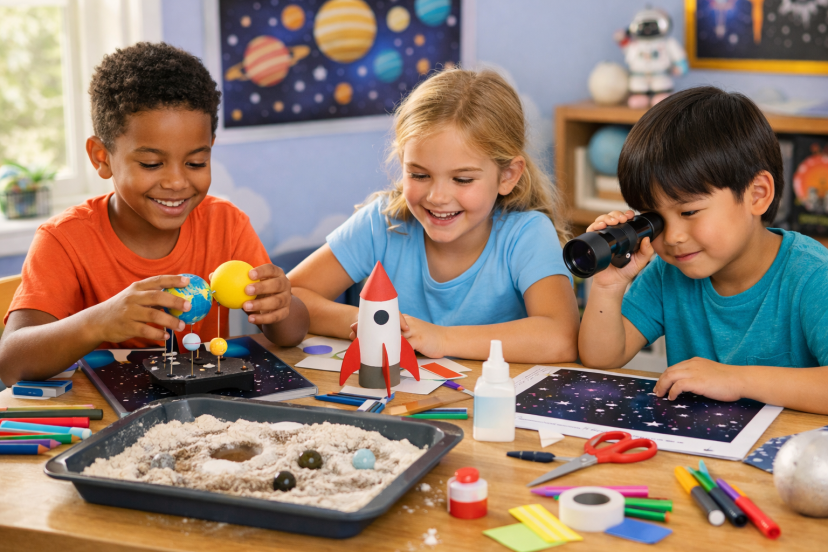
Space already has the magic. STEM learning gives that magic a structure. Put them together, and suddenly science feels less like a worksheet and more like a mission. In this guide, you’ll find simple, hands-on ideas that help elementary students explore astronomy, problem-solving, engineering, and curiosity without needing a fancy lab or a teacher voice that sounds like a documentary narrator.
Why Space STEM Activities Feel Like Play
Space is naturally sticky for kids. It pulls them in fast. Planets, rockets, black holes, astronauts, moon landings—this stuff already feels bigger than everyday life.
That matters because when kids are emotionally hooked, they are more willing to test ideas, make mistakes, and try again. In plain English, they learn more because they care more.
That is the sweet spot of STEM learning. You are not forcing interest. You are building on it.
What Kids Learn Beyond “Fun Science”
Good elementary STEM activities do more than fill an afternoon.
They help kids practice:
- asking questions
- making predictions
- testing ideas
- noticing patterns
- fixing what did not work
- explaining results in simple words
And honestly, that last one is a big deal. When a child can say, “My rocket went farther because the straw had less drag,” you are not just doing a craft. You are building real understanding.
How to Set Up a Simple Space STEM Station at Home or School
You do not need a Pinterest-perfect setup. A small basket and a clear table can do the job.
Keep a few basics nearby:
- paper towels
- tape
- string
- index cards
- aluminum foil
- plastic cups
- cotton balls
- markers
- measuring tape
- baking soda or flour for messy tests
If you want to build a stronger rotation over time, adding a few hands-on educational toys for curious kids can make your space science experiments easier to repeat without reinventing the wheel each week.
A simple rule helps too: ask kids to predict first, build second, and explain last. That one habit turns ordinary play into inquiry-based learning.
Moon Crater Drop: A Messy Favorite
This one is classic for a reason.
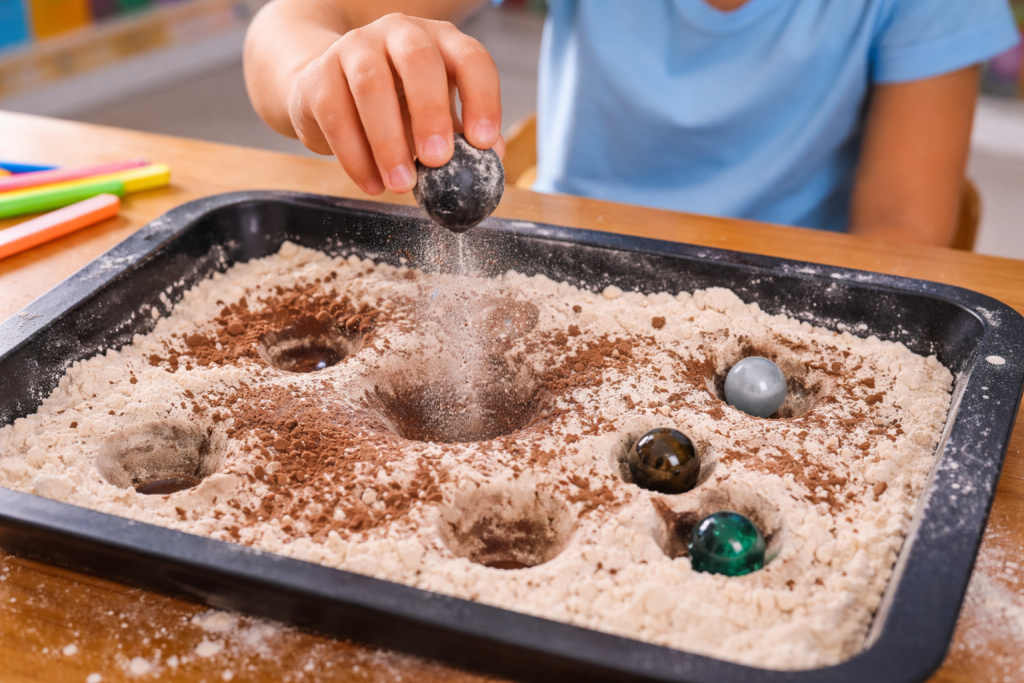
Fill a tray with flour. Dust cocoa powder on top. Then drop marbles, pom-poms, or small balls from different heights.
What kids notice
They quickly see that bigger objects or higher drops make larger craters. That opens the door to conversations about force, impact, and why the Moon’s surface looks the way it does.
Why it works
It gives kids something they can see right away. No abstract lecture needed. Just drop, observe, compare, repeat.
This is one of the best space science experiments for younger elementary kids because it feels like science and snack prep had a chaotic little meeting.
Balloon Rocket Race Across the Room
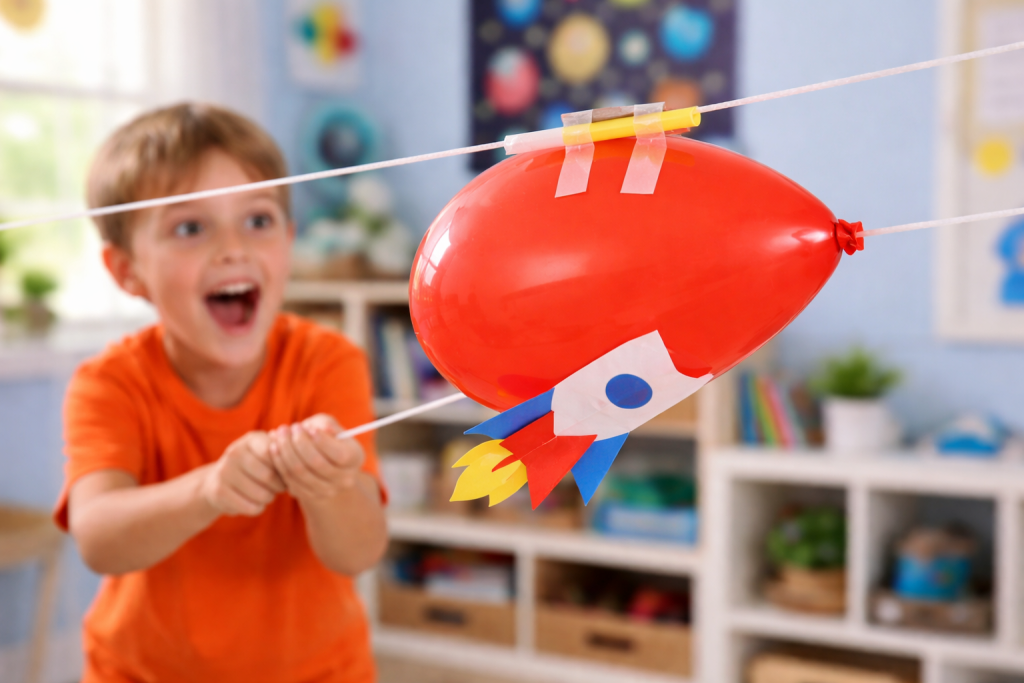
Tape a long string across the room. Thread a straw through it. Tape an inflated balloon to the straw, then let it go.
Zoom.
STEM skills inside the fun
Kids explore thrust, motion, and design changes. You can ask:
- Does a bigger balloon go farther?
- Does the angle matter?
- What happens if the string sags?
This is also a sneaky way to introduce engineering. Children are not just launching a balloon. They are testing a transport system.
Oreo Moon Phases That Kids Actually Remember
Yes, it is delicious. Yes, it is educational. That is what we call range.
Twist open sandwich cookies and scrape the cream to show each Moon phase.
Why this activity sticks
Moon phases can feel abstract when they live only in a diagram. But when kids shape them with their own hands, the pattern makes more sense.
You can line the cookies up in order and ask them to tell the Moon’s “story” from new moon to full moon and back again. That storytelling step helps memory more than most people realize.
Build Constellations with Toothpicks and Marshmallows
This is one of my favorite astronomy activities for kids because it mixes art, structure, and science.
Give kids star maps or simple constellation cards. Then let them build the shapes with marshmallows and toothpicks.
Extend the learning
Ask:
- Which stars seem close together from Earth?
- Are they really close in space?
- What happens if we look from a different angle?
That last question is gold. It helps kids see that the patterns we know are based on perspective. Space is a giant reminder that what looks simple from far away usually is not.
Code a Mars Rover Maze
Draw a grid on paper or tape one on the floor. Add rocks, craters, and a landing zone. Then ask kids to “program” a rover using arrows or simple commands.
Skills this builds
This activity blends coding for kids with problem-solving. Children practice sequencing, direction, logic, and debugging.
When the rover crashes into a pretend crater, that is not failure. That is data. Very dramatic data, but still data.
For older elementary students, you can add challenge cards like “collect a rock sample before returning to base.”
Design a Moon Lander That Can Survive the Drop
Give kids paper, straws, tape, cotton balls, and a small toy astronaut or pom-pom passenger. Their mission is to build a lunar lander that survives a drop.
Questions to ask
- What kind of base absorbs impact best?
- Does width matter?
- What keeps the passenger from bouncing out?
This is one of the strongest engineering challenges for kids because it feels real. It also teaches something important: first designs are rarely the best ones.
That lesson alone is worth the tape explosion.
Take a Scale Solar System Walk
Kids hear that planets are “far apart,” but those words do not really land until they walk it out.
Use a hallway, sidewalk, or field. Mark the Sun first. Then pace out the planets using a simplified scale.
Why this one surprises kids
The biggest lesson is usually not planet size. It is the empty space between them.
That pause between markers gives children a much better feel for the solar system than a tiny textbook picture ever could. NASA Space Place also offers kid-friendly activities like space mazes, launch projects, and planet games, while NASA JPL lists hundreds of lesson plans and student projects educators can pull from when they want more ideas.
Create a Space Habitat for Future Astronauts
Ask kids to design a home on the Moon, Mars, or a made-up planet.
They must solve problems like:
- How will people breathe?
- Where will food grow?
- How will they stay warm?
- What protects them from dust or radiation?
Why this matters
This turns NASA activities for kids into deeper systems thinking. Children start connecting science with human needs, design, and real-world constraints.
It is also wonderfully inclusive. A child who loves drawing can sketch the habitat. A child who loves building can make a model. A child who loves telling stories can explain daily life inside it.
Make Space STEM Activities Work for Different Elementary Ages
Not every child needs the same level of challenge, and that is fine.
For grades K–2
Keep it visual and physical. Use sorting, matching, building, and noticing.
For grades 3–5
Add measuring, graphing, written predictions, and redesign steps.
For mixed ages
Pair younger kids with older helpers. That works especially well in family settings. The younger child brings wonder. The older child brings structure. Both feel useful.
The goal is not perfection. The goal is momentum.
5 Tools That Make Space STEM Easier
These picks are useful because they support repeatable hands-on science activities instead of becoming one-and-done clutter monsters.
Learning Resources Shining Stars Projector
A simple projector that displays stars, planets, and space images on a wall or ceiling.
Features: portable projector, image discs, stand, and activity guide.
Best for: younger kids who are just getting into space and need a visual, low-pressure entry point. It works well for dark-room observation, planet talks, and calm-down science time.
Learning Resources Giant Inflatable Solar System
A large solar system model set that helps kids see the planets as objects they can touch, move, and compare.
Features: includes all 8 planets, Pluto, the Sun, Earth’s moon, an activity guide, repair kit, and foot pump.
Best for: classrooms, homeschool groups, and kids who learn best by moving their bodies while learning.
Educational Insights Nancy B’s Science Club MoonScope Kids Telescope
A kid-friendly beginner telescope that makes moon watching feel exciting instead of frustrating.
Features: all-glass optics, manual focus, altazimuth mount, magnification up to 90x, and a 22-page activity journal.
Best for: older elementary students ready for real observation, moon journaling, and simple night-sky routines.
Educational Insights Design & Drill Space Circuits
A building set that combines simple circuits with a fun space theme.
Features: 52 assorted pieces, a kid-friendly power drill, and 20 challenges.
Best for: children who love hands-on building and need movement built into their STEM learning. It is a strong fit for rover or station-themed engineering play.
Skillmatics Flash Cards – Science Snippets Space
A space-themed card set that answers the “why” behind big questions.
Features: 70+ double-sided cards, interactive prompts, and a box that turns into a display stand.
Best for: travel, quick warm-ups, reading-based science discussions, and kids who love facts almost as much as astronauts love checklists.
What Research Says About Hands-On STEM Learning
This is not just a “kids like rockets” idea.
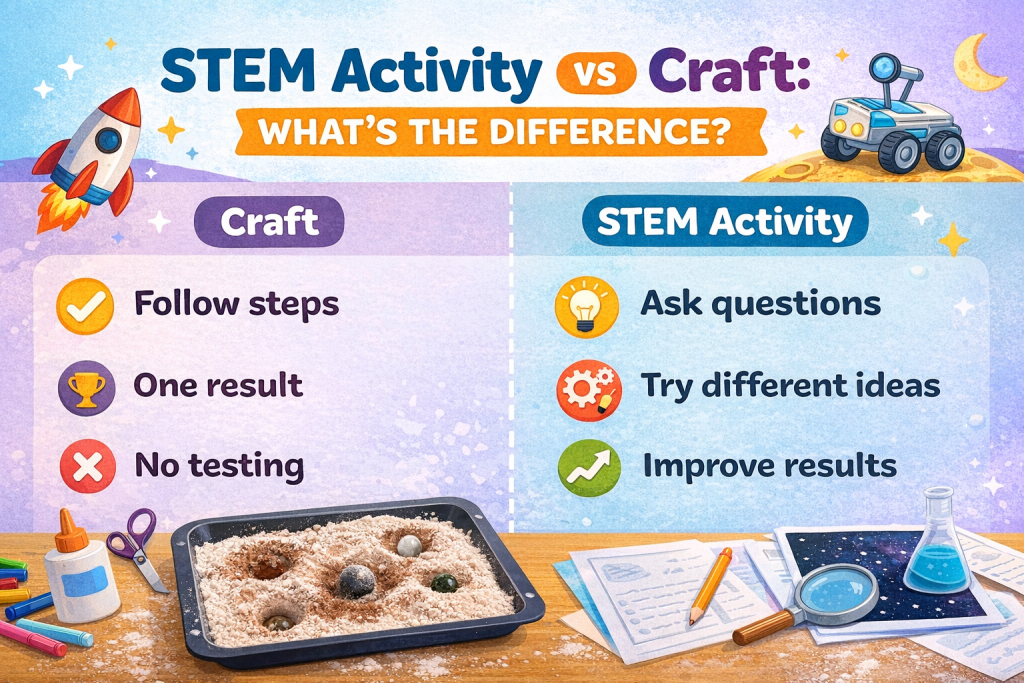
A systematic review of integrated STEM learning outcomes found that different integrated STEM approaches lead to different learning outcomes, and that engineering-design and project-based work were especially connected to gains in learning achievement and higher-order thinking. That lines up nicely with activities like moon landers, rover mazes, and habitat design, where kids have to build, test, and rethink instead of just memorize.
A more space-specific example came from a K–5 hands-on space weather curriculum, where students used inquiry-based activities to connect ideas from the Sun to Earth. The study reported that students showed a strong grasp of basic principles, responded well to collaborative hands-on work, and gained confidence through trial and error. That is a pretty strong case for making Space STEM Activities active, visual, and discussion-based.
FAQs
What are some top Space STEM Activities for elementary-aged kids?
The best ones are simple, hands-on, and easy to repeat. Moon crater trays, balloon rockets, rover mazes, moon phases, and habitat design all work well because kids can test ideas instead of only hearing about them.
How do I teach space science without expensive materials?
Start with household items. Flour, cookies, paper, tape, string, and cups go a long way. You do not need a lab. You need a question, a challenge, and room for kids to try.
Are Space STEM Activities good for homeschool?
Yes. They work especially well for homeschool because you can slow down, repeat experiments, and mix ages. Many activities also blend science with writing, reading, art, and math.
How can I make space activities more educational and less chaotic?
Use a simple rhythm: predict, test, record, explain. That keeps the fun while still giving the activity a clear learning path.
What skills do kids build through space STEM learning?
Kids build observation, logic, creativity, measurement, communication, and resilience. They also learn that changing a design after failure is normal, which might be the most useful skill of all.
Space has a way of making kids feel small and powerful at the same time. Small because the universe is huge. Powerful because they can still ask questions about it, test ideas, and discover how things work.
That is why Space STEM Activities matter. They turn curiosity into action.
So start simple. Drop a crater. Launch a balloon rocket. Build a shaky little moon lander that absolutely crashes the first time. That is not a bad lesson. That is the lesson.