Sensory Toys for Toddlers: Safe, Top-Rated Choices
We may earn a commission for purchases made using our links. Please see our disclosure to learn more.
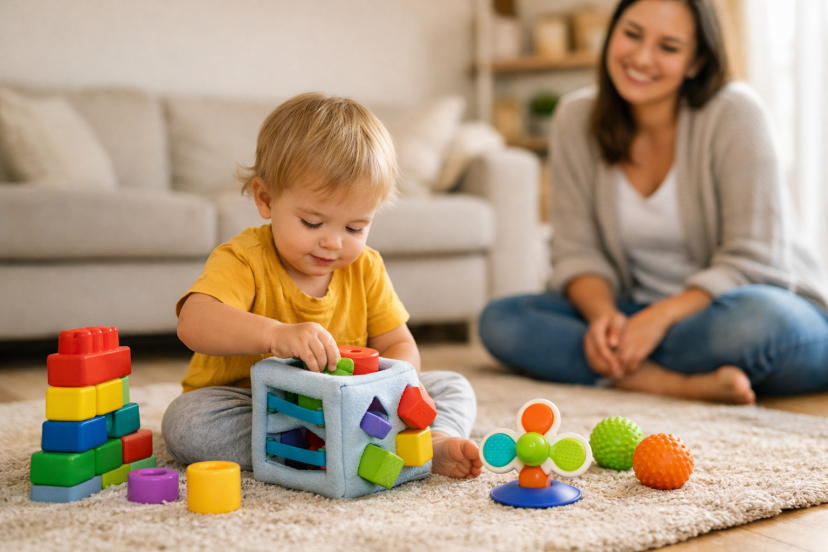
If you’ve ever watched your toddler melt down because their socks “feel wrong,” or because you opened the blue snack instead of the red one… yeah. Toddlers feel everything at full volume. That’s exactly why sensory toys for toddlers can be such a game-changer.
They’re not just “busy toys.” The right sensory toy can help your child focus, calm their body, practice new skills, and explore the world in a way that actually makes sense to their growing brain.
Quick affiliate note: This article includes an affiliate product section; if you buy through links on your own later, we may earn a small commission at no extra cost to you.
Why sensory play matters more than you think
Sensory play is basically your toddler’s “research lab.” They squeeze, spin, stack, chew (sigh), tap, sort, and repeat—because their brain is building pathways for things like coordination, language, and self-control.
Think of it like this: adults decompress with a coffee, a walk, or scrolling. Toddlers decompress by doing—hands busy, body regulated, brain happier. Toddler sensory activities give them that outlet without turning your living room into a full-time wrestling ring.
What sensory play supports
- Body awareness (proprioception) and balance (vestibular input)
- Touch tolerance (tactile play)
- Early problem-solving and cause-and-effect
- Patience and frustration tolerance (yes, really)
The 8 sensory “channels” toddlers explore
Most people think “sensory” means touch. Touch is big, but it’s not the only one.
The main sensory systems
- Tactile: textures, squishy, rough, smooth
- Visual: color, movement, patterns
- Auditory: gentle sounds, clicking, rattling
- Oral: chewing, mouthing (especially 12–24 months)
- Olfactory/gustatory: smell/taste (usually with supervised play)
- Proprioceptive: pushing, pulling, heavy work
- Vestibular: rocking, spinning, balance
- Interoception: noticing hunger, thirst, “I need a break”
The best sensory toys for toddlers usually hit 2–3 systems at once (without overwhelming them).
How to choose sensory toys without getting overwhelmed
Amazon will happily show you 900 “sensory toys” and half of them are… loud. Or tiny. Or weirdly sticky.
Here’s a simple filter that works in real life:
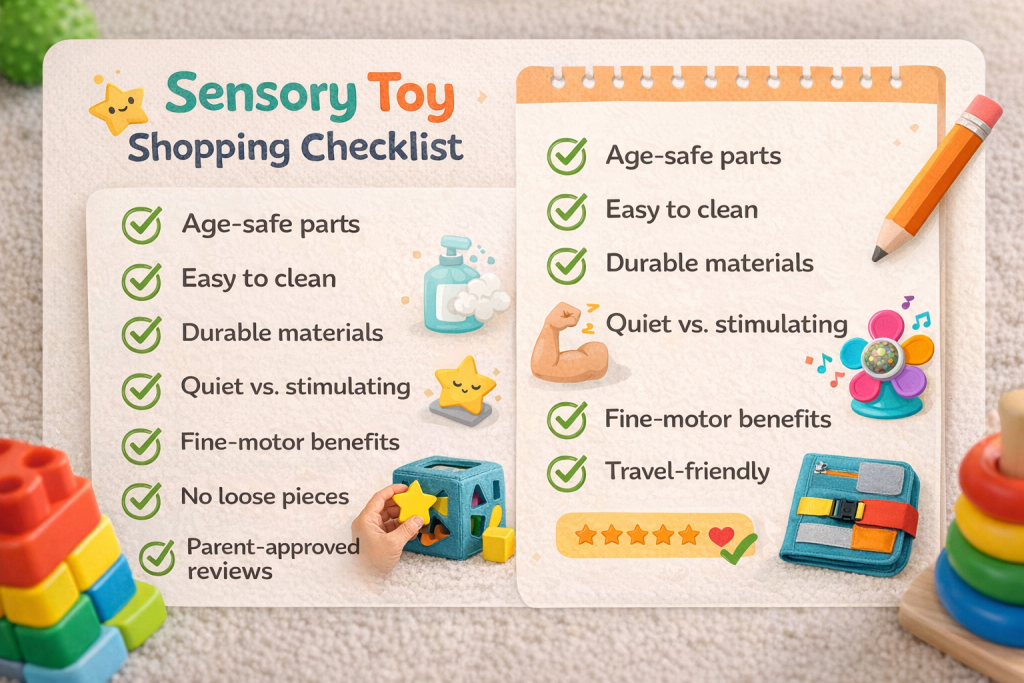
The “3 S” checklist
- Safe: age-appropriate, sturdy, easy to clean
- Simple: doesn’t need 40 instructions
- Satisfying: your child actually wants to repeat it
And if you’re shopping for developmental toys ages 1–3, prioritize durability and repeat play. Toddlers don’t do “delicate.”
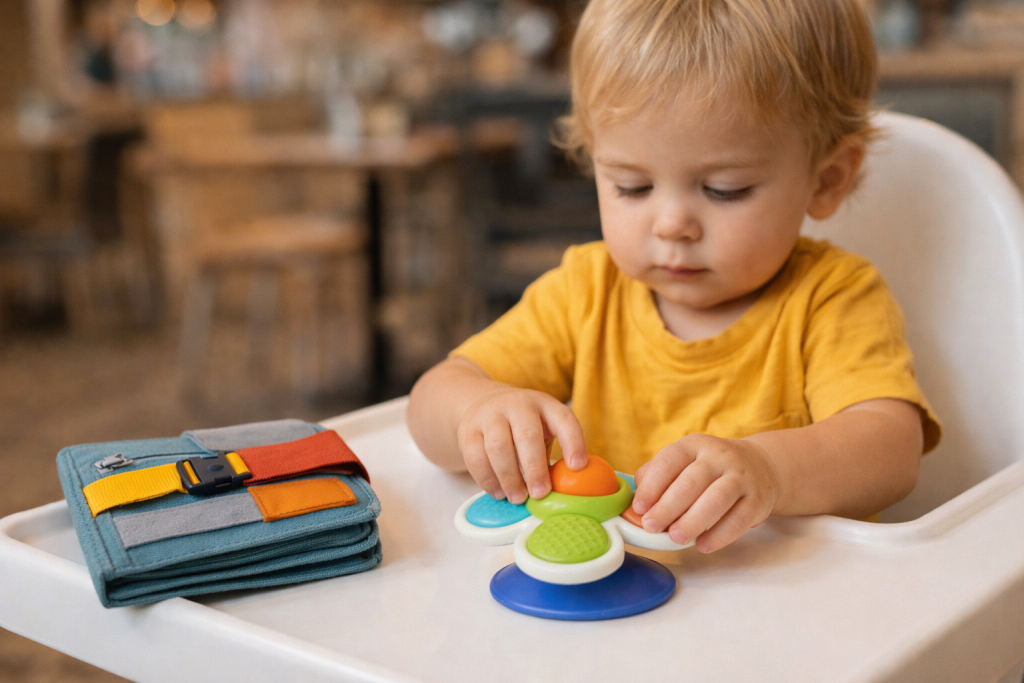
Safety first: what to avoid (especially with online buys)
I’m going to be the slightly paranoid friend for 20 seconds: always scan reviews for choking risks, loose parts, and breakage.
A real example: the U.S. CPSC reported a recall of a popular Montessori-style pull-string teething toy sold online after 32 choking incidents and about 6,800 units affected.
Quick safety checks before you buy
- Avoid tiny removable pieces (especially under 3)
- Prefer one-piece silicone/wood designs from reputable brands
- If it has strings, tabs, or cords—double-check length and attachment
- When in doubt: bigger parts, thicker materials, simpler construction
Match the toy to your toddler’s “sensory personality”
Two toddlers can be the same age and need totally different sensory input.
Common sensory styles (in normal-human language)
- The Busy Hands Kid: loves flipping, snapping, latching (hello, busy boards)
- The Seeker: crashes, climbs, spins—needs more movement input
- The Sensitive One: easily overwhelmed—does best with calm, predictable toys
- The Oral Explorer: mouths everything—needs safe chew and texture options
If your toddler gets overstimulated fast, look for calm down toys for toddlers that are quiet, repetitive, and not flashy.
Sensory toys that build fine motor skills (without feeling like “learning”)
If your child is working those tiny finger muscles, you’re helping future skills like feeding, dressing, crayons, and eventually writing.
Great “fine motor skills toys” features
- Pinching, pulling, twisting, pushing
- Sorting shapes or matching pieces
- Lids, doors, buttons, buckles, zippers
This is where Montessori-style play shines: purposeful, hands-on, and not gimmicky.
Quiet sensory toys for travel, restaurants, and waiting rooms
You know that moment when you’re at a restaurant and your toddler decides the spoon is a drum solo? Quiet toys aren’t a luxury. They’re survival.
What to look for in quiet travel toys
- Soft materials (felt busy books, fabric boards)
- No loud electronics
- Easy to clean
- Stays together (nothing that rolls under tables)
Busy boards and compact sorting toys are often the MVPs here.
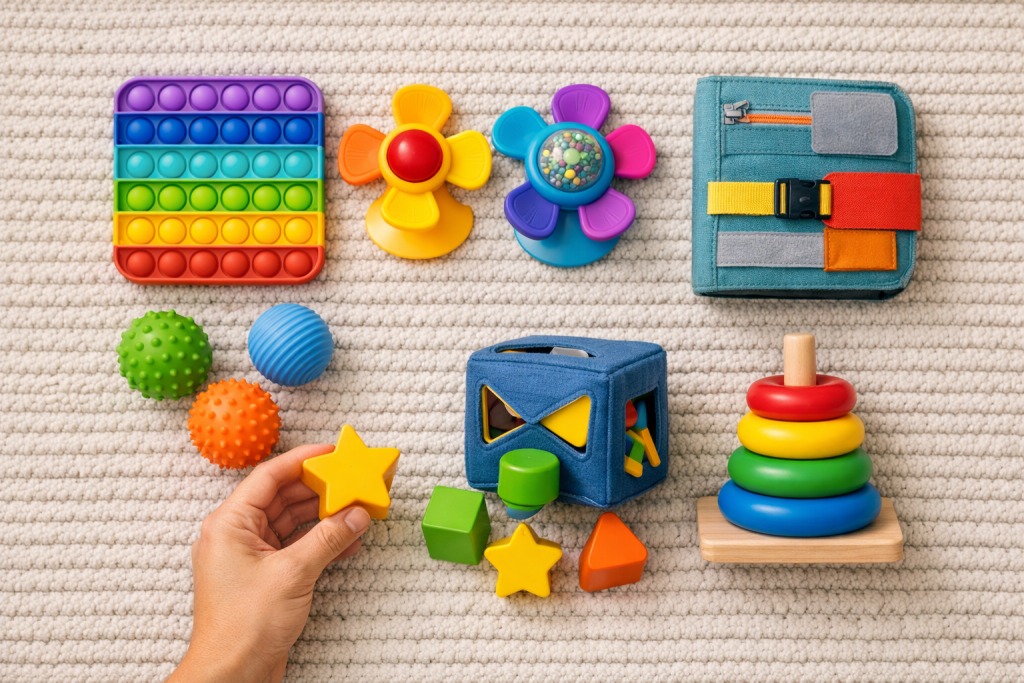
Sensory toys that encourage language and social play
Sensory play isn’t only solo play. Some toys naturally invite you to narrate, name, and pretend—without forcing it.
Easy ways to build language during sensory play
- “You found the blue one—where’s red?”
- “Spin… stop… spin… stop!”
- “In… out… in… out…” (toddlers love this rhythm)
Pretend-play sensory sets (like animals in a barn, textured figures, matching games) often spark more back-and-forth.
Sensory toys for toddlers who need help calming down
Some kids don’t “settle” easily. They need input to regulate—like a nervous system reset.
Calming sensory input usually looks like
- Slow, repetitive movement (spinners, pop-and-press)
- Deep pressure or resistance (pulling, pushing, “heavy work”)
- Predictable patterns (sorters, stacking, matching)
If bedtime or transitions are tough, have a “calm bin” ready: one or two reliable toys, not a whole toy explosion.
DIY sensory play at home (cheap, easy, actually fun)
You don’t need fancy toys to do sensory play. You need safe materials and a little structure.
Simple toddler sensory activities at home
- Rice bin with scoops (supervised)
- Water play with cups + a towel under it
- Pom-poms + tongs into containers
- Tape “roads” on the floor for cars
- Texture hunt: soft/rough/smooth around the house
A small hot take: DIY sensory bins are amazing… until cleanup. So keep them simple and containable.
When sensory toys help kids with sensory processing differences
If your toddler seems extra sensitive—or extra intense—sensory toys can still help, but the goal is comfort, not “fixing.”
Helpful approach
- Offer choices (“Do you want the spinner or the sorter?”)
- Keep sessions short and positive
- Watch their signals (turning away, covering ears, tossing toys)
If you’re concerned about sensory challenges, an OT (occupational therapist) can help you match tools to your child’s needs.
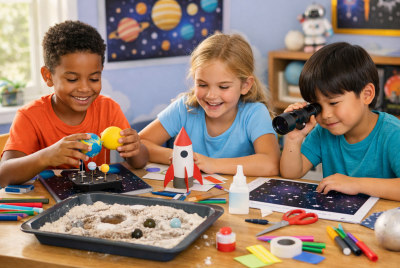
STEM-friendly sensory play (because curiosity starts early)
Some sensory toys naturally build early STEM thinking—cause/effect, patterns, problem-solving. And yes, toddlers can do STEM. It just looks like play.
If you want structured, fun ideas that keep that curiosity rolling, check out these back-to-school STEM challenges for kids (easy to adapt for toddler-friendly play with supervision).
Product picks: 5 popular sensory toys for toddlers
1) Fat Brain Toys InnyBin (Shape sorter + sensory cube)
Short description: A soft, flexible cube where toddlers push shapes in and pull them out—again and again.
Features:
- Flexible bands (satisfying resistance)
- Chunky shapes for easy grasp
- Great tactile + fine motor practice
Best for: 10 months–3 years, “busy hands” kids, independent play
2) Melissa & Doug Deluxe Pounding Bench (Wooden pounding toy)
Short description: Classic pound-the-pegs fun with a peekaboo twist (pound them down, flip, repeat).
Features:
- Durable wood construction
- Hand-eye coordination practice
- Repetition toddlers love
Best for: Ages 2–4, high-energy kids, screen-free play
3) Learning Resources Peekaboo Learning Farm (Counting/sorting + pretend play)
Short description: A hands-on farm set where toddlers open barns, match animals, and build early counting/sorting skills.
Features:
- Hide-and-reveal play (peekaboo = instant toddler magnet)
- Sorting + matching
- Builds early vocabulary (animals, colors, numbers)
Best for: 18 months–4 years, language development, parent-child play
4) Suction Cup Spinner Toys (High chair/bath/travel fidgets)
Short description: Stick, spin, repeat—great for waiting times and quick regulation.
Features:
- Strong suction for smooth surfaces
- Encourages visual tracking and hand control
- Handy for travel and transitions
Best for: 1–3 years, restaurants, stroller time, calm-down moments
5) MEGA BLOKS First Builders Big Building Bag (80-piece)
Short description: Big blocks for little hands—stacking, building, knocking down, rebuilding.
Features:
- Chunky pieces (toddler-friendly grip)
- Open-ended creativity
- Builds coordination and early engineering thinking
Best for: Ages 1–3, imaginative play, siblings playing together
What research and experts say about sensory play
Let’s keep this practical: you don’t need to “optimize” childhood. But it’s reassuring to know the experts back the value of play and sensory-rich experiences.
- The American Academy of Pediatrics clinical report emphasizes play as a powerful driver of healthy development, supporting skills like self-regulation, executive functioning, and resilience. The AAP’s guidance on play and development lays out why play isn’t extra—it’s foundational.
- Research also suggests multi-sensory learning tools can increase children’s interest and engagement during learning activities. This 2024 paper in Frontiers explores multi-sensory vs. traditional toys and discusses benefits tied to attention and learning experience: multi-sensory toys in child education.
FAQs: sensory toys for toddlers
Is it okay for children with autism to play with sensory toys?
They can be helpful, especially when matched to your child’s sensory needs (calming vs. alerting). Start simple, observe reactions, and consider OT guidance for personalized support.
What are the best sensory toys for toddlers ages 1–3?
Look for sturdy sorters, spinners, chunky blocks, simple busy boards, and tactile toys that build fine motor skills. Choose 1–2 that your toddler wants to repeat.
How many sensory toys does a toddler actually need?
Usually fewer than you think. Two or three “go-to” options beat a giant pile. Rotation helps: keep most toys put away and swap weekly.
What sensory toys help toddlers calm down?
Quiet, repetitive toys often work best: suction spinners, push-and-pop toys, simple sorting, and slow-movement activities. Pair with a calm corner and predictable routine.
Are electronic sensory toys better than non-electronic ones?
Not automatically. Many toddlers regulate best with simple, hands-on toys that don’t overstimulate. If you use electronic toys, pick gentle sound/light options and keep volume low.
Conclusion
The best sensory toys for toddlers aren’t the flashiest ones—they’re the ones your child comes back to when their body feels wiggly, their brain feels loud, or they just need a win.
If you remember nothing else, remember this: match the toy to your toddler, keep safety and simplicity at the center, and don’t underestimate the power of repeat play. Those “again, again!” moments? That’s learning happening in real time.
And hey—if you want a simple next step: pick one calming toy and one fine-motor toy, try them for a week, and watch what changes. Small choices can make your days feel a whole lot smoother.