Best Sensory Toys for Kids in 2025: Top Picks & Reviews
We may earn a commission for purchases made using our links. Please see our disclosure to learn more.
Ever wished you had a “calm” button for those high-energy moments? Or a simple way to help your child focus, relax, or explore the world with more confidence? That’s where sensory toys for kids shine. They turn everyday play into soothing, skill-building moments—without feeling like homework.
In this guide, you’ll learn what sensory toys are, how to choose the right ones for your child, research-backed benefits, and our favorite Amazon picks. I’ll also share practical tips, real-life examples, and a few easy activities you can try today.
Understanding Sensory Toys for Kids
Think of them as tools for the senses: they stimulate touch, vision, hearing, smell, and movement feedback. Think squishy textures, soothing resistance, gentle sounds, and satisfying clicks or “pop” sensations. The goal is simple: help kids regulate emotions, build fine motor skills, and learn through hands-on discovery—aka sensory play.
These toys aren’t only for specific diagnoses. They’re supportive for many children—busy toddlers, careful observers, kids who love deep pressure, and kids who seek calm.
The Real-World Benefits of Sensory Play
Sensory play can help kids settle, focus, and explore safely. Pediatric experts emphasize that play supports social-emotional growth, language, and executive function (think planning and self-control). In other words, play is serious brain work—with giggles.
Signs a Sensory Toy Might Help Your Child
- They seek extra movement or pressure (love to jump, push, or squeeze).
- They “stim” or fidget when they need focus or comfort.
- Transitions are tough without a calming object.
- They avoid certain textures and need gentle exposure.
- They benefit from short sensory breaks between tasks.
None of these are “problems.” They’re clues. Use them to guide your toy choices.
Types of Sensory Toys (By Sensory System)
Tactile (Touch)
Soft putties, tactile toys with bumps or ridges, textured balls, squish-and-pull materials (like foam or pop tubes).
Proprioceptive (Body Awareness)
Items that push/pull/squeeze: resistance bands, weighted lap pads (use thoughtfully), play that involves carrying or stacking blocks.
Vestibular (Movement)
Rockers, wobble boards, scooters, or activities that safely encourage balance and spinning—always with supervision.
Visual & Auditory
Light-up toys with soft glow, calm color changes, gentle musical toys, and simple rhythm instruments.
Oral (Taste/Exploration)
For babies, safe teething toys; for older kids, crunchy snacks and sip-straws used mindfully with adult guidance if oral input helps them self-regulate.
How to Choose Sensory Toys by Age & Need
- Match intensity: Some kids prefer subtle textures; others love bold resistance and “pop.”
- Think goals: Do you want calm, focus, or exploration? Choose calming toys for transitions; open-ended sets for creativity.
- Size & storage: School-friendly fidgets should be quiet and pocket-sized.
- Follow your child: Interests matter. Dinosaurs? Colors? Magnetic builds? Lean in.
Quick fit guide
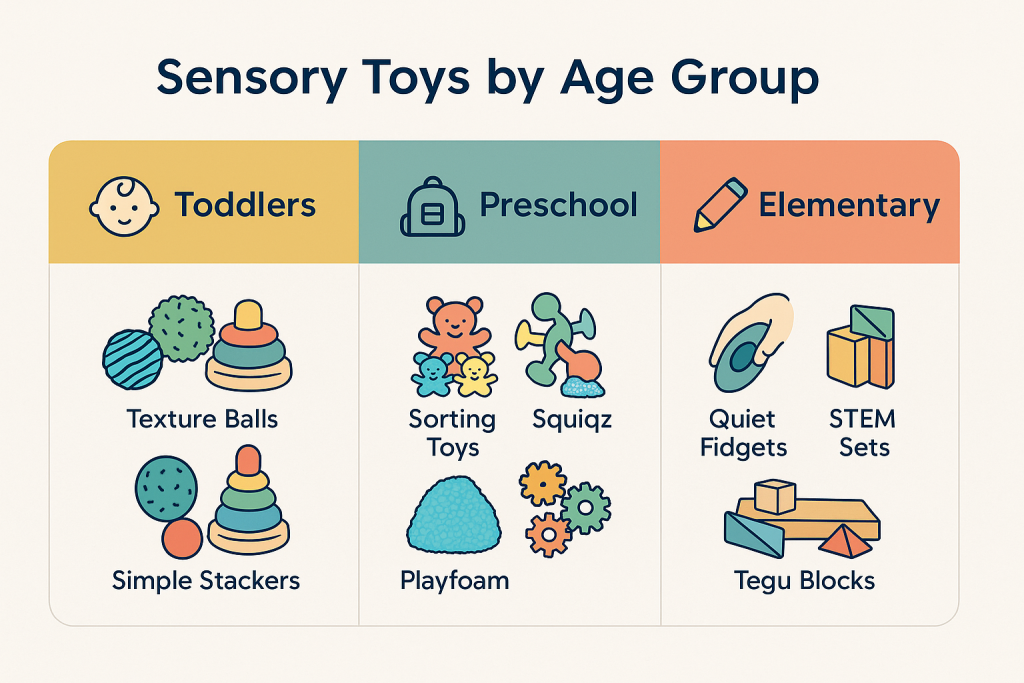
- Toddlers (1–3): Big shapes, bright but not overwhelming colors, easy-to-grip pieces.
- Preschool (3–5): Building sets, simple tools, gentle cause-and-effect toys.
- Early elementary (5–8): STEM play, construction, patterning, light fidgets.
- Older kids (8+): Discreet fidgets, challenge builds, DIY maker kits.
Safety, Materials, and What to Avoid
- Check age ratings, small-parts warnings, and manufacturer guidelines.
- Choose non-toxic finishes and BPA-free plastics when possible.
- Avoid loud/noisy fidgets in class spaces.
- Store small items safely away from babies and pets.
- Clean regularly (warm, soapy water for many plastics/silicones; always follow the label).
- Skip materials you can’t supervise safely.
Sensory Toys for Toddlers (1–3 Years)
Toddlers benefit from chunky shapes and simple actions: pull, place, pop, stack. Look for toys that invite repetition. Repetition builds confidence and fine motor skills—and yes, it’s normal to repeat a favorite action 100 times.
Try: soft blocks, pop tubes with adult guidance, simple peg-and-place sets, textured balls, easy musical shakers.
Calming Fidgets for Focus & Self-Regulation
Fidgets give the hands a job so the brain can zero in. They’re great during car rides, waiting rooms, or homework time.
What works well:
- Soft, squeezable putty or foam
- Fidget toys with quiet clicks or “pop” feedback
- Suction-cup builders you can pull apart with a satisfying “POP”
- Discreet keychain spinners (for older kids)
Tip: Introduce a “fidget rule”—if it helps you focus, it stays; if it distracts, it takes a break.

Montessori-Inspired Sensory Toys (Open-Ended Play)
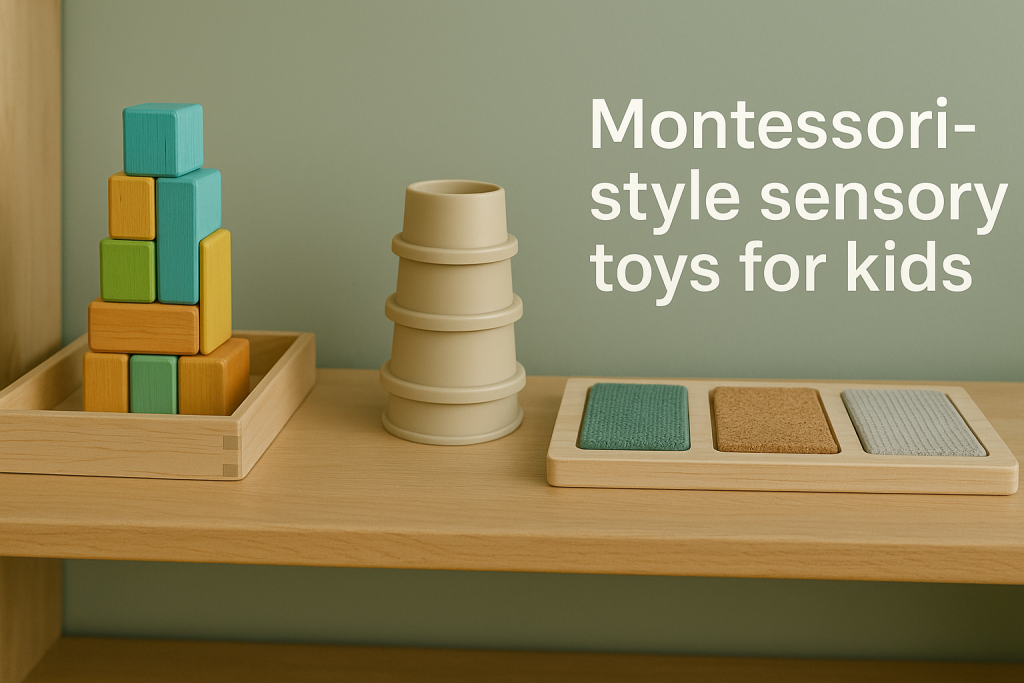
Montessori-style toys are simple, beautiful, and open-ended. They invite problem-solving instead of telling kids what to do. Think wooden blocks, magnetic planks, and nesting cups. They scale with your child—today it’s stacking, next month it’s bridges, next year it’s elaborate worlds.
DIY, Low-Cost Sensory Play Ideas (No Water Beads)
- Texture tray: Fabric scraps, smooth stones, pom-poms—touch and sort.
- Rice or lentil bin (well-supervised): Hide big wooden shapes to scoop and find.
- Painter’s tape roads on the floor or wall: drive, peel, restick.
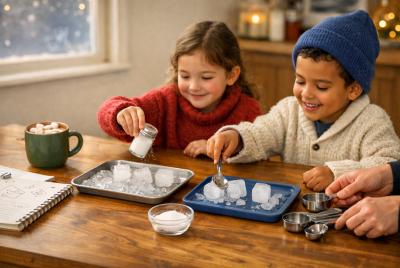
- Ice + salt + droppers: Color melting ice with a few drops of food coloring.
- Sound jars: Fill sealed containers with different materials—rice, paper clips, buttons—and compare.
Reflect: Which texture made your child light up? That’s your clue for the next toy.
Outdoor Sensory Play Ideas You Can Try Today
Fresh air changes everything—more space, new textures, and natural sensory input.
- Nature textures: Bark rubbings, leaf printing, sand writing.
- Heavy work: Garden scoops, small watering cans, carrying sticks for a fort.
- Campfire curiosity: Observe heat, crackle, color changes, and smoke direction from a safe distance with adult guidance, then connect it to simple science. Try these hands-on campfire science experiments for kid-friendly STEM inspiration.
How to Add Sensory Breaks to Daily Routines
- Before school: 5 minutes of wall push-ups or animal walks.
- After school: Build time, squish putty, or dance to one song.
- Homework: Quiet fidget + chair band for feet.
- Bedtime: Slow stretches, deep breathing, soft textures.
Consistency beats intensity. Short and predictable wins.
Research-Backed Insights on Sensory Play
Two high-quality sources help set expectations:
- The American Academy of Pediatrics emphasizes that play builds brain structure and supports language, self-regulation, and executive function—key foundations for learning. The AAP even encourages pediatricians to “prescribe” play in early years.
- A randomized controlled trial found that occupational therapy using Ayres Sensory Integration® helped autistic children achieve individualized functional goals, suggesting structured sensory approaches can be effective within an OT framework.
Takeaway: Play is powerful. And sensory-rich experiences—especially when guided and personalized—can support regulation, participation, and goal-oriented growth.
Amazon Top Picks: Sensory Toys for Kids (5 Editor-Approved)
We selected items known for durability, safety features, and real-world usefulness. Always follow age ratings and supervise play.
1) Learning Resources Spike the Fine Motor Hedgehog
A friendly hedgehog with chunky “quills” kids push in and pull out—great for grip strength and coordination. Ages 18m+.
Features
- Large, easy-grip pegs; color sorting and counting potential
- Sturdy base; wipe-clean surface
Pros
- Excellent for fine motor skills
- Grows with kids (colors, patterns, counting)
Cons
- Pieces can roll under couches
- Not ideal for on-the-go play
Best for: Toddlers and preschoolers who love “put in/take out” play.
Review snapshot: Parents praise the grip practice and tidy storage; occasional notes about pegs going missing.
2) Fat Brain Toys Squigz (Starter/Deluxe Sets)
Soft silicone suction builders that stick to smooth surfaces and pull apart with a delightful “POP.” Great for tactile input and creative builds.
Features
- 100% food-grade silicone; BPA- and latex-free
- Multiple shapes and sizes for open-ended constructions
Pros
- Super satisfying sensory feedback
- Bathtub/window friendly; easy cleanup
Cons
- Suction depends on clean, smooth surfaces
- Pop sound may distract in quiet settings
Best for: Kids who love construction + tactile feedback.
Review snapshot: Loved for creativity and “pop” factor; occasional comments that suction weakens on dusty surfaces.
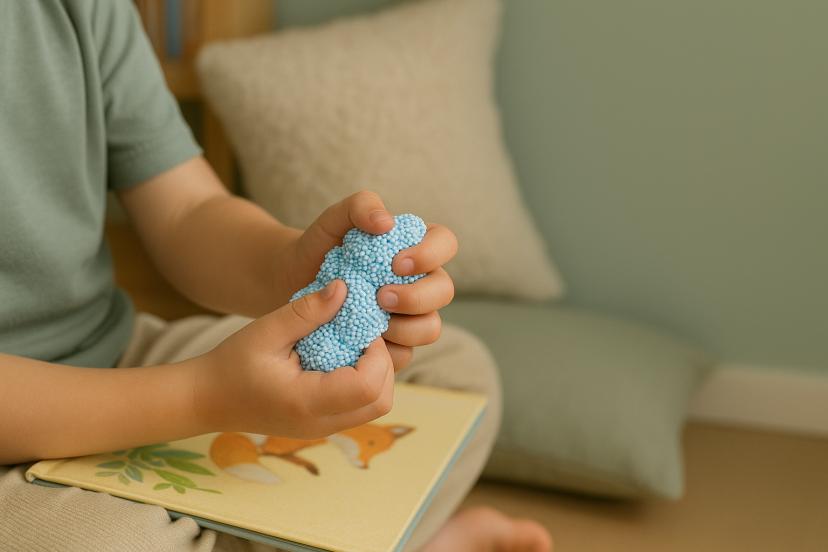
3) Educational Insights Playfoam (8-Pack)
Squishy, never-dries-out foam kids can squeeze, shape, and smush—fantastic for tactile exploration without the mess of doughs.
Features
- No-dry formula; ready to squish and reshape
- Portable pods for travel or calm corners
Pros
- Low mess; soothing squeeze
- Great for hand strength and creativity
Cons
- Keep away from fabric seams; bits can cling
- Not for kids who mouth materials
Best for: Calming breaks, creative shaping, travel kits.
Review snapshot: Parents love the sensory feel and reusability; a few report pieces sticking to carpet if pressed in.
4) BunMo Pop Tubes
Expandable tubes that stretch, bend, connect—and make a quiet “crinkle pop.” Offer light resistance for hands that need to pull and push.
Features
- Durable, BPA-free plastic; connectable ends
- Visual, tactile, and light auditory feedback
Pros
- Great for bilateral coordination and strength
- Budget-friendly; classroom-sized packs available
Cons
- Can get noisy if whipped around
- Supervision needed with younger siblings
Best for: On-the-go fidgeting and fine motor work.
Review snapshot: High marks for durability and value; some prefer quieter fidgets for class time.
5) Tegu Magnetic Wooden Blocks (24-Piece Set)
Satisfying click-together wooden blocks with hidden magnets—simple, open-ended builds with a premium, Montessori-friendly feel.
Features
- Solid wood with safely embedded magnets
- Six shapes for endless structures
Pros
- Beautiful, durable, sensory-rich “click”
- Scales from simple stacks to complex builds
Cons
- Premium price tier
- Magnets add weight for travel
Best for: Kids who love building challenges and open-ended STEM play.
Review snapshot: Praised for longevity and creativity; cost noted as the trade-off.
Quick Comparison Table
| Model | Key Spec(s) | Warranty* | Approx Price/Tier | Best For |
| Learning Resources Spike the Fine Motor Hedgehog | Peg-and-place fine motor set | Manufacturer/varies by seller | Budget | Toddlers; color sorting; grip practice |
| Fat Brain Toys Squigz (Starter/Deluxe) | Silicone suction builders | Manufacturer/varies by seller | Mid | Tactile feedback; bath/window builds |
| Educational Insights Playfoam 8-Pack | Never-dries tactile foam | Manufacturer/varies by seller | Budget | Calming squeeze; travel-friendly |
| BunMo Pop Tubes | Expand, bend, connect tubes | Manufacturer/varies by seller | Budget | Bilateral coordination; fidgeting |
| Tegu Magnetic Wooden Blocks (24-pc) | Magnetic wooden planks | Manufacturer/varies by seller | Premium | Open-ended building; Montessori vibe |
*Always check seller listings for current warranty details.
FAQs
Are sensory toys only for autistic kids?
No. While autism sensory toys can support some children, sensory tools help many kids with focus, regulation, and exploration. The right match depends on your child’s preferences and goals. (For clinical needs, partner with an OT.)
What makes a good calming toy for school?
Quiet, pocket-size, and discreet. Think small squeeze fidgets, soft putty, or a smooth worry stone. Set a simple rule: it helps you focus, it stays.
How often should my child use sensory toys?
Short, regular sensory breaks (2–10 minutes) work well—before homework, between tasks, or during transitions. Follow your child’s cues.
Are there research-backed benefits?
Yes. The AAP highlights play’s role in building brain and self-regulation skills, and RCTs of Ayres Sensory Integration® show goal-related gains within OT. See the Research-Backed section for sources.
What if my child doesn’t like a texture?
That’s okay. Offer choices, model gently, and let them lead. Start with nearby textures they already enjoy, then expand slowly.
Conclusion
Sensory play is not a trend. It’s a heartfelt, practical way to help your child feel grounded, curious, and confident. Start small, observe what lights them up, and build a tiny toolkit that fits your routines. Whether it’s a squishy foam for calm, magnetic blocks for focus, or a nature walk for fresh input, you’ve got this.