Science Experiment Kits: Best Gifts for Curious Kids

We may earn a commission for purchases made using our links. Please see our disclosure to learn more.
You know that moment when a kid asks “Why does that happen?” and you can feel your brain reaching for a science textbook you don’t have? That’s where science experiment kits absolutely shine. They turn curiosity into something you can do—right on your kitchen table, classroom counter, or living-room floor (with a towel… we’ll talk about that).
This guide helps you choose science experiment kits that actually get used (not shoved into a closet), based on age, interests, and what you can realistically handle. And yes—there are product picks too.
Why science experiment kits beat “just read the chapter”
Because kids don’t fall in love with science from definitions. They fall in love when something fizzes, glows, grows, spins, or surprises them—and then they get to say, “WAIT, I did that.”
Science experiment kits work like a “shortcut” to motivation:
- Instant feedback (the volcano erupts, the circuit lights up, the crystal forms)
- Low barrier to starting (everything’s in the box)
- Built-in confidence (“I can do hard things” energy)
And honestly? You don’t need to be a science genius. You just need to be the person who says, “Let’s test it.”
The checklist: how to spot a good kit fast
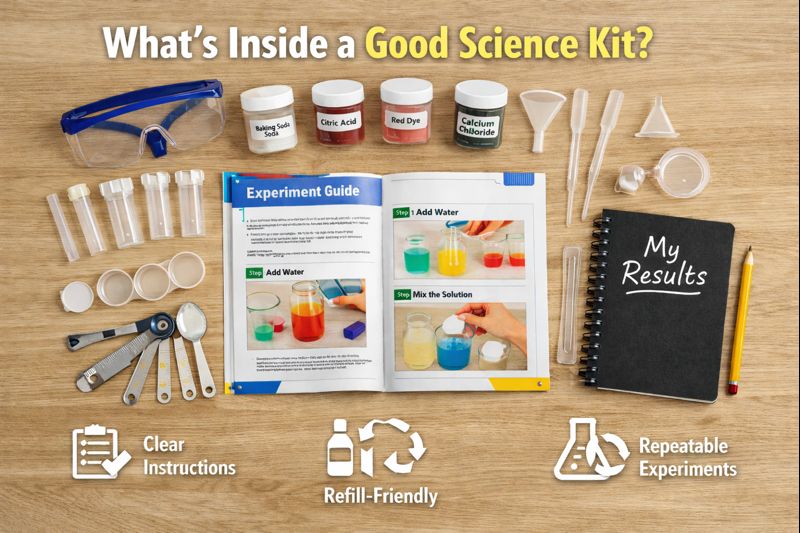
If you want science experiment kits that feel worth it, scan for these things:
- Clear instruction style: pictures + step-by-step (bonus if it explains “why”)
- Repeatable experiments: not a one-and-done
- Organized materials: labeled containers beat mystery baggies
- Real science, not just “crafts”: fun is great—but it should teach something
- Refill-friendly: common ingredients or easy-to-replace components
Quick gut-check question: Could a kid start this with only light help from you? If the answer is “absolutely not,” it might become your project, not theirs.
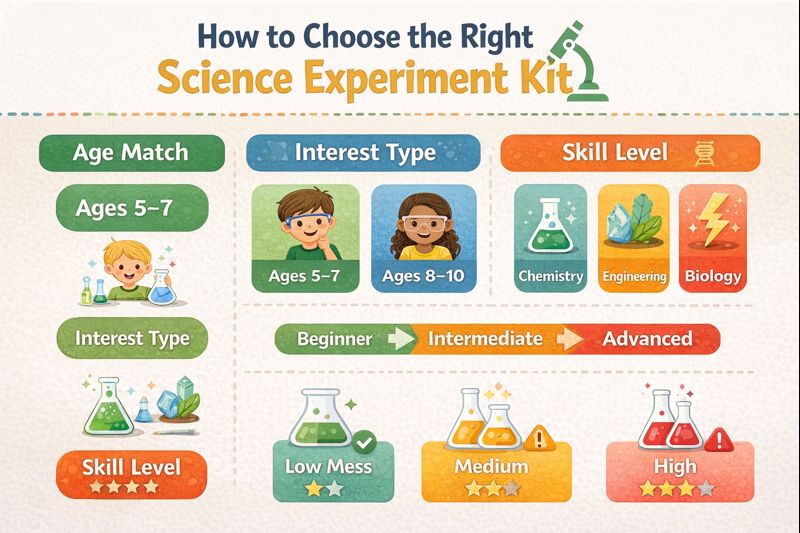
Choosing by age (and attention span)
Most “kid frustration” isn’t about science—it’s about mismatched expectations. Here’s the sweet spot:
Ages 5–7: “Wow now” science
Look for simple cause-and-effect (colors changing, magnets, basic mixing). Keep steps short.
Ages 8–10: Skill-building science
They can follow multi-step directions and start predicting outcomes. Great time for beginner chemistry, crystal growing, or simple circuits.
Ages 11–14: Real experiment mode
This is where science experiment kits can feel like actual science: variables, data, troubleshooting, and “why didn’t it work?” conversations that build real thinking.
Choosing by interest: chemistry, physics, biology, engineering
If you’re stuck, ask one question:
Do you want to mix it, build it, grow it, or figure it out?
- Mix it → chemistry kits (reactions, color changes, slime-with-a-purpose)
- Build it → engineering kits (structures, design challenges)
- Grow it → biology/nature kits (plants, crystals, ecosystems)
- Figure it out → physics/electronics kits (circuits, magnets, motion)
Matching the kit to their “curiosity style” is the fastest way to avoid the half-finished-box-of-sadness.

Chemistry-style kits: the “wow” factor
Chemistry kits are popular for a reason: they’re dramatic. A good one teaches:
- reactions (gas, heat, color change)
- mixtures vs. solutions
- observation and measurement
But here’s the secret: the best chemistry moments come from asking the next question:
- “What if we use less water?”
- “What changes if we stir longer?”
- “Which step mattered most?”
That’s science. Not memorizing. Testing.
Physics and electronics: lightbulb moments
If you’ve ever seen a kid’s face when a circuit finally works… yeah. It’s basically magic, but with logic.
Physics/electronics kits are amazing for:
- problem-solving
- patience (because troubleshooting is the lesson)
- confidence (because they made it work)
They’re also a stealth way to build early engineering thinking—without calling it that (because the moment you label it “learning,” kids get suspicious).
Biology and nature: slow science that builds patience
Not all science needs explosions. Biology and nature kits teach a different kind of skill: paying attention over time.
These are great for kids who:
- love animals, plants, rocks, weather
- enjoy collecting, sorting, observing
- get calmer when they can “check on something” daily
And if you want a sweet bonus: these kits often encourage journaling and drawing—perfect for kids who think visually.
Engineering builds: bridges, towers, and sturdy structures
Engineering is where science experiment kits turn into real-world thinking:
- “How do I make it stronger?”
- “Why did it collapse?”
- “What if I change the shape?”
If you want an easy extension that feels like a challenge (not homework), try a bridge build after your kit session. These bridge-building STEM activities are a fun next step when kids are ready to test strength, balance, and design tweaks.
Mess & safety: keep it fun, keep it safe
You don’t have to turn into the Fun Police™—just set the stage.
My go-to “calm chaos” setup:
- old towel or tray as the “lab zone”
- apron or old shirt = lab coat
- small cup of water + paper towels ready
- you do the “sharp/hot” parts, they do the rest
Also: if a kit includes powders and tiny tools, treat it like cooking—don’t taste, don’t touch your face, wash hands after.
Setting up your “kitchen-table lab”
Kids stick with science when it feels doable. So make starting easy.
The 2-minute setup trick
Keep a small bin with:
- measuring spoons/cups you don’t mind getting messy
- safety goggles (even cheap ones make kids feel legit)
- a notebook + pencil
- tape + scissors
When everything’s in one place, you get fewer “Where is the…?” interruptions and more actual experimenting.
The kid-friendly scientific method in 10 minutes
Forget formal lab reports. Do this instead:
- Question: “What are we testing?”
- Guess: “What do you think will happen?”
- Test: do the experiment
- Notice: “What did you see/smell/hear?”
- Explain: “Why do you think it happened?”
- Try again: change ONE thing
That last step is the secret sauce. Repeating with one change teaches real scientific thinking—without the boring vibe.
Confidence boosters: how kits help shy kids speak up
One underrated perk of science experiment kits: they give kids something to talk about that isn’t “look at me.”
A quiet kid might not jump into a group conversation… but they’ll happily say:
- “I think we added too much.”
- “Let’s try a smaller amount.”
- “The result changed when we…”
Science gives them a role: observer, tester, problem-solver. That’s powerful.
Getting more value: refills, repeats, and everyday add-ons
Want your kit to last longer? Treat it like a base, not a one-time event.
Easy add-ons (usually already at home):
- baking soda + vinegar (classic for a reason)
- food coloring (turns basic experiments into “I made a discovery”)
- cornstarch (non-Newtonian fluid = instant physics party)
- coins + paper clips + magnets (sorting, testing, graphing)
And if the kit has a “challenge” experiment, do it twice: once as instructed, then once with your kid choosing one variable to change.
Product Picks: 5 science experiment kits
Below are five science experiment kits with strong ratings and lots of buyer feedback, each with a clear “best for” use case.
1) Snap Circuits Jr. SC-100 Electronics Exploration Kit
Why it’s great: Hands-on circuits without soldering. Build real working projects and learn how electricity flows.
Notable features:
- Modular snap-together parts
- Tons of project combinations
- Strong “problem-solving” focus
Best for: Ages ~8+ (or younger with help), kids who love building, tinkering, and figuring things out.
2) NATIONAL GEOGRAPHIC Mega Science Lab Kit
Why it’s great: Variety pack energy—multiple experiment types so kids can bounce between interests.
Notable features:
- Mix of chemistry + other science themes
- Good for group or sibling use
- Big “gift” feel
Best for: Kids who get bored easily and want options (also great for classrooms).
3) NATIONAL GEOGRAPHIC Science Magic Kit
Why it’s great: The experiments feel like “magic,” but they’re really science principles in disguise—perfect for reluctant learners.
Notable features:
- High entertainment value
- Great for parties or science nights
- Easy to get kids to start
Best for: Ages ~8–12, kids who love surprises and “show me again!” reactions.
4) Playz Extreme Chemistry Experiment Set
Why it’s great: Chemistry-forward kit with a lab vibe—good for kids who want “real experiments,” not just crafts.
Notable features:
- Lots of experiments in one box
- Structured for repeat sessions
- Strong gift appeal
Best for: Ages ~8–13, kids who love mixing, testing, and observing changes.
5) UNGLINGA Science Lab Experiments Kit (100+ Experiments)
Why it’s great: Big set with tons of activities—ideal if you want long-term use and plenty of variety.
Notable features:
- Many experiments for repeated play
- Works well for sibling groups
- Strong “STEM toy” value
Best for: Families who want one kit that can power weeks of science time.
Research-backed: what studies and experts say
Hands-on learning isn’t just cute—it’s effective.
One large meta-analysis in PNAS (2014) compared traditional lecturing versus active learning across 225 studies and found that student performance improved in active learning settings, with exam scores improving by about 6% on average; students in lecture-heavy classes were also more likely to fail compared to active-learning classes.
Now, your kid isn’t in an undergrad STEM lecture—but the principle translates: when learners do the thinking (predicting, testing, explaining), they learn more deeply.
On the K–12 side, the National Research Council’s Framework for K–12 Science Education emphasizes science learning through scientific and engineering practices, crosscutting concepts, and core ideas—basically: science is something students practice, not just memorize.
That’s exactly why science experiment kits can be such a smart buy: they naturally push kids into observing, modeling, testing, and revising—without you having to “teach a unit.”
FAQs
What are the best science experiment kits for kids aged 8–12?
Look for kits with clear instructions, repeatable experiments, and a theme your kid already loves (chemistry “wow,” circuits, or nature). At this age, variety + independence matters most.
Are science experiment kits safe to use at home?
Most are safe with basic supervision. Choose age-appropriate kits, set up a “lab zone,” and make hand-washing and “no tasting” non-negotiable.
What should I look for in high-quality science experiment kits?
Clear steps, labeled materials, real explanations (not just “do this”), durable parts, and experiments you can repeat or extend with household items.
Do science experiment kits actually help with STEM learning?
Yes—especially when you encourage predicting, observing, and explaining. The learning sticks when kids test ideas and troubleshoot, not just follow steps.
What’s a good science kit gift for a kid who says they “hate science”?
Try a kit that feels like a trick: “science magic,” glow/light experiments, or a build-it electronics kit. The goal is momentum first—depth comes later.
If you want the easiest win: pick a kit that matches your kid’s personality, set it up like a tiny “lab,” and treat the first session like a hangout—not a lesson. You’ll be shocked how fast “I’m bored” turns into “Wait… can we try it again but different?” That’s the moment science becomes theirs.