Microscope for Kindergarteners: Kid-Safe Features

We may earn a commission for purchases made using our links. Please see our disclosure to learn more.
You know that moment when a kindergartener asks one question… and it turns into twelve? (“Why is the leaf bumpy?” “What’s that dot?” “Is it alive?”) That’s exactly why a microscope for kindergarteners can be such a win. It turns curiosity into a calm, focused kind of play the “I’m exploring!” vibe instead of the “I’m climbing the couch!” vibe.
In this guide, you’ll learn what actually matters when buying a kid-friendly microscope (and what’s just marketing glitter), how to pick the right style for your child, and which features keep it safe, sturdy, and easy to use.
Affiliate note: This post may include affiliate links, which means I may earn a small commission at no extra cost to you.
Why a microscope is the ultimate “slow-down” toy
A good kids microscope doesn’t just show tiny things. It teaches your child to pause, look closely, and describe what they notice. It’s like giving them “zoom glasses” for the real world.
Also, it’s surprisingly confidence-boosting. Kindergarteners love being the person who discovered “the sparkly dust on the rock” (spoiler: it’s probably sand… but let them have the glory).
What makes a microscope for kindergarteners actually work
A microscope can be “for kids” and still be frustrating. For kindergarten, the sweet spot is:
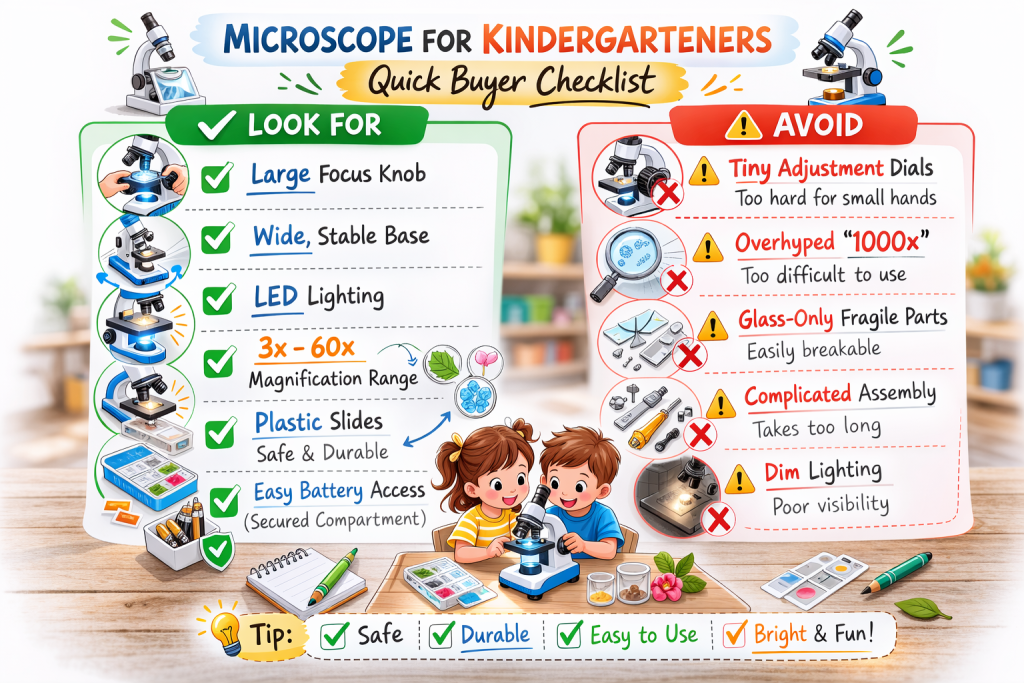
- Easy focusing (one big knob beats tiny precision dials)
- Low to moderate magnification (higher isn’t automatically better)
- Bright lighting (dim views = instant boredom)
- Simple specimen setup (no complicated slide prep required)
- Durable build (because… kindergarten)
Think of it like a bike: training wheels aren’t “lesser,” they’re how you get rolling without tears.
Real microscope vs toy microscope: the honest difference
Here’s the truth: some “toy microscopes” are basically plastic binoculars with vibes.
A real beginner microscope for kids (even a simple one) gives a clearer image and a smoother experience. But “real” doesn’t have to mean complicated. In fact, for kindergarten, simple is the whole point.
If your child loves building and tinkering, you can go a bit more “student microscope.” If they’re more of a “show me NOW” kid, go for a slide-free or pre-made-slide model.
Kid-safe features checklist
Rounded, stable, and hard to pinch
Look for a wide base, non-slip feet, and no obvious pinch points around hinges or stages.
Big controls
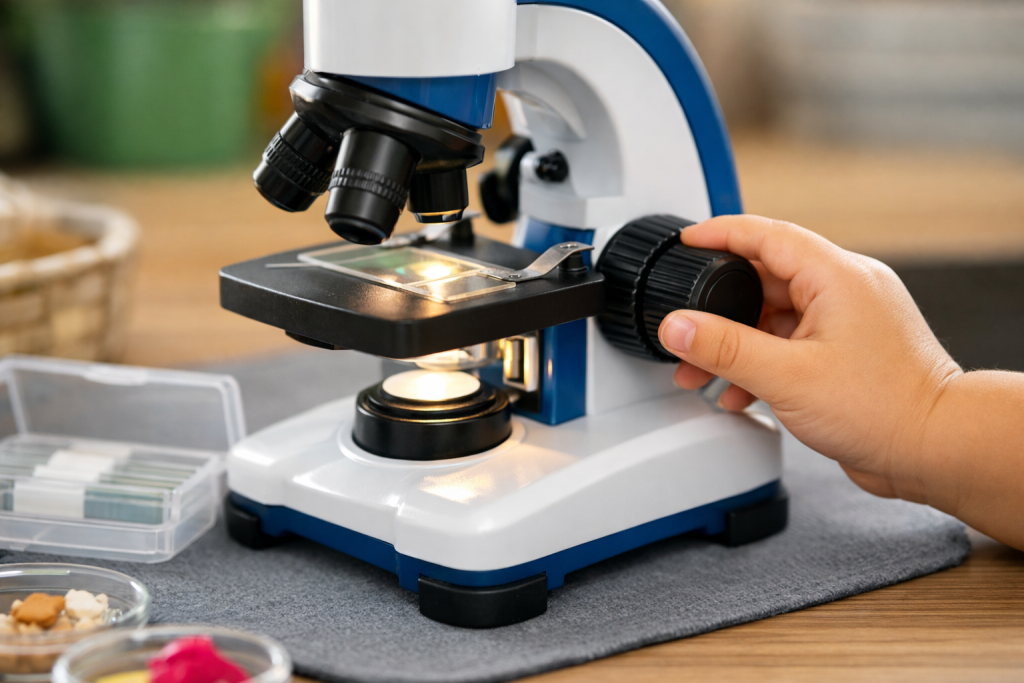
Kindergarten hands don’t do “tiny precision.” Big focus knobs and simple brightness controls matter.
Battery compartments that don’t pop open
If it needs a screwdriver to open, that’s usually a good thing.
Shatter-resistant parts
Plastic slides or pre-printed slides reduce stress (yours and theirs).
How much magnification does a kindergartener need
Most kindergarteners do best with low magnification that gives a wide, bright view. That’s where the “wow!” happens.
- 3x–10x is fantastic for textures (leaves, fabric, hair, paper fibers).
- 20x–60x starts to reveal more detail, especially with good lighting.
- 100x+ can be cool, but it’s harder to focus and easier to shake.
If a microscope screams “1000x!”, treat it like a cereal box that says “NOW WITH MORE FUN!” It might be true, but it’s not the whole story.
Digital vs optical microscopes
Optical (eyepiece) microscopes
Pros: no screens, simpler, often clearer for the price.
Cons: some kids struggle with keeping one eye aligned.
Digital microscopes (screen or phone-connected)
Pros: easier group viewing, less eye fatigue, fun to record.
Cons: can be glitchy, sometimes “digital zoom” looks fuzzy.
If you’re buying a microscope kit for children mainly for solo exploration, optical can be great. If you want siblings/friends to see the same thing without arguing, digital can save your sanity.
Slides, petri dishes, or “no-slide” viewing
This is where most kindergarten frustration happens.
- No-slide viewing: fastest start, lowest effort.
- Pre-made slides: still easy, very reliable “wow factor.”
- DIY slides: awesome later, but often too fiddly at first.
A good rule: if your child needs you to make it work every time, it won’t get used much.
Lighting matters more than you think
Magnification gets all the attention, but lighting is what makes the image clear.
Look for:
- LED light (bright, consistent)
- Adjustable brightness (so white paper doesn’t look like the sun)
- Top light + bottom light if you want flexibility (bottom for slides, top for opaque objects)
If the image looks dim, kids assume it’s “broken.” Totally normal. Totally avoidable.
Durability test: the “oops, it fell” factor
Ask yourself: Will this survive a backpack, a kitchen table, and a small human who forgets gravity exists?
Good signs:
- Chunky body, solid base
- Fewer fragile attachments
- Storage case or built-in storage
Also, don’t underestimate low refund risk features like a carry handle and fewer tiny loose parts.
Quick-start setup for busy adults
If you want this to become a real routine, aim for a setup that takes under 3 minutes:
- Keep the microscope in one spot (a “science corner” is magic)
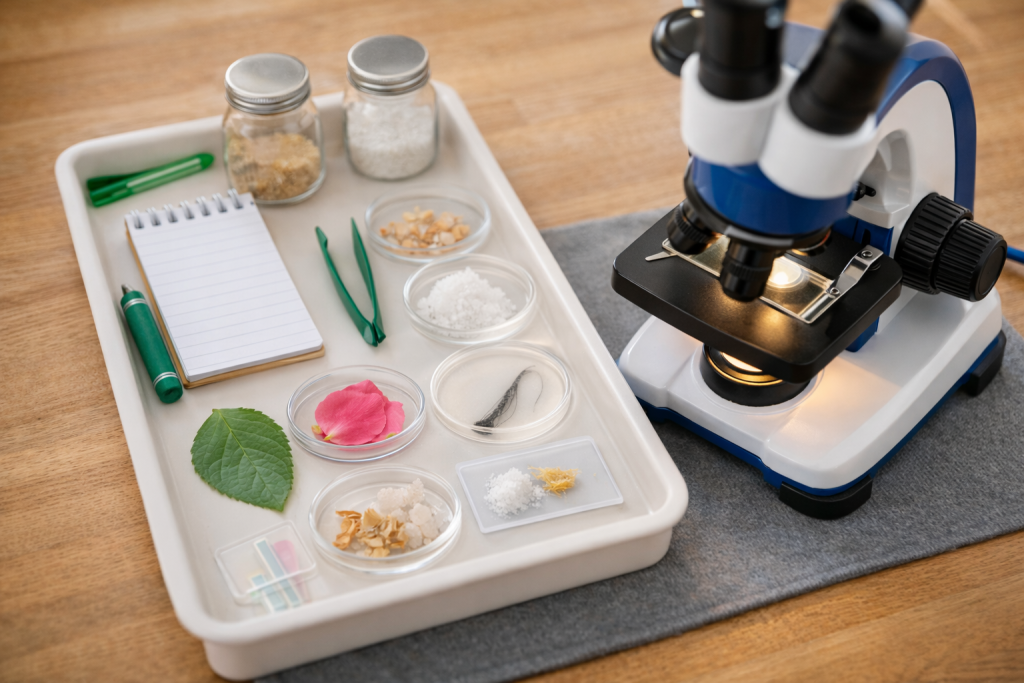
- Keep a small tray with “specimens of the week”
- Teach one habit: start on the lowest power
- Celebrate the first clear view like it’s a trophy (because to them, it is)
What to look at first: 10 easy specimens kids love
Here are kindergarten-friendly “first wins” that don’t require lab skills:
- A leaf (especially the underside)
- Flower petal
- Salt vs sugar (tiny crystals!)
- Onion skin (thin and see-through)
- A strand of hair
- Fabric (t-shirt vs towel)
- Pencil shavings
- Paper (construction paper is wild up close)
- Sand or dirt (so many textures)
- A fingerprint smudge on tape
Let them choose too. Giving control makes the experience feel like their discovery.
Keeping it clean and not losing pieces
Microscopes don’t need intense maintenance, but they do need “kid-proof systems.”
Simple cleaning habits
- Use a soft cloth for lenses (no shirts, no tissues if you can help it)
- Turn off the light after use
- Put slides back in a case immediately
Storage that actually works
If parts live in one box, you’ll use them. If parts live in five drawers, you’ll eventually own “a microscope… minus the thing that makes it work.”
Product Section: 5 picks that fit kindergarten
Below are five real options that match the goal of a microscope for kindergarteners: simple, sturdy, and designed for early STEM exploration.
1) Carson MicroBrite Plus 60x–120x Pocket Microscope (MM-300)
Short description: A pocket microscope that’s easy to grab and use anywhere. Great for “field trip in the backyard” kids.
Features:
- 60x–120x magnification
- Built-in LED light
- Compact, handheld design
Best for: Curious kids who love rocks, leaves, and random sidewalk treasures (and families who want minimal setup).
Why it’s low-drama: Tons of global ratings and a steady reputation for being a “works out of the box” option.
2) Educational Insights GeoSafari Jr. KidScope
Short description: A slide-based microscope designed to feel comfortable for kids (including a double eyepiece so it’s less “squint and struggle”).
Features:
- Double eyepiece (kid-friendly viewing)
- Pre-printed slides included (fast “wow” moments)
- Simple focus knob + LED light
Best for: Kids who like predictable results and parents/teachers who want fewer “it’s not working!” moments.
Ratings note: Strong global rating volume reported across Amazon regions.
3) SWIFT SW200DL Compound Monocular Microscope
Short description: More “student microscope” than “toy,” but still beginner-friendly if you want room to grow past kindergarten.
Features:
- Dual light (top + bottom illumination)
- Multiple magnification levels (good for longer-term use)
- Sturdy build compared to many kids kits
Best for: Families who want one microscope that can follow your child into early grade school.
Heads up: It’s bigger and more “real lab,” so it’s best with some adult guidance early on.
4) Carson MicroFlip 100x–250x Pocket Microscope (MP-250)
Short description: A pocket microscope with a wider magnification range, plus a digiscoping clip for sharing what they see.
Features:
- 100x–250x magnification range
- Smartphone clip (great for group viewing)
- LED/UV lighting on some versions
Best for: Kids who love showing people their discoveries (“Look! LOOK! Everyone LOOK!”).
Ratings note: High volume of global ratings reported on Amazon UK.
5) Students Pocket Microscope (100x–500x, 8 LED Lights)
Short description: A handheld option with built-in lighting and a wide zoom range, designed for quick viewing without a whole desk setup.
Features:
- 100x–500x zoom range
- Multiple LEDs for brighter viewing
- Portable for outdoor exploration
Best for: Kids who won’t sit still for long (this one keeps up with them).
Ratings note: Listed with a high review count and a 4.2+ rating on Amazon.
Want a cute follow-up activity after microscope time? Pair it with hands-on building using STEM activities with popsicle sticks so your child gets both “observe” and “create” in one week. (It’s also a lifesaver on rainy afternoons.)
How to choose based on your child’s personality
This sounds fluffy, but it’s actually practical:
- The “I need it NOW” kid: go pocket microscope or pre-made slides
- The careful, patient kid: slide microscope can be amazing
- The social kid: choose something easy to share (phone clip or screen)
- The outdoors kid: handheld wins
- The “this will be a long-term hobby” kid: a sturdier student-style microscope makes sense
You’re not just buying a tool. You’re buying a routine your kid will actually use.
🧪 Research-backed: what studies say about early STEM tools
Here’s the credibility piece without making it feel like homework.
Guided inquiry works especially well
A 2012 meta-analysis on inquiry-based science teaching found that inquiry instruction can boost learning, and it also highlighted a big nuance: kids tend to do better when inquiry includes teacher guidance (simple prompts, modeling, and “try this next” support) rather than being totally hands-off. That’s basically the sweet spot with kindergarten science: you let them explore, but you’re still the friendly co-pilot.
Early STEM is growing fast, and digital activities are becoming common
A 2024 systematic review of early childhood STEM teaching methods looked at 29 publications (2014–2023) and reported that digital activities and impact-focused studies have become especially common in early childhood STEM research. That matches what many families notice: kids love tools that let them see and share discoveries (photos, zoom, “come look!” moments).
FAQs: microscope for kindergarteners
What is the best microscope for kindergarteners?
The best choice is one your child can use with minimal help: big controls, bright lighting, and either slide-free viewing or reliable pre-made slides.
Is a digital microscope better for kindergarten?
It can be, especially if your child gets frustrated with eyepieces or if siblings want to view together. Optical microscopes can still be great when they’re simple and bright.
What magnification should a kids microscope have for ages 4–6?
Low magnification is often best. It’s easier to focus, brighter to view, and still gives plenty of “wow” for textures and everyday objects.
Are microscope slides safe for kindergarteners?
Yes, especially plastic slides or pre-made slides. If you use glass slides, adult supervision is smart, and you’ll want a storage case so they aren’t loose.
How do I get my child to actually use the microscope?
Make it a tiny ritual: keep it set up in one spot, pick 3–5 “specimens of the week,” and let them be the boss of what to zoom in on first.
Conclusion
A microscope for kindergarteners doesn’t need to be fancy. It needs to be easy, sturdy, bright, and kid-proof. If you match the microscope style to your child’s personality (and your patience level), it turns into the kind of toy that gets used again and again, not the kind that quietly disappears into a closet.
Pick one solid option, set up a simple “science corner,” and let your child fall in love with the tiny world. The big learning usually starts with a small “whoa.”