Fun Pumpkin STEM Activities
We may earn a commission for purchases made using our links. Please see our disclosure to learn more.
Some fall activities look adorable on Pinterest and then completely fall apart in real life. You set out the pumpkin, grab the markers, and five minutes later someone is bored, someone is sticky, and you are wondering why this “simple learning moment” feels like a tiny orange disaster.
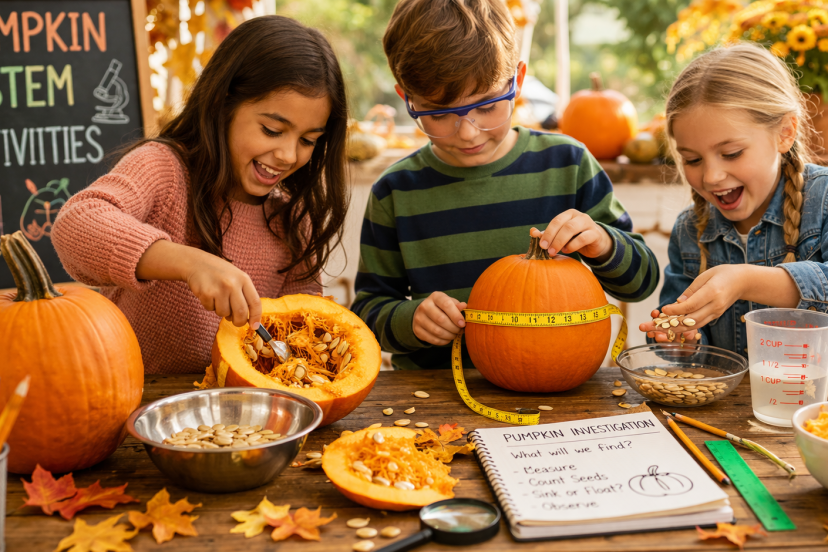
That is exactly why Pumpkin STEM Activities work so well. They give kids something real to touch, test, compare, build, and question. Instead of forcing learning, you sneak it in through curiosity. A pumpkin becomes a science lab, a math tool, a sensory bin, and a design challenge all at once.
In this article, you’ll find easy pumpkin-based ideas that help kids explore science, technology, engineering, and math without making it feel like a formal lesson. You’ll also get product suggestions, age-level tweaks, and a research-backed reason these activities are worth the mess.
Affiliate note: This article includes a few Amazon product suggestions, and I may earn a small commission from qualifying purchases at no extra cost to you.
Why Pumpkin STEM Activities Work So Well
Pumpkins are basically nature’s version of a hands-on learning kit. They’re big, textured, measurable, cuttable, scoopable, and weird enough to make kids ask questions right away.
Why is it heavier than it looks?
Why do some pumpkins roll differently?
Why do the seeds stick together?
Why does one float and another barely bob?
That kind of natural curiosity is the sweet spot for STEM.
Kids Learn More Than You Think
A good pumpkin activity is never just “playing with a pumpkin.” It quietly builds real skills.
Science skills
Kids observe, predict, compare, test, and record what happens.
Math skills
They count seeds, measure circumference, compare weight, and sort by size.
Engineering skills
They build ramps, design catapults, test structures, and solve little design problems.
Soft skills too
They practice patience, teamwork, messy problem-solving, and the brave art of trying again when something flops.
Set Up a Pumpkin Lab Without Losing Your Mind
You do not need a perfect classroom setup. You need a smart one.
Use a tray, old towel, or plastic tablecloth. Keep paper towels nearby. Give kids a simple job before starting, like “You’re the seed counter” or “You’re in charge of measuring.”
A few basic supplies go a long way:
- pumpkins in different sizes
- measuring tape or ruler
- bowls or cups
- baking soda and vinegar
- markers
- kid-safe carving tools
- recording sheet or plain paper
The less you overcomplicate it, the better it usually goes.
Try a Pumpkin Sink-or-Float Test
This one is always a hit because kids usually have strong opinions before the test even starts.
Fill a bin, tub, or sink with water. Then test mini pumpkins, medium pumpkins, and pumpkin pieces. Ask kids to predict first.
Questions to ask
- Does size decide whether it floats?
- What happens if the pumpkin is cut open?
- Do seeds float too?
- What changes when the pumpkin starts to age?
This is a simple way to introduce buoyancy without sounding like a textbook.
Turn Pumpkin Measuring Into Real-World Math
Pumpkins are perfect for measurement because they are lumpy, curved, and not neatly shaped like classroom objects.
Let kids:
- measure height
- measure circumference
- compare width
- estimate weight
- line up pumpkins from smallest to biggest
Then ask, “Which measurement surprised you?” That question alone often gets better thinking than a worksheet ever could.
Make a Pumpkin Volcano
If you want the dramatic moment, here it is.
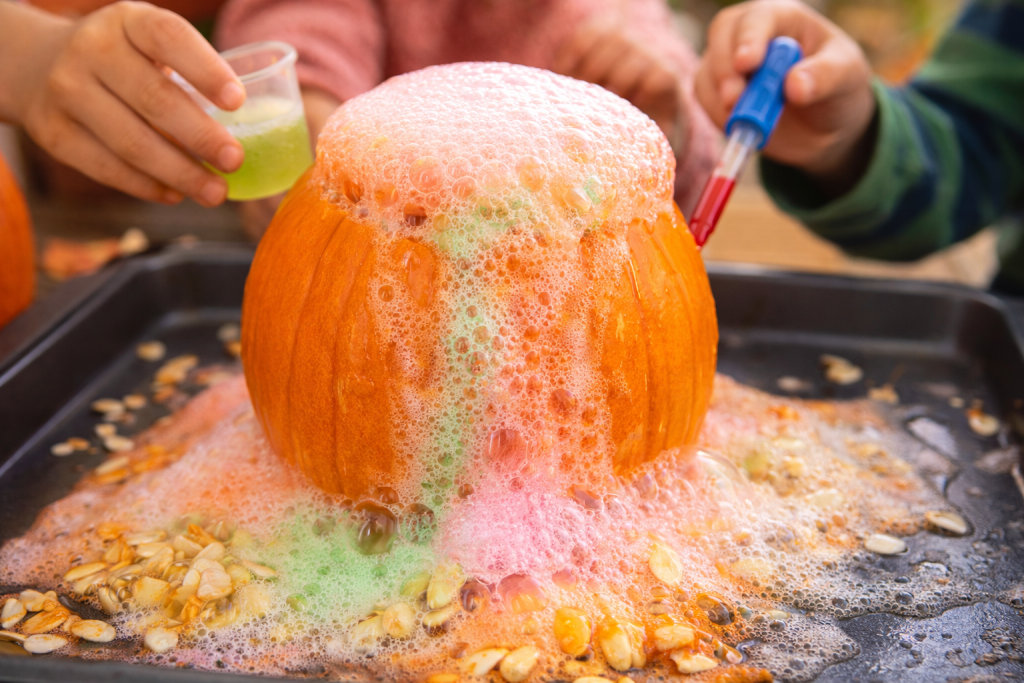
Cut open a pumpkin and scoop part of it out. Put a cup or small space inside for baking soda. Add a few drops of food coloring if you want extra flair. Then pour in vinegar.
Foam. Bubbles. Cheers. Probably a little shrieking.
What kids can learn
The fun part is the reaction, but the learning part is the pattern. Kids can compare what happens when they use more vinegar, more baking soda, or a bigger opening.
It feels like a Halloween party trick, but it is still a real chemical reaction lesson.
Explore Pumpkin Seeds With Sorting and Counting
Pumpkin seeds are tiny math manipulatives pretending to be snack material.
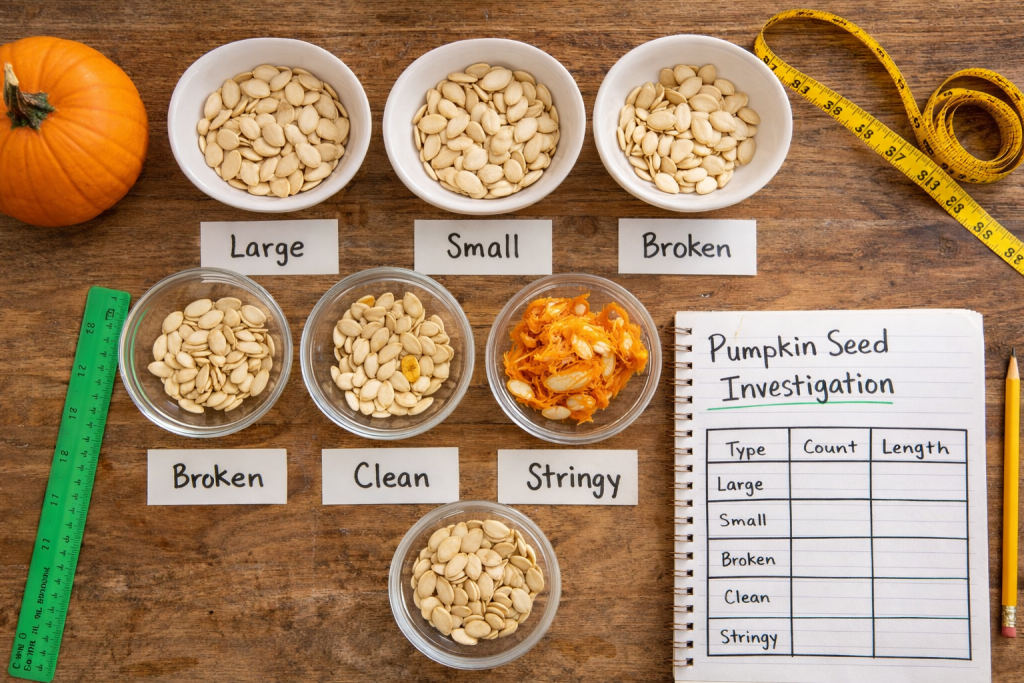
Have kids sort seeds by:
- size
- color
- shape
- clean vs. stringy
- broken vs. whole
Then move into counting, skip counting, grouping by tens, or making simple graphs.
For older kids, ask them to estimate first and then count to see how close they were. That little prediction step adds real mathematical thinking.
Test Pumpkin Ramps and Rolling Distance
Not all pumpkins roll the same, and that is where the fun begins.
Build a simple ramp from cardboard, a board, or a baking tray. Roll different pumpkins and compare what happens.
Things to test
- smooth vs. bumpy pumpkins
- round vs. tall pumpkins
- steep ramp vs. gentle ramp
- starting from different heights
This turns basic motion and force into something kids can see with their own eyes.
Build a No-Carve Pumpkin Engineering Challenge
This is a lifesaver when you want less mess but still want real thinking.
Challenge kids to build something with or around a pumpkin:
- a tower that supports a mini pumpkin
- a bridge for a pumpkin to cross
- a protective “pumpkin landing pad”
- a pumpkin stand that keeps it from rolling
Use tape, craft sticks, rubber bands, cardboard, blocks, or recycled materials.
It is basically engineering in a sweater.
Compare Fresh and Aging Pumpkins
This one is slower, but honestly, it is one of the richest science activities.
Leave one pumpkin whole. Cut another open. Observe them over several days.
Track changes like:
- smell
- softness
- color
- mold
- moisture
- seed appearance
Kids start noticing decomposition, life cycles, and change over time without needing a lecture. They just need permission to keep observing.
Use Pumpkin Guts for Sensory Science
Some kids love pumpkin guts. Some react like you just handed them alien noodles. Both responses are useful.
Ask descriptive questions:
- Is it slippery or sticky?
- Does it stretch?
- Is it cold?
- Does it smell sweet, earthy, or strange?
This kind of language-rich exploration supports science talk and sensory development at the same time. It is especially helpful for younger learners who learn best through touch and vocabulary.
Turn a Pumpkin Taste Test Into Data
If you are using edible pumpkin foods, you can turn snack time into data collection.
Try roasted pumpkin, pumpkin bread, pumpkin puree, or pumpkin seeds. Then make a simple chart for kids to record favorites.
Graphing ideas
- favorite taste
- favorite texture
- sweetest option
- crunchiest option
It is a sneaky way to mix observation, comparison, and basic graphing into something delicious.
Adapt Pumpkin STEM Activities for Different Ages
The trick is not making every child do the same thing. The trick is giving the same theme different levels.
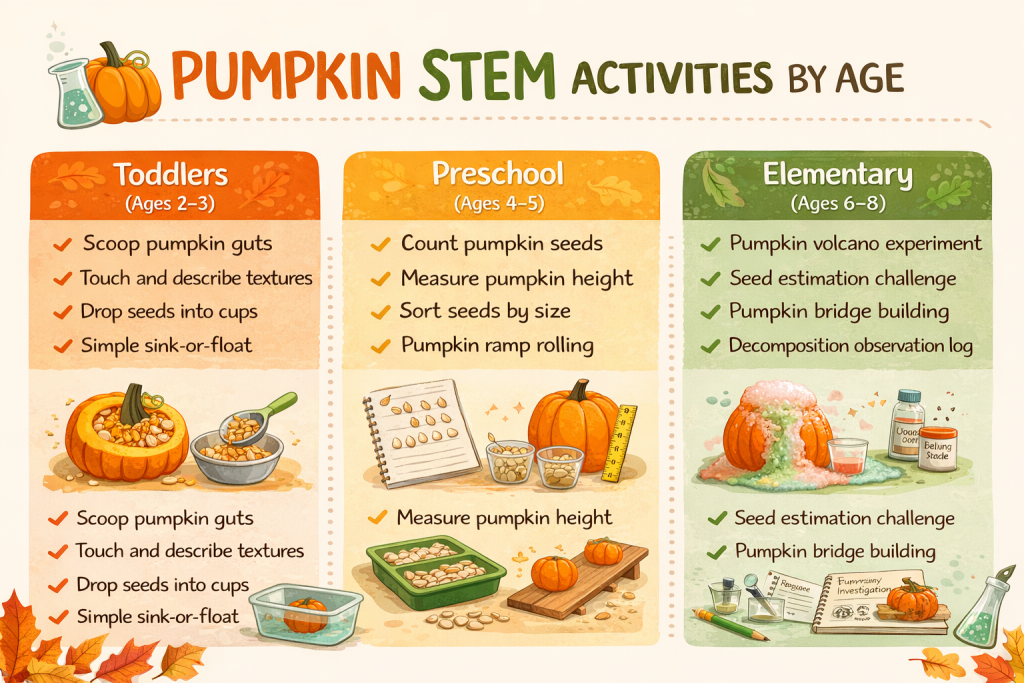
Toddlers and preschoolers
Focus on scooping, touching, pouring, sorting, and simple prediction.
Kindergarten and early elementary
Add measuring, counting, graphing, and recording observations.
Older kids
Push into variables, data tables, decomposition logs, and engineering redesigns.
And if you want a calmer follow-up after all the pumpkin chaos, these toddler puzzles that build logic and problem-solving make a nice next step for quiet hands-on learning.
Best Tools for Pumpkin STEM Activities
Learning Resources Jumbo Eyedroppers
Short description: Great for pumpkin goo transfer, vinegar experiments, and fine-motor practice.
Features: Kid-sized droppers, colorful set, stand for storage.
Who it’s for: Preschoolers and early elementary kids doing liquid-based pumpkin science.
Learning Resources Primary Science Jumbo Test Tubes
Short description: Useful for collecting seeds, comparing liquids, or making mini pumpkin experiment stations.
Features: Six jumbo test tubes, caps, stand, and activity guide.
Who it’s for: Kids who like sorting, mixing, and setting up simple investigations.
Learning Resources Mix and Measure Activity Set
Short description: A smart pick for pumpkin math activities involving volume, spooning, and comparing quantities.
Features: Scale, bowl, spoons, cups, and activity cards.
Who it’s for: Families or teachers who want one kit that supports early measurement skills.
hand2mind Math Balance
Short description: Helpful for comparing pumpkin seed weights and introducing equality in a visual way.
Features: Self-correcting balance, numbered beam, storage compartments, hanging weights.
Who it’s for: Kindergarten and elementary learners exploring weight, comparison, and number sense.
Pumpkin Masters Halloween Pumpkin Carving Kit
Short description: A practical tool for pumpkin anatomy, carving design, and safe-ish supervised STEM exploration.
Features: Four carving tools and stencil patterns for guided designs.
Who it’s for: Older kids, classrooms, or families doing supervised pumpkin cutting and design challenges.
What the Research Says About Playful STEM
A 2022 systematic review on hands-on STEM learning for young children looked at 36 eligible studies and found that informal STEM experiences can support school readiness and STEM skill growth, especially when adults use questioning, scaffolding, and meaningful interaction. In plain English: kids learn more when grown-ups stay curious with them instead of taking over.
A 2022 expert review on playful learning in early childhood explains that playful learning supports active, meaningful, socially interactive, and iterative learning, and can outperform more rigid, didactic approaches. That is exactly why pumpkin investigations work so well. They feel like play, but they create real learning.
Common Mistakes That Make Pumpkin Activities Flop
One big mistake is doing all the thinking for the child. It is tempting, especially when you are busy. But STEM gets stronger when kids predict first, test second, and explain third.
Another mistake is making the activity too polished. Real STEM is a little messy. The pumpkin tips over. The ramp fails. The vinegar overflows. That is not failure. That is data with bad manners.
Also, do not make every activity last forever. A sharp 15-minute investigation can teach more than a dragged-out hour.
FAQ About Pumpkin STEM Activities
What pumpkin STEM ideas are most suitable for preschoolers?
The best ones are simple, sensory, and hands-on: scooping guts, sorting seeds, using droppers, and testing whether mini pumpkins sink or float.
How do you turn pumpkins into a STEM lesson?
Start with a question. Ask kids to predict, test, observe, and explain. That one shift turns a seasonal craft into real STEM learning.
Are Pumpkin STEM Activities good for classrooms?
Yes. They work well for centers, small groups, and whole-class demos because one pumpkin can support science, math, and engineering all at once.
What supplies do I need for easy pumpkin science experiments?
A pumpkin, a tray, bowls, measuring tools, baking soda, vinegar, markers, and paper are enough to start.
Can older kids still enjoy pumpkin STEM projects?
Absolutely. Older kids can collect data, compare variables, redesign structures, and keep observation logs over several days.
Conclusion
Pumpkin STEM Activities are one of those rare wins that feel festive, useful, and genuinely fun. You are not just filling time in the fall. You are helping kids notice, question, test, measure, and think like little scientists and engineers.
So keep it simple. Pick one pumpkin. Ask one good question. Let the mess happen a little. That is usually where the best learning starts.