
Bridge Building STEM Activities: 5 Kits for Structural Engineering
We may earn a commission for purchases made using our links. Please see our disclosure to learn more.
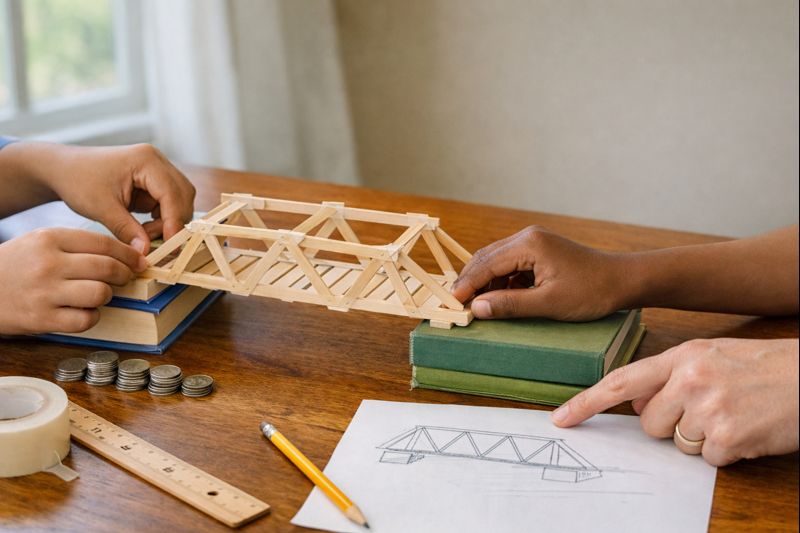
Ever tried a “simple” bridge build with kids… and somehow ended up in a tiny engineering crisis where the bridge collapses, someone gasps dramatically, and you’re holding a glue bottle like it’s a fire extinguisher?
Yeah. Same energy.
That’s exactly why Bridge Building STEM Activities are so good: they turn big, intimidating engineering ideas into something you can actually touch, test, and laugh about—even when the first version flops.
In this guide, you’ll get bridge ideas that work at home or in a classroom, a kid-friendly engineering process, easy ways to test strength without chaos, and products that make the whole thing smoother.
Affiliate note: This article includes affiliate links in the product section, which may earn a small commission at no extra cost to you.
Why Bridge Building STEM Activities Click With Kids (and Adults)
Bridges are basically “real-life magic.” You put a path over a gap and suddenly two places can connect.
Kids feel that instantly.
And STEM-wise, bridge building sneaks in the good stuff:
- Problem-solving (Why did it fail?)
- Design thinking (What can we change?)
- Math (measuring, counting, comparing)
- Science (forces, materials, balance)
- Confidence (“Wait… I built that?!”)
The best part? It’s not about perfection. It’s about iteration—aka the “try, tweak, try again” muscle.
The Tiny Story Behind Every Bridge: Your “Why” Moment
Here’s a fun question to ask before you start:
“Who is this bridge for?”
Because the moment kids have a reason, the build gets personal.
Maybe it’s:
- A bridge to help toy animals cross a “river”
- A bridge strong enough for a toy car delivery
- A bridge to connect two “villages” in a made-up world
That little story turns a craft into an engineering mission. And suddenly, you’re not “just building.” You’re solving a problem with purpose.
The Engineering Design Process (Kid-Friendly Version)
If “engineering design process” sounds like a textbook, don’t worry. Here’s the kid version that actually sticks.
Ask
What does the bridge need to do?
- Span 20 cm?
- Hold 10 coins?
- Let a toy car cross?
Imagine
Brainstorm a few ideas. Even silly ones. Especially silly ones.
Plan
Sketch it. Quick and messy is fine. A napkin sketch counts.
Create
Build the first version.
Improve
Test, spot weak points, and upgrade.
If you want one phrase kids remember, try: “Build. Break. Learn. Repeat.”
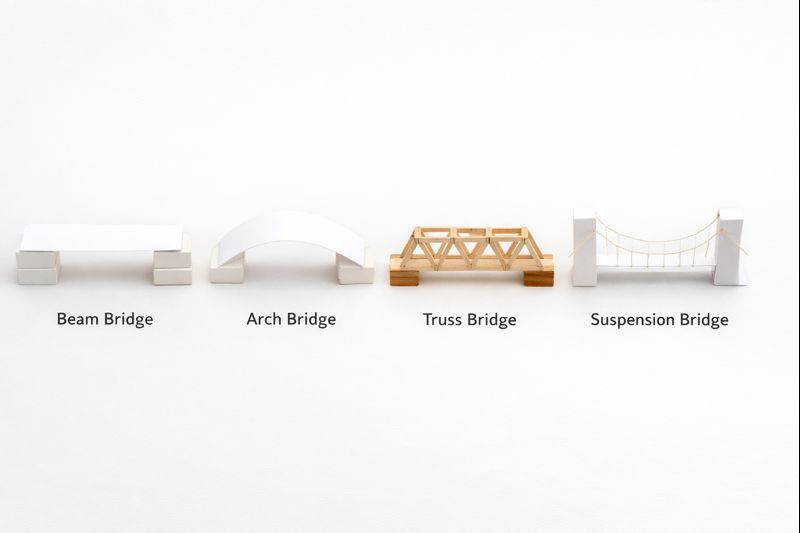
Quick Bridge Types Cheat Sheet: Beam, Arch, Truss, Suspension, Cable-Stayed
Different bridges solve different problems. Let kids pick one “style” to copy—or mix styles like tiny bridge artists.
Beam bridge
The simplest: a flat span supported at both ends.
Great starter bridge.
Arch bridge
A curved shape that redirects weight outward.
Surprisingly strong when done right.
Truss bridge
Triangles everywhere (because triangles are drama-free and stable).
Best for strength challenges.
Suspension bridge
A deck held by hanging cables.
Fun for older kids + string lovers.
Cable-stayed bridge
Cables connect directly from towers to the deck.
Looks fancy, teaches tension fast.
Materials That Actually Work (and What to Avoid)
You don’t need expensive supplies. You need predictable materials.
Best beginner materials
- Popsicle/craft sticks
- Straws
- Index cards
- Paper (folded paper is secretly powerful)
- Tape (masking tape is a classic)
- String/yarn
What makes builds frustrating
- Super bendy cardboard
- Slippery tape that won’t stick
- Glue that takes forever to set (tiny patience levels, remember?)
Pro tip: If you’re doing a timed challenge, pick tape-only or glue-only so you don’t end up with tape-glue chaos. (It’s a real genre.)
How to Run a Bridge Building Challenge at Home
Home challenges work best when they’re short and clear.
A simple home setup
- Create the gap: two books with space between.
- Set the rules (pick 2–3 max):
- Only 20 sticks
- Only 30 cm tape
- Must hold 10 coins
- Build for 15–25 minutes
- Test
- Do one improvement round
Make it feel like a game
- Give the bridge a name (kids love this)
- Add a “client” (toy bear needs to cross for snacks, obviously)
How to Run a Bridge Building Challenge in a Classroom or Club
Group builds are amazing… if roles are clear.
Easy team roles
- Designer (sketches)
- Builder (assembles)
- Tester (adds weights + records results)
- Reporter (shares what changed and why)
Keep the vibe positive
Instead of “This failed,” use:
- “This is our first prototype.”
- “We found a weak point.”
- “Our next version will…”
That language teaches real engineering culture: failure is data, not a verdict.
The Fun Part: Load Testing Without Tears
Testing is where the magic happens—if it feels safe and fair.
Safer testing options
- Coins (easy to count and increase gradually)
- Washers
- Small bags of rice (gentle and adjustable)
- Toy car “drive test” (if the bridge is stable)
The rule that prevents heartbreak
Add weight slowly.
One at a time. Pause. Observe. Record.
When a bridge collapses, keep it light:
“Okay, that was dramatic. What do you think gave up first?”
Make It Inclusive: Ages, Abilities, and Different Learning Styles
Bridge building should feel welcoming—not like a competition only “the building kids” can win.
For younger kids
Focus on:
- Stacking
- balancing
- experimenting with “what holds?”
If you’re supporting very early learners, you can also build their foundation with hands-on play first—here’s a helpful guide to developmental toys for infants that support early problem-solving and fine-motor skills.
For neurodivergent learners
Try:
- Visual instructions (simple picture steps)
- Predictable routines (build → test → improve)
- Choice-based challenges (“Pick your bridge type”)
For kids with limited hand strength
Offer:
- Larger materials (wide craft sticks, thicker straws)
- Pre-cut tape strips
- Clip-style connectors where possible
Engineering belongs to everyone. Period.

Add Math Without the Eye-Roll: Measuring, Ratios, and Data Tables
Math lands better when it answers a real question.
Easy math add-ons
- Measure the span length
- Count how many weights it holds
- Track “strength per stick” (weights ÷ number of sticks)
A simple data table kids can handle
- Bridge type
- Materials used
- Max coins held
- What we changed in version 2
Suddenly, they’re doing engineering documentation… without calling it that.
Add Science Without the Yawn: Forces, Materials, and Failure
Bridge science is basically “why things fall down” (kids are naturally interested).
Quick force vocabulary (kid-friendly)
- Compression: squishing
- Tension: pulling/stretching
- Load: what the bridge is carrying
- Distribution: spreading weight out
The most useful idea
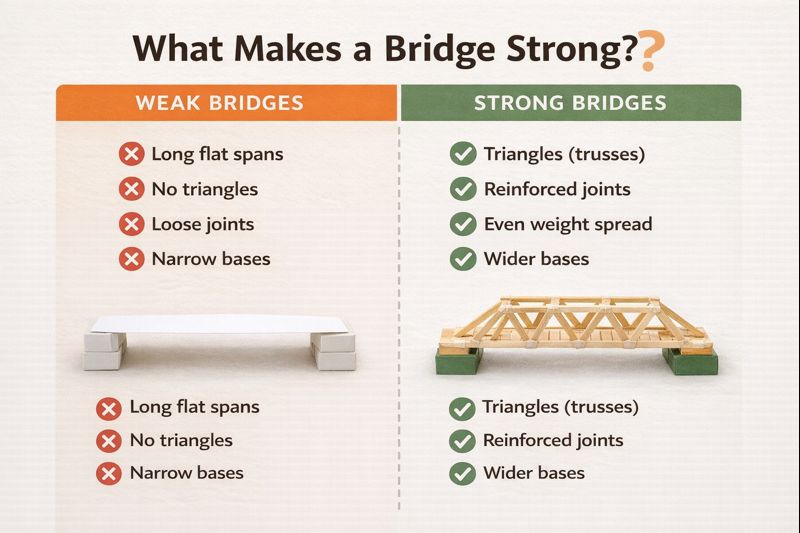
Triangles spread force better than rectangles.
That’s why truss bridges are such overachievers.
Common Bridge Problems (and Fixes That Actually Work)
If your bridge fails, it’s usually one of these:
Problem: It bends in the middle
Fix:
- Add a truss (triangles on the sides)
- Fold paper into a beam (like a “U” or triangle tube)
Problem: The joints are weak
Fix:
- Reinforce joints with small tape “tabs”
- Overlap sticks instead of end-to-end connections
Problem: It twists sideways
Fix:
- Add cross-bracing (an “X” pattern)
- Make the base wider
Tell kids: “We’re not starting over—we’re upgrading.”
Mini Bridge Challenges You Can Rotate All Year
Want variety without reinventing the wheel? Rotate these:
- The Penny Challenge: hold the most pennies with 20 sticks
- The Long Span Challenge: longest bridge that still holds 5 coins
- The Budget Build: limited tape + limited sticks
- The Moving Load: a toy car must cross
- The Earthquake Test: gentle shake table (cookie sheet wiggle)
Each one teaches a different engineering priority: strength, efficiency, stability, or real-world motion.
Bridge Building STEM Activities for Different Age Groups
Here’s a quick guide so you’re not accidentally giving a kindergartener a “suspension cable optimization problem.”
Ages 4–6
- Paper bridges
- Straw bridges
- Big craft sticks + tape
Ages 7–9
- Popsicle stick trusses
- Simple arch experiments
- Coin-based load testing
Ages 10–13
- Full truss designs
- Suspension/cable-stayed builds
- Data tracking + redesign cycles
Teens
- Constraint-based engineering
- Material efficiency scoring
- Real bridge case studies + design arguments
5 Kits and Supplies for Bridge Building
Below are five solid choices for bridge building challenges—great for home, classrooms, STEM clubs, or weekend “let’s build something cool” energy.
1) Learning Resources STEM Explorers Bridge Builders (Activity Set)
Short description: A friendly, hands-on set made for younger builders learning structure basics.
Features:
- Buildable pieces designed for repeated use
- Great for guided challenges and open-ended builds
- Easy setup for small groups
Use cases (who it’s for): - Parents and teachers working with early elementary kids
- STEM centers, makerspaces, and small groups
2) K’NEX Education Intro to Structures: Bridges Set
Short description: A classroom-style kit that leans into real bridge concepts—especially trusses and structural stability.
Features:
- Durable build pieces for repeated prototypes
- Great for teamwork and role-based building
- Strong fit for design-process lessons
Use cases (who it’s for): - Grades 3–6 engineering challenges
- Homeschool STEM units and after-school clubs
3) Thames & Kosmos Structural Engineering: Bridges & Skyscrapers
Short description: A structured kit that mixes building with learning—perfect for kids who like to know the “why” behind the build.
Features:
- Focus on structural engineering concepts
- Guided builds that lead into experimentation
- Great for independent learners
Use cases (who it’s for): - Upper elementary and middle school
- Kids who enjoy detailed projects and step-by-step builds
4) Engino Discovering STEM: Structures—Buildings & Bridges
Short description: A deeper engineering-style set that explores multiple bridge types and structural forces.
Features:
- Builds include different bridge models
- Strong “learn + build + test” flow
- Great for longer STEM sessions
Use cases (who it’s for): - Ages 9+ who want more challenge
- STEM clubs and project-based learning units
5) GUSTO 1000 Count Wooden Popsicle Sticks (Multi-Purpose Craft Sticks)
Short description: Not a “kit,” but a bridge-building essential—especially for truss and prototype challenges.
Features:
- Bulk quantity for repeated builds
- Great for classrooms or big sibling groups
- Perfect for constraint challenges (“You only get 25 sticks!”)
Use cases (who it’s for): - Teachers, homeschoolers, and makerspaces
- Anyone doing popsicle stick bridge challenges regularly
Research-Backed Why This Works
If you’ve ever wondered, “Is this just play… or is it actually learning?”—it’s both.
Hands-on engineering supports real K–12 learning goals
The National Academies discuss how engineering in K–12 connects naturally with science, math, and problem-solving—and why design-based tasks help students learn how ideas work in the real world (not just on paper). See engineering learning goals in K–12 education.
Building activities strengthen spatial thinking (a key STEM skill)
A 2020 meta-analysis in Frontiers in Psychology reviewed 20 spatial-intervention studies (2009–2020) with children ages 0–8 and found spatial skills are malleable early—and strongly connected to later STEM pathways. Bridge building is basically spatial thinking with snacks nearby. Here’s the meta-analysis on early spatial skills training.
FAQs About Bridge Building STEM Activities
What are the best Bridge Building STEM Activities for beginners?
Start with a beam bridge using paper or craft sticks, then test with coins. Keep rules simple: one material, one span length, one goal.
How can I reinforce a popsicle stick bridge to make it sturdier without adding extra sticks?
Reinforce joints (overlap connections), add triangles along the sides (truss), and widen the base to reduce twisting.
What’s the easiest way to test bridge strength at home?
Use coins or washers and add them one at a time, recording the total. Slow testing keeps it fair—and way less heartbreaking.
How do I run a bridge building challenge for mixed ages?
Give the same goal, but different constraints: younger kids get fewer rules and bigger materials; older kids get tighter limits (tape length, stick count) and must sketch first.
How do Bridge Building STEM Activities connect to real engineering?
They model the real process: define a problem, prototype, test, analyze failure, and redesign—exactly how structural engineers improve bridges in the real world.
Conclusion
Bridge building isn’t just “a craft that sometimes collapses.” It’s a tiny, powerful way to teach your kid (or your students) that smart people don’t get it right on the first try—they get curious, adjust, and build again.
So pick a gap, grab some sticks, and start with version one.
Because the real win isn’t the perfect bridge.
It’s the moment they say, “Wait… I know how to fix it.”