5 Back-to-School STEM Challenges

We may earn a commission for purchases made using our links. Please see our disclosure to learn more.
The first weeks back can feel like you’re juggling a thousand things—new routines, new expectations, and kids who are either too wound up or totally wiped out. That’s exactly why Back-to-School STEM Challenges work so well: they turn that nervous energy into hands-on learning, teamwork, and tiny “I did it!” wins.
Affiliate note: This post includes Amazon product links; if you buy through them, I may earn a small commission at no extra cost to you.
Why Back-to-School STEM Challenges are a September superpower
Back-to-school is prime time for problem solving because kids are already adjusting and noticing patterns: “Where do I sit?” “How do I pack faster?” STEM challenges use that same brain mode—observe, test, tweak—without it feeling like another worksheet.
Plus, these challenges build classroom and family culture fast. You’re not just teaching science or engineering. You’re practicing “We can try again” and “Let’s hear everyone’s idea,” which is basically gold in week one.
The “Goldilocks” formula for challenge difficulty
A great engineering design challenge should feel tricky-but-doable. Here’s the quick way to pick the right level:
A simple difficulty check
- Too easy: finished in 2 minutes, no debate, no redesign
- Too hard: frustration spikes, kids freeze, one person takes over
- Just right: they test, fail (a little), laugh, redesign, and improve
Easy ways to adjust on the fly
- Time: 8 minutes (easy) → 15 minutes (harder)
- Materials: fewer items = harder
- Goal: “hold 10 pennies” → “hold 20 pennies”
Your 10-minute setup checklist (so it runs smooth)
Before you start, set the vibe like you’re hosting a tiny “maker challenge.”
Quick prep
- Pick one clear goal (what counts as success?)
- Set a short timer (kids work better with a finish line)
- Choose roles (so nobody bulldozes)
Kid-friendly team roles
- Builder (hands-on)
- Tester (checks results)
- Recorder (writes or draws what happened)
- Encourager (yes, really—keeps the team moving)
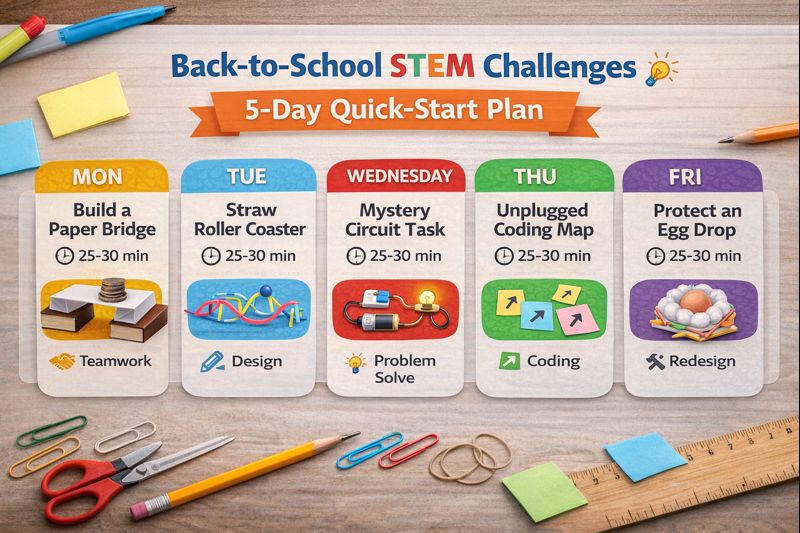
Challenge #1: The paper bridge weight test
This one feels simple… until it isn’t. Perfect for critical thinking.
Materials
Paper, tape, 2 cups/books (as supports), coins or pennies
The challenge
Build a paper bridge that spans two supports and holds the most weight.
How to run it
- Give 10 minutes to build
- Test by adding coins slowly
- Redesign once after the first test
Make it richer (without making it longer)
- Measure the span and write it down
- Ask: “What changed when you folded the paper?”
Challenge #2: The straw roller coaster
If you want instant engagement, this is it. It’s physics… disguised as fun.
Materials
Straws (or paper strips), tape, a marble or small ball
The challenge
Create a track that lets the marble travel the farthest without falling.
Quick tips that help kids succeed
- Start with a gentle slope
- Use “guard rails” (two straws side-by-side)
- Test every 30 seconds, not only at the end
Reflection question
“What made it faster—steeper drops or smoother turns?”
Challenge #3: The mystery circuit “light it up” task
This one turns kids into detectives and quietly teaches systems thinking.
Materials
A simple snap-circuit set or a battery + tiny LED + tape (with supervision)
The challenge
Make a light turn on—then redesign so it turns off/on again (switch concept).
Add a teamwork twist
Only the “Tester” can touch the pieces during the first 3 minutes. Everyone else must explain ideas clearly. It’s hilarious—and surprisingly effective.
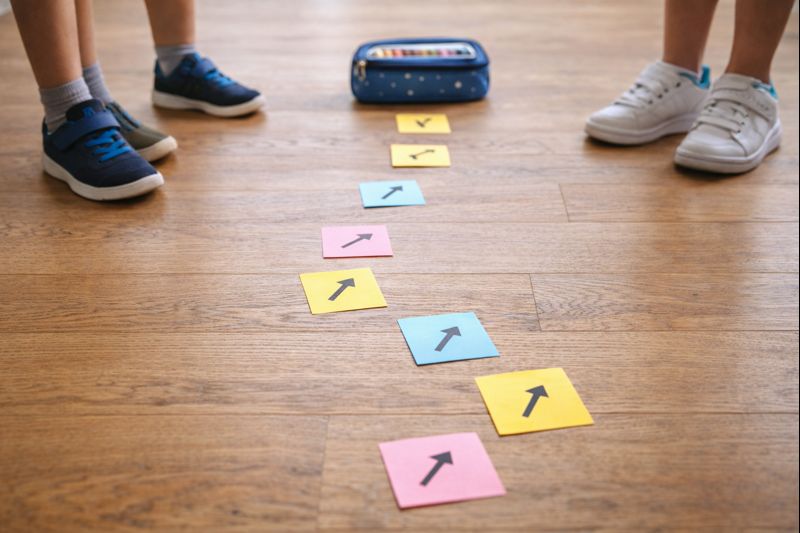
Challenge #4: Unplugged coding treasure map
Great for kids who love stories, movement, and “game rules.”
Materials
Sticky notes or paper arrows, a small “treasure,” and floor space
The challenge
Write an “algorithm” (step-by-step instructions) to guide a partner to the treasure.
Level-ups
- Add obstacles (“lava” squares)
- Require loops: “Repeat forward 3 times”
- Debugging round: partner follows the code exactly—no guessing allowed
Challenge #5: Protect the egg drop (table-top edition)
Classic, but still undefeated.
Materials
A raw egg (or a plastic one), paper, tape, straws, cotton balls, and a drop zone (chair height)
The challenge
Design a protective container so the egg survives the drop.
A kinder version for sensitive kids
Use a plastic egg with a small object inside. Goal: protect what’s inside from “damage” (no loud splat fears).

Make it collaborative: roles that reduce arguing
If you’ve ever watched a team meltdown over tape—same—you’re not alone.
Two rules that prevent drama
- “Hands off” planning minute: nobody touches materials for 60 seconds
- “Two voices before yours”: you must hear two ideas before deciding
These tiny rules stop the “one kid takes over” pattern and help quieter kids (including English learners) get space to contribute.
Make it inclusive: sensory-friendly + culture-friendly tweaks
Back-to-school groups include different needs, personalities, and home experiences. Your STEM challenge should welcome all of it.
Sensory-friendly options
- Offer gloves, quieter materials, or a “low-noise testing corner”
- Let kids choose draw-first planning instead of talk-first planning
Culturally responsive prompts
Use contexts kids recognize:
- Designing a cooler for a street market drink stand
- Building shade for a waiting area
- Creating a water-saving “delivery” system for plants
It says, “Your world belongs in STEM,” which is the whole point.
Turn each challenge into a quick writing/math win
You don’t need a full lab report. Keep it short and real.
The 3-sentence STEM recap
- We tried…
- It worked/didn’t work because…
- Next time we will…
Easy math tie-ins
- Count and graph test results
- Compare two designs with a simple table
- Estimate before testing (“How many coins do you predict?”)
Troubleshooting: scripts for “I’m stuck” moments
When kids stall, they usually need structure, not a lecture.
Try these prompts
- “What’s one tiny change we can test in 30 seconds?”
- “If we had to remove one material, what stays?”
- “What part failed—the design or the testing method?”
For perfectionists
Say: “Your first version is just Version 1. Engineers don’t marry Version 1.”
5 Tools that make Back-to-School STEM Challenges easier
1) Elenco Snap Circuits Jr. SC-100 Electronics Exploration Kit
Short description: A beginner-friendly circuits kit for building real working projects (without soldering).
Features:
- Snap-together parts (easy resets)
- Tons of guided builds + free exploration
- Strong “test and redesign” energy
Best for: Ages ~8+, families/classrooms doing hands-on STEM activities and basic electricity.
2) ThinkFun Gravity Maze Marble Run Logic Game
Short description: A logic + spatial reasoning game that feels like a puzzle and sneaks in engineering thinking.
Features:
- Challenge cards that scale difficulty
- Great for solo or partner problem solving
- Quick to set up (low mess, high focus)
Best for: Kids who love puzzles and need calmer STEM classroom stations.
3) LEGO Classic Large Creative Brick Box 10698
Short description: The ultimate “prototype anything” kit for design challenges.
Features:
- Huge variety of pieces for open-ended builds
- Works for towers, bridges, vehicles, machines
- Easy to reuse across the whole school year
Best for: Group maker challenges, early finishers, and “build it your way” kids.
4) National Geographic Mega Science Lab
Short description: A big, varied lab kit—great when you want structured experiments and options.
Features:
- Multiple experiment types (chemistry/earth science-style activities)
- Clear directions (helpful for busy weeks)
- Feels like a “science fair in a box”
Best for: Families who want back-to-school STEM challenges that don’t require lots of prep.
5) Osmo Genius Starter Kit for iPad
Short description: A smart blend of hands-on pieces + guided digital games (works well for stations).
Features:
- Multiple learning games in one kit
- Great for problem solving, shapes/words/math practice
- Good “structured independence” tool
Best for: Kids who like tech—but still need real-world interaction and design thinking.
Bonus for little siblings (sensory support): If you’re building a calmer corner for younger kids while older ones do STEM, this guide on sensory toys for babies can help you choose soothing, development-friendly options.
The research behind hands-on STEM challenges
Here’s the credibility piece—without turning this into a journal article.
What integrated STEM looks like in real life (expert review)
The National Academies describe integrated STEM as learning through problem-, project-, or design-based tasks where kids use multiple disciplines together—planning, creating, testing, and improving.
That’s basically the heart of Back-to-School STEM Challenges: not “memorize the steps,” but “try a design, learn from it, and iterate.”
Read it here: STEM Integration in K–12 Education (National Academies report)
Why inquiry-style challenges build critical thinking (meta-analysis)
A 2025 systematic review and meta-analysis found inquiry-based learning in science education supports students’ critical thinking (with effects varying by approach and context).
That’s why your best move isn’t “give the answer.” It’s “help them test a smaller version,” because the thinking happens in the testing.
Read it here: Inquiry-based learning and critical thinking (systematic review & meta-analysis)
A quick “why now” stat (and why challenges help)
OECD’s PISA 2022 reported math performance across OECD countries dropped by nearly 15 points compared with 2018, and about 30% of students said they get distracted by digital resources in math lessons.
Short, active, hands-on challenges help because they pull attention back into the room—into the materials, the team, and the test.
FAQs about Back-to-School STEM Challenges (plus a gentle send-off)
How do I run Back-to-School STEM Challenges if I’m not “good at STEM”?
You don’t need to be the expert—you’re the coach. Ask questions, set a timer, and help them test smaller changes. Curiosity beats credentials here.
What are the best Back-to-School STEM Challenges for mixed ages?
Pick one shared goal (like “strongest bridge”) and give optional constraints to older kids (fewer materials, longer span, heavier weight).
How long should a STEM challenge take in a classroom?
Aim for 20–30 minutes total: 3 minutes setup, 10–12 minutes build, 5 minutes test, 5 minutes redesign, 3 minutes share-out.
What if kids argue or one student dominates the build?
Use roles and a “hands off planning minute.” Also, rotate who touches materials first. Structure fixes most “dominance” issues fast.
How do I assess learning without killing the fun?
Use one exit question: “What did you change after testing—and why?” If they can answer that, learning happened.
Conclusion
Back-to-school doesn’t need to feel like a sprint where everyone’s stressed and behind. With Back-to-School STEM Challenges, you’re giving kids a way to practice resilience in a fun wrapper—build, test, laugh, improve, repeat.
If you want, tell me the age/grade range (and whether this is for home or a classroom), and I’ll tailor these five challenges with the exact materials you already have and a simple week-by-week plan.