Sensory Toys for Babies: 7 Developmental Milestones
We may earn a commission for purchases made using our links. Please see our disclosure to learn more.
If you’ve ever bought a “cute” baby toy… only to watch your baby stare at the ceiling fan like it’s the main event—yep. Been there. 😅
The truth is, sensory toys for babies work best when they match what your baby is actually learning right now—seeing, reaching, mouthing, rolling, sitting, crawling… basically training for their tiny-human Olympics.
In this guide, you’ll learn 7 key developmental milestones, how to pick toys by age, what to avoid for safety, and (if you’re shopping) 5 product picks that parents keep coming back to.
Affiliate note: If you buy through affiliate links on your site, you may earn a commission at no extra cost to you.
What sensory toys for babies are (and what they’re not)
Think of sensory toys as “experience tools.” They’re not about entertainment first—they’re about input: texture, sound, movement, contrast, and simple cause-and-effect.
Sensory toys for babies usually include:
- Interesting textures (soft bumps, ridges, crinkle fabric)
- Easy-to-grab shapes (loops, lightweight balls, flexible frames)
- Gentle sounds (rattles, crinkles—not a full concert in your living room)
- High-contrast visuals (especially early months)
- Safe teething-friendly parts (when age-appropriate)
What they’re not:
- Overstimulating noise machines disguised as toys
- “One-size-fits-all” gadgets that your baby can’t hold, reach, or understand yet
- Anything with small parts, harsh edges, or questionable materials
If a toy feels like it’s trying harder than you are… it’s probably too much.
Why sensory play matters (the friendly science)
Your baby’s brain is basically building highways right now. Every time they see a new pattern, feel a new texture, or hear a new sound, they’re forming connections.
Sensory play helps support:
- Attention and calming (yes, even tiny babies practice “focus”)
- Motor development (reaching, grabbing, rolling, crawling)
- Language foundations (babies learn from your voice + shared play)
- Social-emotional skills (bonding, turn-taking, “I did it!” confidence)
And honestly? It also helps you because a well-matched toy can buy you 6 peaceful minutes to drink coffee while it’s still warm. That’s basically luxury.
Milestone 1: Visual tracking and calm focus (0–3 months)
Newborns don’t need a toy chest. They need simple, bold, close-up visuals.
Look for:
- High-contrast cards or black-and-white patterns
- Soft mobiles (not too busy)
- A simple rattle you can move slowly side-to-side
Tiny play idea
Hold a high-contrast image about 8–12 inches from their face and slowly move it. If they track it with their eyes? That’s a win.
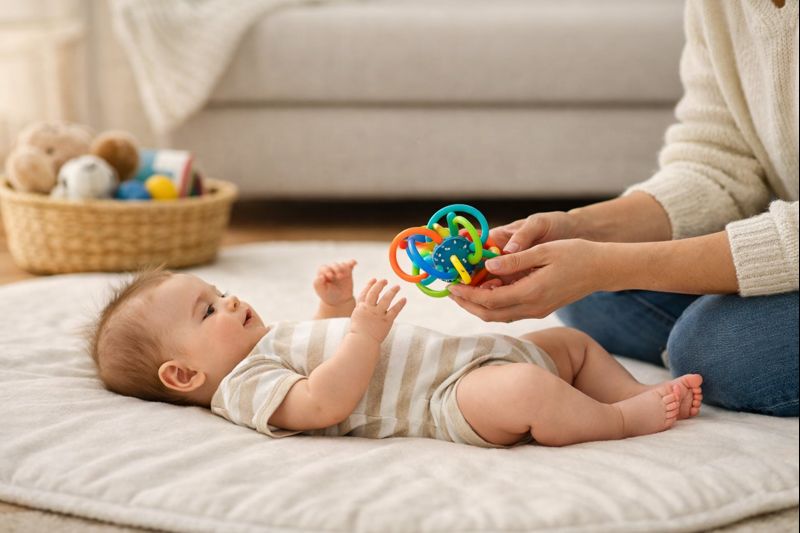
Milestone 2: Grasping, reaching, and hand discovery (2–4 months)
This is when babies start realizing: “Oh wait… these hands are mine?!”
Great sensory toy traits:
- Easy-grip loops or lightweight shapes
- Soft rattles that reward movement
- Textured surfaces (so hands “notice” the object)
What you’ll see
Lots of open-hand swats that slowly turn into purposeful grabs. It’s messy progress—still progress.
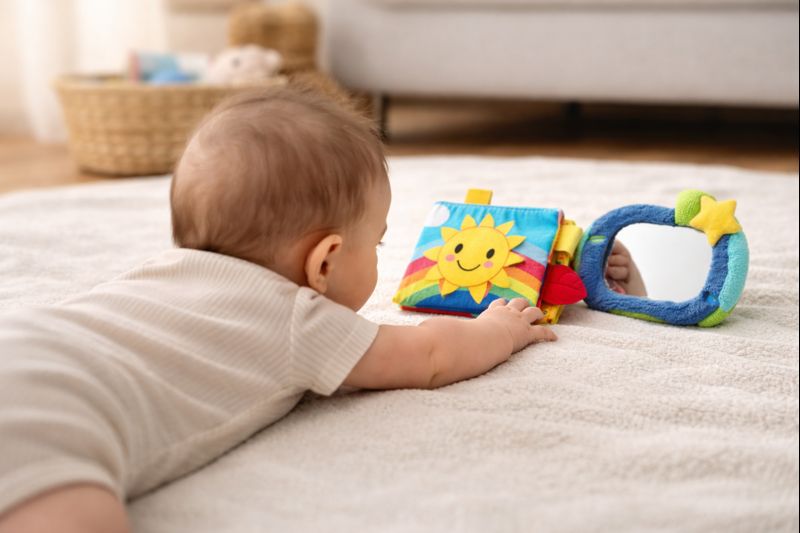
Milestone 3: Tummy time strength and head control (2–6 months)
Tummy time becomes less dramatic when babies have something interesting in front of them.
Best tummy-time sensory toys:
- Crinkle books
- A mirror (baby-safe)
- Soft, textured toys you can place slightly to the side to encourage turning
Quick tip
Put the toy just out of reach—not in a mean way, in a “you can do it” way.
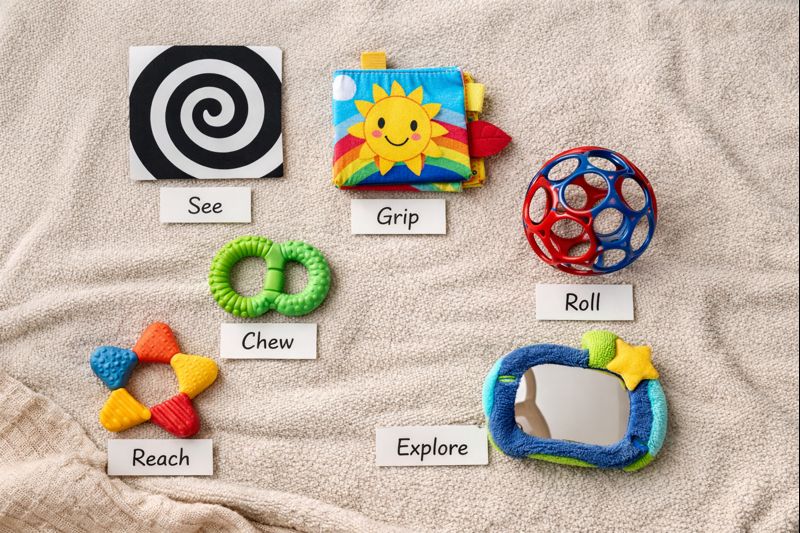
Milestone 4: Mouth exploration and teething relief (3–7 months)
Babies learn by tasting the world. (Your remote control knows this personally.)
Sensory toys here should be:
- Teether-safe and easy to wash
- Varied textures (smooth + ridged)
- Lightweight so baby can bring it to their mouth
Parent reality check
Drool is normal. So is the “I’m mad at the universe” teething mood. A good textured teether can genuinely help.
Milestone 5: Cause-and-effect learning (4–9 months)
This is the “I shook it and it made a sound… do it again!” phase.
Look for sensory toys that reward action:
- Rattles
- Crinkle fabric
- Pop-and-press features (bigger, baby-safe ones)
- Toys that roll and invite chasing
Why it matters
Cause-and-effect is early problem-solving. Your baby is learning: “My actions change things.” That’s a huge brain step.
Milestone 6: Sitting steady and fine motor skills (6–10 months)
Once babies sit with more confidence, they start doing “hand work.”
Helpful toy features:
- Small-but-safe grasp points (loops, knobs, tabs)
- Textured balls or sensory blocks (large enough to be safe)
- Toys that encourage transferring hand-to-hand
What you’ll notice
Your baby may rotate toys, bang them, inspect them, drop them on purpose… (that last one is science, apparently).
Milestone 7: Crawling, cruising, and little problem-solvers (7–12 months)
Mobility changes everything. Babies want to move toward interesting things.
Great sensory toys now:
- Rolling balls (easy to chase)
- Textured pull toys (simple, sturdy)
- Soft activity cubes (big features, no tiny pieces)
Pro tip
Rotate toys. Same toys, fewer toys out at once. It keeps the “newness” without buying more.
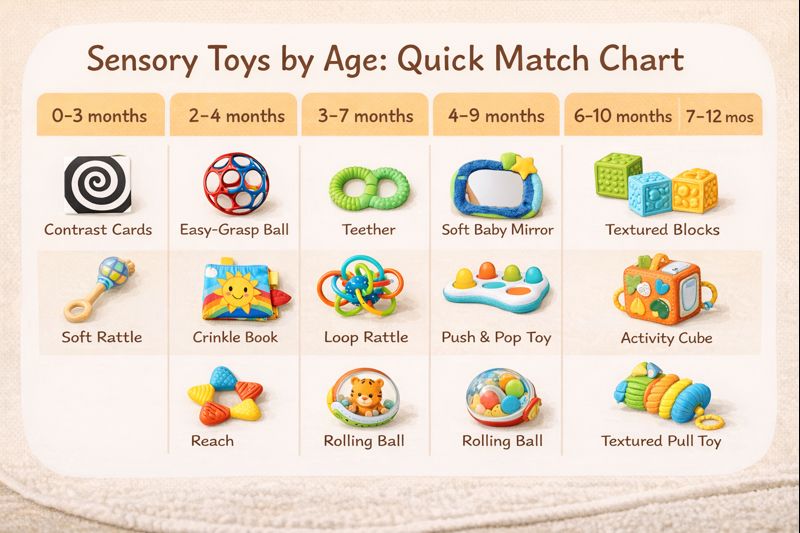
Choose sensory toys by age (a quick cheat sheet)
Here’s the simple version:
- 0–3 months: high-contrast visuals, gentle sound, soft textures
- 2–4 months: easy-grasp rattles, soft crinkle, light toys
- 3–7 months: teethers, textured grips, mouth-safe materials
- 4–9 months: cause-and-effect toys (shake, crinkle, press)
- 6–10 months: fine motor toys (transfer, twist, explore)
- 7–12 months: movement toys (roll, chase, pull)
If you’re unsure, choose the toy your baby can hold and control. Control = confidence.
Montessori sensory toys vs. “more lights!” toys
Montessori-style sensory toys are often:
- Simpler
- More hands-on
- Less overstimulating
- Easier to repeat (which babies love)
But here’s the nuance: “simple” doesn’t mean “boring.”
A good middle ground:
- Choose one engaging musical toy if you want (not five)
- Prioritize toys that invite your baby to do something (grab, shake, mouth, roll)
- Avoid toys that perform at your baby nonstop
If a toy is so loud you feel your soul leaving your body… you don’t need it.
Safety checklist for sensory toys (materials, choking, cleaning)
Before you buy (or even accept a hand-me-down), do a quick scan:
Safety must-haves:
- No small detachable parts
- Smooth edges, no splinters or cracking plastic
- BPA-free / non-toxic materials (from reputable brands)
- Easy cleaning (because… life)
Choking rule of thumb:
If it can fit through a toilet paper roll, it’s too small for baby play.
Also check:
- Seams on fabric toys (no loose threads)
- Battery compartments (must be secured with screws)
- Noise level (your baby’s ears are sensitive)
DIY sensory play at home (no fancy gear required)
You don’t need a big budget. Some of the best sensory “toys” are already in your house.
Easy baby-safe ideas:
- A soft scarf to gently brush hands/feet (supervised)
- A crinkle sound made from a clean, baby-safe crinkle book alternative
- A shallow “texture walk” for hands: towel + soft blanket + foam mat (supervised)
- Singing + clapping games (sensory + bonding)
Mini routine that works
Try this 5-minute sequence:
- 1 minute visual (contrast card)
- 2 minutes touch (textured toy + naming it)
- 2 minutes movement (tummy time with a mirror)
Short + consistent beats long + exhausting.
Product Section: 5 sensory toys worth it
These picks are popular because they’re simple, durable, clearly useful, and easy for babies to actually handle. (Translation: not a “cute but pointless” purchase.)
1) Manhattan Toy Winkel Rattle & Sensory Teether
Why it’s loved: flexible loops, easy grip, gentle rattle, doubles as a teether.
Features: BPA-free plastic loops, lightweight, easy to wash.
Best for: 3–8 months, especially “I want to hold everything” babies.
2) Bright Starts Oball Classic Easy-Grasp Toy
Why it’s loved: it’s basically baby’s first “I can do it!” ball.
Features: tons of finger holes for gripping, soft and flexible.
Best for: 0–6+ months, great for grasp practice and early rolling/chasing.
3) Lamaze Freddie the Firefly
Why it’s loved: texture party without being overwhelming.
Features: crinkle wings, bright colors, clip for stroller/highchair.
Best for: on-the-go sensory play and cause-and-effect exploration.
4) Baby Einstein Take Along Tunes (Musical Toy)
Why it’s loved: gentle music and lights that aren’t too chaotic.
Features: simple buttons, handle for carrying, introduces rhythm.
Best for: 6–12 months, sitting play and cause-and-effect learning.
5) Manhattan Toy Skwish (Classic Wooden Grasping Toy)
Why it’s loved: it’s oddly mesmerizing—babies squeeze it, shake it, stare at it like it’s a magic trick.
Features: compressible design, smooth wood, built-in rattle.
Best for: grasping practice, two-handed play, and calmer sensory exploration.
Bonus idea (STEM + sensory fun): If you want a simple hands-on activity that grows with your child, try this DIY robot-hand sensory activity for baby-friendly STEM play—it’s a cool way to mix touch, movement, and curiosity as your little one gets older.
What research says (plus 5 FAQs)
Study #1: Play isn’t “extra”—it’s brain-building (AAP, 2018)
In the American Academy of Pediatrics clinical report sensory play research on early brain development, the authors explain that developmentally appropriate play supports social-emotional growth, language, self-regulation, and executive function—basically the skills behind focus and learning.
Study #2: Tummy time shows measurable benefits (Pediatrics, 2020)
A Pediatrics systematic review tummy time evidence for infant development found tummy time was positively associated with gross motor and total development, with additional links to reduced risk of some head-shape issues and improved movement skills (rolling, crawling, prone motion).
And if you like a clear benchmark: the World Health Organization’s 2019 guidance includes at least 30 minutes of tummy time per day (spread out while baby is awake) for infants not yet mobile.
FAQs
What are the best sensory toys for babies 0–3 months?
Go simple: high-contrast cards, soft textures, and gentle rattles you control. Babies this age benefit most from calm sensory input, not constant stimulation.
Are sensory toys safe for newborns?
They can be—if they’re made for newborns and don’t have loose parts. Choose soft, washable items and avoid anything with small pieces, beads, or detachable elements.
How many sensory toys does a baby actually need?
Honestly? A small rotation works great. Think 6–10 total (mix of visual, touch, sound, and teething). Too many toys can be overwhelming—for you and baby.
Can sensory toys help with tummy time?
Yes—especially mirrors, crinkle books, and textured toys placed slightly to the side (to encourage head turning). The “toy goal” is to make tummy time feel like exploration, not punishment.
What should I avoid when buying sensory toys for babies?
Skip toys with tiny detachable parts, harsh sounds, strong chemical smells, or unclear material labeling. Also skip anything your baby can’t hold or interact with—it’ll just become décor.
Conclusion:
The best sensory toys for babies aren’t the fanciest ones—they’re the ones that meet your baby right where they are. If you match toys to milestones (seeing, grasping, teething, moving), you’ll notice more engagement, more confidence, and fewer “why did I buy this?” moments.
If you want a soft next step: pick one toy that supports your baby’s current stage, and build a tiny daily routine around it. Small, steady play adds up—like compound interest, but with more drool.