5 Spooky Halloween STEM Activities For Kids
We may earn a commission for purchases made using our links. Please see our disclosure to learn more.
If you’ve ever wanted Halloween to feel fun and a little meaningful (without turning into a Pinterest stress-fest), you’re in the right place. Halloween STEM Activities For Kids are basically the parenting/teaching cheat code: kids think they’re “just playing,” but they’re actually testing ideas, building things, and asking the big questions like, “WHY is it fizzing like that?!”
In this guide, you’ll get 5 genuinely doable spooky-season STEM activities, plus ways to tweak them for different ages, run them like stations, and keep the whole thing from becoming a glitter-and-vinegar incident.
Why Halloween STEM activities feel like play but teach a lot
Halloween already has three things STEM needs:
- Curiosity (“What happens if…?”)
- Story (witches, ghosts, monsters = instant motivation)
- Props (pumpkins, candy, costumes… your supplies practically show up on their own)
And when kids learn through play, they tend to stick with it longer because it doesn’t feel like a worksheet wearing a costume. You’re not forcing learning. You’re inviting it.
Quick setup and safety: your 10-minute prep checklist
Before you start, do this quick “future you will thank you” prep:
Set boundaries (nicely):
- “This is a look with your eyes experiment until I say it’s safe.”
- “Nothing goes in mouths unless it’s in the snack bowl.”
Create a mini lab zone:
- Old towel or newspaper
- A tray or baking sheet to catch spills
- A “done bin” for used tools
Use kid-safe basics:
- Warm water only (skip hot liquids)
- Safety goggles if you have them
- Adult help with scissors, skewers, or anything that launches
Make it feel official (kids love this):
- Give them a “Lab Name” (Monster Lab, Ghost Lab, etc.)
- Let them “record results” with drawings, stickers, or tallies
Activity 1: Fizzy Cauldron Chemistry
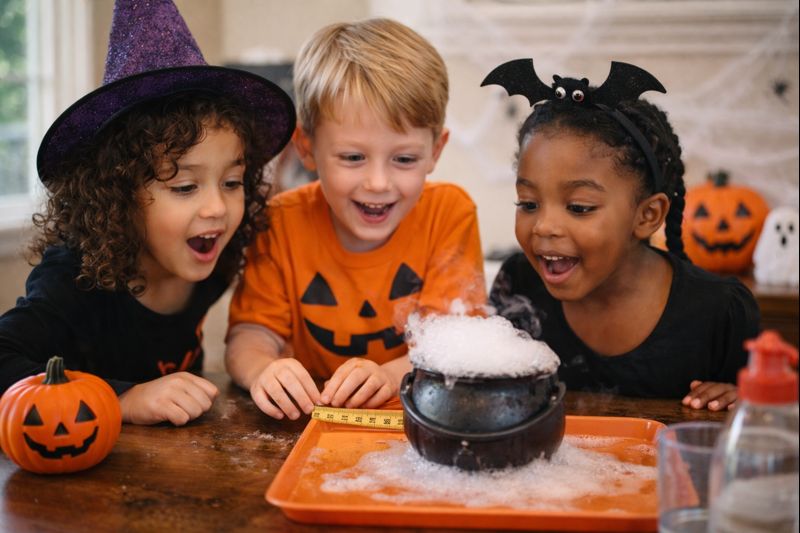
This one is a Halloween classic for a reason: it’s dramatic, it’s loud, and it makes kids feel like they’re doing real magic (spoiler: it’s science).
What you’re teaching
Acid–base reactions + observation skills.
Supplies
- Baking soda
- Vinegar
- Dish soap (a few drops)
- Food coloring (optional)
- A cup or small container (your “cauldron”)
- Tray underneath
Steps
- Put your “cauldron” on a tray.
- Add 2–3 spoonfuls of baking soda.
- Add a few drops of dish soap (more foam = more “witchy”).
- Add the vinegar gradually and watch it bubble up and fizz.
Turn it into a quick challenge.
Ask:
- “What happens if we add more baking soda?”
- “What happens if we pour the vinegar fast vs slow?”
- “Can we make the foam last longer?”
Tiny learning moment
Have them describe it like scientists:
- “I notice…”
- “I predict…”
- “I wonder…”
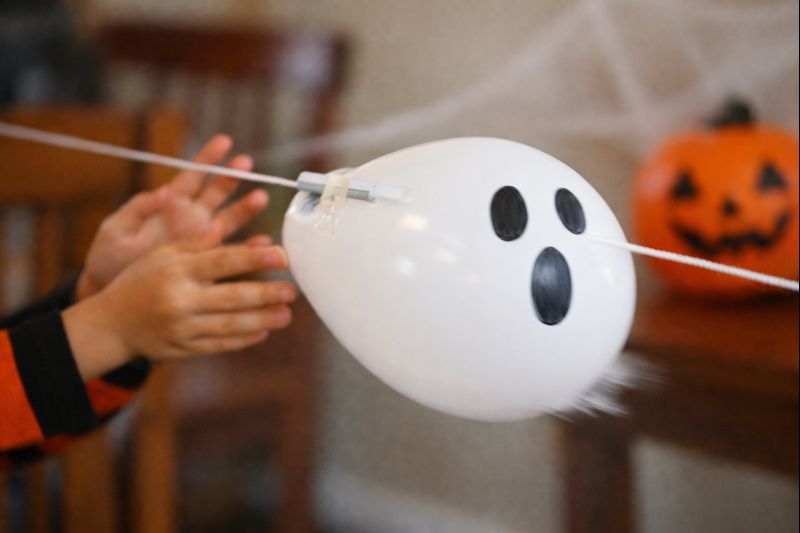
Activity 2: Ghost Balloon Rockets
This is the kind of activity where kids scream, laugh, and accidentally learn physics. Perfect.
What you’re teaching
Newton’s Third Law (action–reaction) + simple engineering.
Supplies
- Balloon
- String (8–12 feet)
- Straw
- Tape
- Two chairs (or doorknobs)
Steps
- Thread the string through the straw.
- Tie the string tight between two chairs.
- Inflate the balloon (don’t tie it).
- Tape the balloon to the straw (balloon opening facing backward).
- Let go and watch your “ghost” fly.
Make it Halloween
Draw a ghost face on the balloon. Or call it:
- “Poltergeist Express”
- “Haunted Rocket 3000”
Level-up questions
- “Which balloon goes farther — big or medium?”
- “What happens if we tilt the string?”
Activity 3: Pumpkin Catapult Engineering
This feels like a game, but it’s secretly a lesson in design, force, and iteration.
What you’re teaching
Engineering design + simple machines + testing variables.
Supplies
- Craft sticks (popsicle sticks)
- Rubber bands
- Plastic spoon
- Mini marshmallows or pom-poms (soft projectiles)
- Small pumpkin or paper pumpkin target
Steps
- Stack 5–7 craft sticks and rubber-band them together.
- Make a “V” base with 2 sticks and rubber-band one end.
- Slide the stacked bundle between the V to create tension.
- Rubber-band a spoon to the top stick as the launcher.
- Launch soft projectiles toward a target.
Turn it into an engineering mission
- “Your pumpkin patch is under monster attack. Build a launcher to protect it.”
Then test: - distance
- accuracy
- consistency
The real STEM win
When it doesn’t work the first time (and it won’t), you get to say:
“Nice — we just found data. What should we change?”
Activity 4: Candy Chromatography Color Monsters
This one is surprisingly mesmerizing. Kids watch colors “escape” and spread like little candy ghosts.
What you’re teaching
Separation science (chromatography) + pattern recognition.
Supplies
- Coffee filters (or paper towels)
- Washable markers or colorful candy (Skittles work great)
- Small cups of water
- Pencil (if drawing)
Option A: Marker chromatography (super reliable)
- Cut a coffee filter into strips.
- Draw a thick marker dot near the bottom.
- Dip the very tip into water (don’t submerge the dot).
- Watch colors separate and climb.
Option B: Candy color bleed (Halloween-style)
- Arrange candies in a circle on a plate.
- Add warm water carefully so it just touches the candy edges.
- Watch the colors travel inward like a “rainbow spell.”
Make it spooky
Call each strip a “Color Monster” and ask:
- “What colors are hiding inside black?”
- “Which color spreads fastest?”
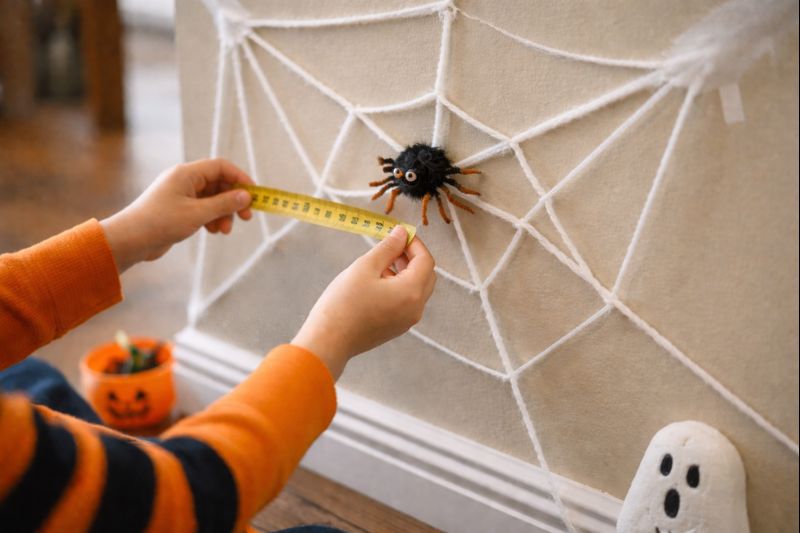
Activity 5: Spider-Web Math and Unplugged Coding
This is perfect when you want STEM without liquids — or when you need to calm the room down a notch.
What you’re teaching
Patterns, geometry, measurement, and early coding logic.
Supplies
- Yarn or string
- Tape
- Optional: ruler, sticky notes, toy spider
Build the web
Tape string in a web shape across a corner, between chair legs, or on a wall (painter’s tape helps).
Add the math
- Count “rings” and “spokes”
- Measure distances between intersections
- Compare shapes (triangles, quadrilaterals)
Add unplugged coding
Give “spider commands” like:
- Step forward 2
- Turn right
- Stop at the next intersection
- If you see a fly (sticky note), turn left
It’s basically coding — just in costume.
Add a “scientist story” to any activity
If you want these to feel more like real learning (without killing the vibe), use this simple story arc:
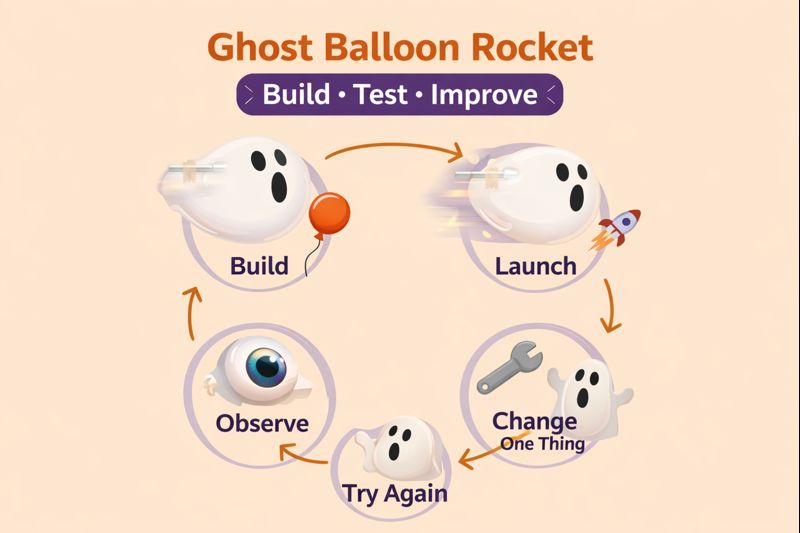
The kid-friendly scientific method
- Ask: “What are we trying to find out?”
- Predict: “What do you think will happen?”
- Test: “Let’s try it.”
- Observe: “What did you notice?”
- Change one thing: “What should we tweak?”
- Try again: “Prototype #2!”
Even one quick “change one thing” round turns play into actual experimentation.
Inclusive tweaks for different ages and learning needs
Not every kid wants loud fizzing or fast rockets — and that’s okay. Here’s how to make this work for more brains and bodies.
Ages 3–5
- Bigger tools, fewer steps
- More “watch and describe” than “do it perfectly”
- Shorter time blocks (5–10 minutes)
Ages 6–9
- Add simple measuring (distance, time, counting trials)
- Let them lead the setup with supervision
Ages 10+
- Add constraints: limited materials, time limit, data chart
- Ask them to explain results like mini presenters
Sensory-sensitive kids
- Offer gloves, quieter stations, or a “watch first” option
- Skip loud pops, strong smells, or messy textures if needed
Culturally aware note
Some families love spooky themes, others prefer “harvest,” “autumn,” or “science party” vibes. You can keep the same STEM and simply rename the story (Harvest Lab, Fall Science Night, Mystery Experiments).
Turn it into a party or classroom STEM station night
Want this to run smoothly with multiple kids? Stations are your best friend.
A simple 45–60 minute station setup
- 5 stations (one per activity)
- 8–10 minutes each
- 1 adult “float” + 1 helper if possible
Keep stations calm and successful
- Put supplies in labeled bowls
- Use a one-page instruction card per station
- Add a “Challenge Question” card:
- “What happens if…?”
- “How can you make it go farther?”
- “What did you notice?”
Built-in troubleshooting (so you don’t panic)
- If fizz is weak: add more baking soda or a drop more soap
- If rocket is slow: tighten the string and use less tape weight
- If colors don’t spread: try warmer water or a different marker/candy
Bonus engineering mission: build a bridge for a monster
If your kids love building (or if you want a slightly bigger challenge that feels like a true engineering quest), try a haunted bridge scenario:
Story prompt:
“A friendly monster needs to cross a swamp to get to the snack table. Build a bridge that can hold ___ (coins/toy cars/blocks).”
If you want a ready-to-go set of ideas and kits, this guide on bridge-building STEM activities is a perfect extension.
Product picks: 5 tools and kits for Halloween STEM
These are parent/teacher-friendly picks that match the activities above and make setup easier. (All are widely reviewed on Amazon listings.)
1) Elenco Snap Circuits Jr. SC-100 Electronics Exploration Kit
Why it fits: Great for “haunted house circuits” (lights, buzzers, switches) after Halloween night.
Features: buildable circuits, snap-together parts, lots of guided projects.
Use cases: best for ages ~8+ (or younger with help), homeschool STEM, rainy-day science.
2) The Original Stomp Rocket Ultra (4 rockets)
Why it fits: A safer, high-energy physics launcher with outdoor “ghost flight tests.”
Features: air-powered stomping, multiple rockets, quick reset.
Use cases: energetic kids, PE + STEM crossovers, backyard science days.
3) Learning Resources Primary Science Lab Activity Set
Why it fits: Gives you real lab-style tools (kid-sized), which makes every activity feel “official.”
Features: durable tools, measurement-friendly pieces, classroom-ready.
Use cases: preschool/early elementary science centers, sensory-friendly exploration, repeated experiments.
4) Learning Resources Fizzy Volcano Preschool Science Lab
Why it fits: Basically the fizzy cauldron’s organized older sibling.
Features: kid-friendly tools + guided experiments, designed for younger hands.
Use cases: ages ~4–10, giftable science kit, structured activity days.
5) Elmer’s Liquid School Glue (Washable)
Why it fits: You’ll use it for catapults, spiderweb builds, pumpkin engineering, and all the “wait… we need to attach this” moments.
Features: washable, kid-safe, reliable bonding for paper/wood crafts.
Use cases: classrooms, homeschool craft-STEM hybrids, weekend maker bins.
Research-backed: what studies say about hands-on STEM
If you ever wonder, “Is this actually educational… or just loud?” — research leans strongly toward active, hands-on learning.
Study 1: Active learning improves performance (Freeman et al., 2014)
A large meta-analysis published in PNAS (2014) found that students in active-learning settings improved average exam scores by about 6%, and traditional lecture formats had higher failure rates. Even though this paper focused on college STEM, the takeaway maps beautifully onto kids: doing beats watching when you want learning to stick.
Study 2: Inquiry-based science shows positive learning trends (Minner, Levy & Century, 2010)
This research synthesis (covering 138 studies) reported a clear positive trend favoring inquiry-based science instruction — especially when learners actively engage with questions, evidence, and explanations. That’s exactly what your kid is doing when they tweak the vinegar, adjust the rocket angle, or redesign the catapult.
So yes — the fizzing cauldron counts.
FAQs
What are the easiest Halloween STEM Activities For Kids at home?
Start with a fizzy cauldron (baking soda + vinegar) and ghost balloon rockets. They use common supplies, set up fast, and still teach real science concepts.
What age is best for Halloween STEM activities?
You can adapt them for almost any age. Ages 3–5 do best with short, sensory-friendly stations. Ages 6–9 can measure, record results, and do simple redesigns. Ages 10+ can add constraints and data tracking.
How do I run a Halloween STEM party without chaos?
Use stations with pre-portioned supplies, simple instruction cards, and timers (8–10 minutes each). Keep one “calm station” (spider-web math/coding) to balance the high-energy ones.
Are these activities safe for classrooms?
Yes — as long as you skip hot liquids, use soft projectiles (pom-poms/marshmallows), and supervise anything that launches. Goggles are a nice bonus for the fizzing station.
How do I make STEM activities feel fun for kids who “don’t like science”?
Lead with story and choice: “Do you want to be a witch chemist or a rocket engineer?” When kids get a role, science stops feeling like school and starts feeling like play.
Conclusion
If Halloween usually ends with sugar highs and tired parents, flipping it into Halloween STEM Activities For Kids is such a win: you still get the magic, but you also get curiosity, confidence, and that “Wait… I did that?!” pride.
Pick one activity to start (seriously — one is enough), let it be a little messy, and treat every “fail” like a clue. That’s the real STEM mindset… and it looks pretty great in a witch hat.