Developmental Toys for Infants: Top Picks for Early Learning
We may earn a commission for purchases made using our links. Please see our disclosure to learn more.
Be honest for a second: have you ever bought a beautiful baby toy… only for your infant to ignore it and play with the tag or the box instead? 😅
You’re not alone. With so many “must-have” gadgets, it’s hard to know which developmental toys for infants actually help with milestones—and which just take up space in the basket.
Note: This kind of guide often pairs with affiliate links, which don’t cost you extra but help keep helpful content free.
Why Developmental Toys for Infants Matter More Than You Think
In the first year, your baby’s brain is wiring up at incredible speed. Every kick, grab, shake, and chew is like a tiny workout for their nervous system.
Developmental toys for infants aren’t magic; they just make it easier for your baby to:
- Practice new skills (like grasping, rolling, sitting)
- Explore cause and effect (“If I kick, the music plays”)
- Build early language and social skills through play with you
Think of toys as “props” that help you create meaningful little moments: tummy-time chats, peek-a-boo sessions, naming colors, or following a rolling ball together. Those small moments stack up.
What Actually Counts as a “Developmental” Toy?
You don’t need a toy that speaks three languages and lights up like a mini casino. In fact, experts usually recommend the opposite.
Good baby developmental toys usually:
- Are simple and open-ended (many ways to play)
- Encourage your baby to do something: reach, shake, press, mouth, roll
- Invite interaction with you: talking, singing, naming, copying sounds
- Match your baby’s current stage (not too easy, not too hard)
Great examples include:
- Sensory toys for infants – rattles, textured balls, crinkle cloths
- Fine motor skills toys – grasping rings, soft blocks, stackers
- Cause-and-effect toys – pop-up toys, rolling balls, piano gyms
- Infant learning toys – activity gyms, soft books, simple puzzles for later months
If a toy does all the work while your baby just watches, it’s usually entertainment—not development.
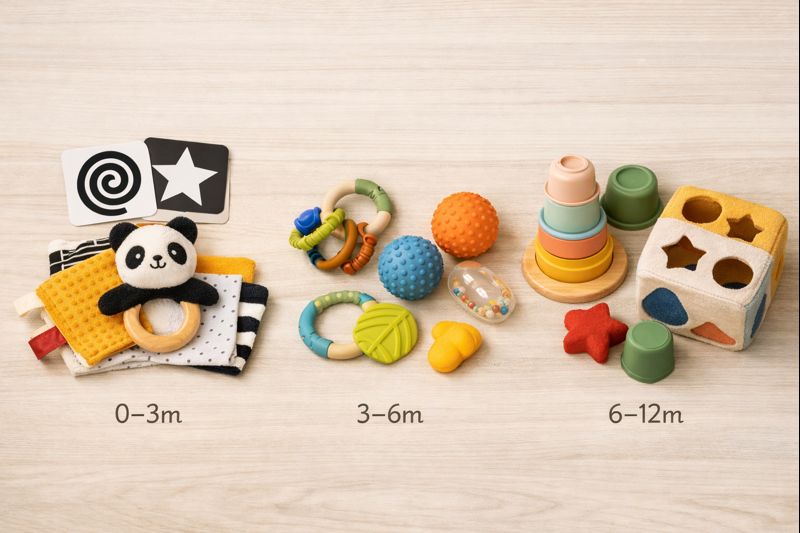
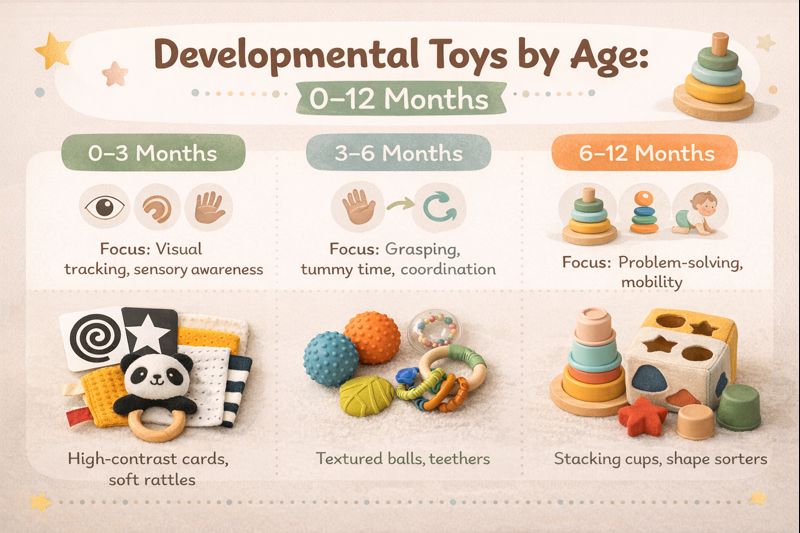
Matching Toys to Baby’s Milestones: 0–3 Months
In the very early months, your baby is basically a tiny scientist with limited control of their body.
Good 0–3 month toys:
- High-contrast cards or books – black and white, bold shapes
- Soft rattles – light, easy to grasp as their hands get stronger
- Crinkle cloths – sound + texture = sensory win
- Infant activity gym – dangling toys at about chest level
Focus on:
- Short bursts of visual tracking (following a toy with their eyes)
- Gentle tummy time with interesting things to look at
- Hearing your voice while you name shapes, colors, and sounds
Ask yourself: Can my baby see it, hear it, or feel it without getting overwhelmed?
Milestone-Friendly Toys for 3–6 Months
Around 3–6 months, babies start rolling, grabbing, and exploring everything with their mouths. This is a fun zone for developmental toys for infants.
Helpful picks:
- Grasping rings and sensory balls – build hand strength
- Tummy time toys – mirrors, rolling toys, or light-up features
- Soft teethers – safe textures for those sore gums
- Rattles that need a bit more effort – encourage purposeful movement
This is a great time to encourage:
- Reaching across midline (toys slightly off to the side)
- Rolling to get to something interesting
- Beginning to sit with support and explore toys in their lap
Milestone-Friendly Toys for 6–12 Months
From 6–12 months, your baby is on the move—rolling, sitting, crawling, maybe even cruising along furniture. Toys can now support more complex skills.
Look for:
- Stacking cups or rings – early problem-solving and hand-eye coordination
- Simple shape sorters (closer to 10–12 months)
- Push-and-go cars or balls – crawling motivation
- Toys with buttons, sliders, and doors – cause-and-effect toys galore
This is where 0–12 month toys start to overlap with toddler gear. Choose items that will still be interesting as your baby approaches their first birthday.
Sensory Toys for Infants: Exploring with All Five Senses
Sensory play doesn’t have to be messy. You can keep it very baby-friendly.
Great sensory toys for infants include:
- Textured balls (nubby, ridged, squishy)
- Soft cloth books with crinkles and squeakers
- Simple musical toys they can shake or press
- Mirrors for exploring faces and expressions
Sensory toys help babies:
- Learn where their body is in space
- Practice coordinating sight, touch, and sound
- Get comfortable with new textures and sensations
If your baby seems overwhelmed, dial it back. One sensory “thing” at a time is enough.
Tummy Time Toys That Make Floor Play More Fun
Tummy time is easier when there’s a reason to lift that little head.
Some go-to tummy time toys:
- A small mirror propped in front of baby
- A rolling toy or rattle just out of reach
- A soft piano or kick pad they can activate with feet or hands
- High-contrast cards taped at eye level
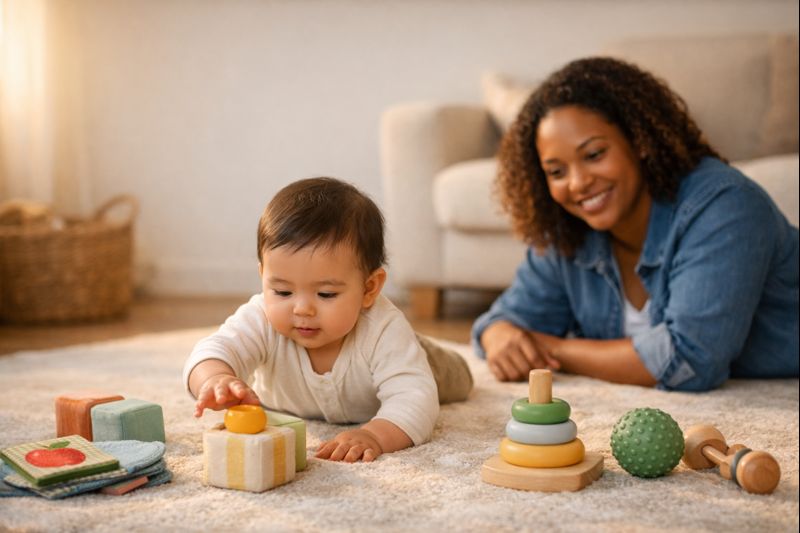
A simple trick: lie down face-to-face with your baby and put a toy between you. Your face + the toy is often the perfect combo.
Montessori & Open-Ended Toys for Babies
You’ll hear a lot about Montessori toys for babies—usually wood, simple shapes, and neutral colors. The idea is to let your baby focus on what the toy does, not on a thousand lights and sounds.
Examples:
- Wooden grasping rings
- Simple ring stackers
- Object permanence boxes (for later in the year)
- Large wooden balls to roll back and forth
The benefit of these open-ended toys is that your child grows with them. A toy that starts as a “thing to chew” at 4 months might become a “thing to stack” at 12 months.
Gentle STEM Play: Science and Curiosity from Day One
“STEM toys for babies” sounds intense, but it can be super simple. STEM at this age is mostly about curiosity:
- What happens when I drop this?
- Where did that ball go?
- What does this texture feel like?
Early STEM-style play can include:
- Rolling balls down a small ramp
- Letting baby explore safe natural materials (smooth wood, large leaves)
- Watching how water splashes during bath time
As your baby grows into a curious toddler, you can introduce easy science activities, like a seasonal autumn leaf STEM activity that mixes observation, colors, and nature exploration. That’s exactly what this hands-on autumn leaf STEM project is designed to do—perfect for when your little one is ready for more structured experiments.
Research-Backed Benefits of Developmental Play
You don’t need to take my word for it—there’s solid science behind simple, thoughtful play.
A 2016 study in JAMA Pediatrics compared electronic toys, traditional toys, and books during parent-infant play. When families used electronic toys (the ones with lots of lights and sounds), parents talked less and used fewer rich words than when they used books or basic toys. In other words, “louder” toys led to quieter conversation—which isn’t great for early language.
A 2019 policy statement from the American Academy of Pediatrics emphasized that the best toys are those that support caregiver–child interaction, imagination, and problem-solving—not just digital features. They specifically highlight simple blocks, books, and pretend toys as ideal for early development.
Together, these findings suggest:
- Traditional, simple toys give you more room to talk, describe, and connect
- Your presence and voice matter more than any “smart” feature
- Good developmental toys for infants are conversation starters, not replacements for you
How to Choose Safe Developmental Toys for Infants
Safety first, always. A toy can be amazing developmentally and still be a “nope” if it isn’t safe.
Basic safety checks:
- Size: Anything that can fit through a toilet paper tube is a choking risk
- Construction: No sharp edges, loose parts, or easily detachable small pieces
- Materials: Look for non-toxic paints and BPA-free plastics
- Sound level: Avoid toys that seem very loud close to the ear
Also check:
- Age recommendation on the packaging
- Washability (you know it’s going in their mouth 😅)
- Recalls or warnings if it’s a second-hand toy
If you’re ever unsure, trust your gut. If it feels borderline, skip it.
Screen-Free vs Electronic Toys: What Experts Say
Do electronic toys have to be banned? Not necessarily. But they shouldn’t be the main event.
Research and pediatric guidelines consistently say:
- Simple toys and books support richer language and interaction
- Electronic toys often “do the talking” so caregivers talk less
- Babies learn best through real-life, face-to-face play with you
If you use electronic toys:
- Treat them as a small part of your toy mix
- Turn volume down and avoid constant flashing lights
- Stay involved—comment on what’s happening instead of letting the toy “babysit”
Budget-Friendly Ideas Using What You Already Have
Good news: you don’t need a designer playroom. Many developmental toys for infants are hiding in your kitchen and closet.
Try:
- Wooden spoons and a silicone whisk (supervised) as early “instruments”
- Large lightweight scarves for peek-a-boo and tracking games
- Empty, clean plastic containers with lids for banging or rolling
- A shallow baking tray with a few safe objects for “treasure baskets”
The key is variety in texture, sound, and shape—not price.
How Many Toys Does Your Baby Really Need?
Short answer: fewer than you think.
Babies can get overstimulated when there’s a huge pile of toys. Instead, try:
- Offering 3–5 infant learning toys at a time
- Rotating toys weekly so they feel “new” again
- Keeping a small basket in each common space
Think of yourself as a curator, not a warehouse manager. 😉
Top Recommended Developmental Toys for Infants
1. LOVEVERY | The Play Gym | Stage-Based Developmental Activity Gym & Play Mat
- What it is: A Montessori-inspired play gym designed to support your baby’s first-year milestones with different play zones and a thick mat.
- Why it’s helpful: Encourages tummy time, visual focus, reaching, and early problem-solving. You can uncover features gradually to keep things interesting.
- Best for: Parents who want one big “anchor” toy that covers a lot of developmental bases from 0–12+ months.
2. Manhattan Toy Winkel Rattle & Sensory Teether Toy
- What it is: A lightweight maze of soft tubing with a gentle rattle in the center; highly rated by thousands of parents.
- Why it’s helpful: Perfect for little hands to grasp from any angle, supports hand-to-mouth coordination, and doubles as a teether.
- Best for: 0–6 month babies who are starting to grab, shake, and chew everything in sight.
3. Fisher-Price Deluxe Kick & Play Piano Gym
- What it is: A piano-style activity gym where baby’s kicks and touches trigger music and lights.
- Why it’s helpful: Encourages kicking, reaching, and rolling; introduces cause and effect and early musical play.
- Best for: Babies who love movement and sound and need extra motivation for tummy time and floor play.
4. Skip Hop Baby Follow-Me Bee Tummy Time Crawl Toy
- What it is: A small bee toy that lights up, plays music, and slowly moves to encourage reaching and crawling.
- Why it’s helpful: Great for strengthening neck, shoulder, and core muscles; keeps tummy time entertaining and later motivates crawling.
- Best for: 5+ month babies who are starting to pivot, scoot, or show interest in chasing moving objects.
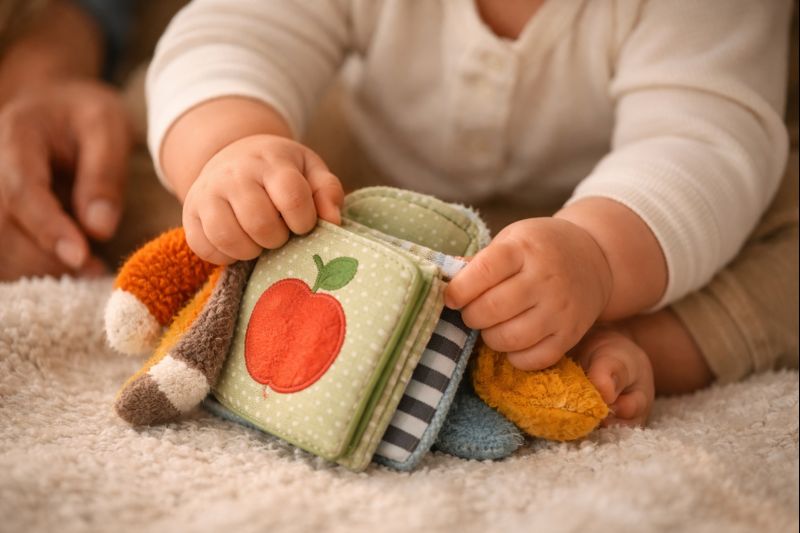
5. GKDOMS Soft Cloth Baby Books Animal Tails 2-Pack
- What it is: A set of soft, crinkly cloth books with textured “tails” and bright patterns.
- Why it’s helpful: Combines visual, tactile, and sound stimulation while introducing early “reading” routines. Easy to toss in the diaper bag.
- Best for: 3–12 month babies; perfect for tummy time, lap reading, and on-the-go sensory play.
Use these as a starting point and mix them with homemade and everyday objects so your baby gets a rich variety of experiences.
FAQs About Developmental Toys for Infants
When should I start using developmental toys for my baby?
From day one, honestly. In the early weeks, “toys” can be as simple as your face, your voice, and a high-contrast card. By 2–3 months, you can add soft rattles, crinkle cloths, and an activity gym.
How many developmental toys does an infant need at one time?
Aim for a small selection—around 3–5 toys within reach. Too many options can be overwhelming. Rotate toys every few days so your baby gets novelty without clutter.
Are electronic developmental toys good for infants?
They can be okay in moderation, but research shows that electronic toys often reduce how much parents talk during play compared with books and traditional toys. For language development, simple toys plus your voice are better as the “main course,” with electronic toys as an occasional extra.
Can developmental toys replace tummy time or floor play?
No. Toys are tools, but your baby still needs time on the floor to roll, push up, and explore. Use toys to support tummy time—like mirrors or rolling toys—not to avoid it.
What are the best developmental toys for infants on a budget?
Some of the best options are low-cost or free: plastic measuring cups, wooden spoons, soft cloths, large cardboard boxes, and simple balls. As long as items are safe, clean, and size-appropriate, they can be fantastic developmental toys for infants.
Final Thoughts: You Don’t Need Perfect—You Need Connection
The best developmental toys for infants aren’t necessarily the fanciest ones. They’re the ones that invite you to get down on the floor, make silly faces, describe what you’re doing, and follow your baby’s lead.
If you remember three things, let them be these:
- Simple, safe, and age-appropriate beats flashy and complicated.
- Your voice, touch, and attention are the “main ingredient” in any toy.
- A few thoughtfully chosen toys (plus everyday objects) can support a whole year of powerful learning.
You’re not just buying toys—you’re setting the stage for curiosity, confidence, and connection. And that’s something you’re already doing just by caring enough to read this. 💛