How to Turn Your Backyard Into a STEM Playground
We may earn a commission for purchases made using our links. Please see our disclosure to learn more.
You want your child to learn, explore, and light up with “I figured it out!” moments—without wrestling them away from screens every five minutes. A STEM Playground is your home’s secret superpower: a simple, low-cost setup that turns everyday spaces into hubs for science, technology, engineering, and math play. In this guide, you’ll get practical ideas, age-wise activities, safety tips, and the exact gear to build a backyard (or balcony!) that inspires curiosity all year long.
Affiliate note: I may earn from qualifying purchases at no extra cost to you.
What Is a STEM Playground?
A STEM Playground is any space—yard, patio, balcony, shared courtyard, even a small driveway—organized for hands-on science, engineering builds, early math games, and simple tech exploration. Think water tables, measuring cups, pulleys, ramps, garden beds, coding robots on chalk tracks, and a “tinker bin” of safe recyclables. It’s less about fancy gear and more about inviting problems to solve.
Why Your Backyard Is Perfect for STEM
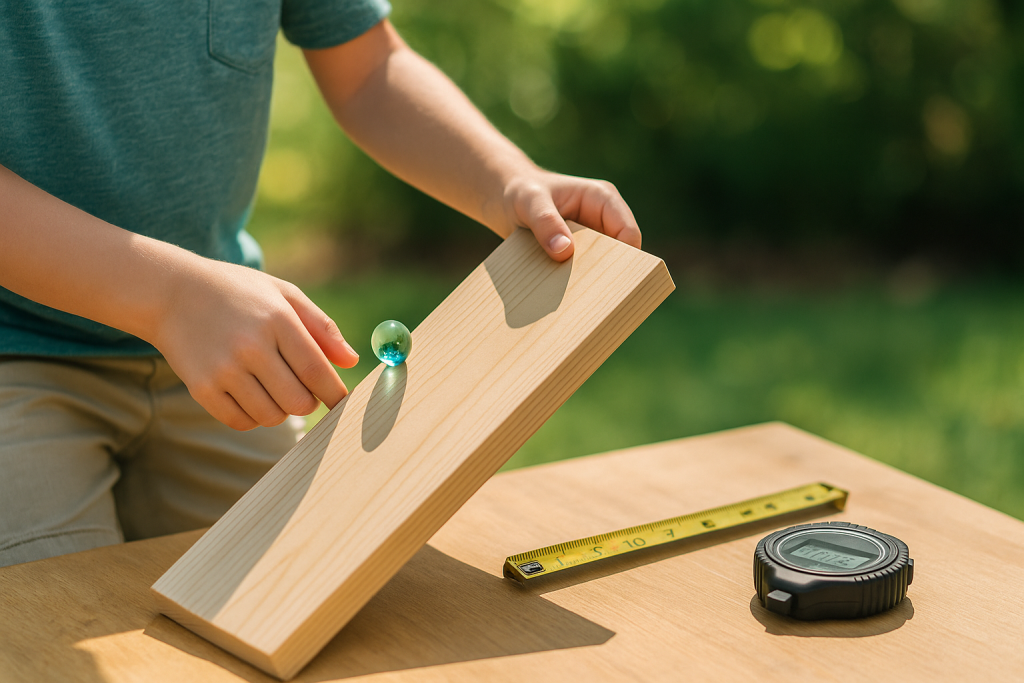
Outdoors you get wind, light, water, friction, and gravity “for free.” Kids test ideas quickly and see the results immediately—Did the ramp angle change distance? Did heavier marbles roll faster? That fast feedback loop builds confidence and persistence. Plus, you can scale up: bigger blocks, longer ramps, splash-proof challenges, and plenty of room to run prototypes over and over.
Quick Safety & Setup Checklist
- Clear the ground (no sharp debris); keep a small first-aid kit nearby.
- Shade + hydration station: a pop-up canopy and water jug go a long way.
- Define “build” and “splash” zones with duct tape, chalk, or garden stakes.
- Use child-safe tools: blunt-tip scissors, plastic clamps, and sanded wood.
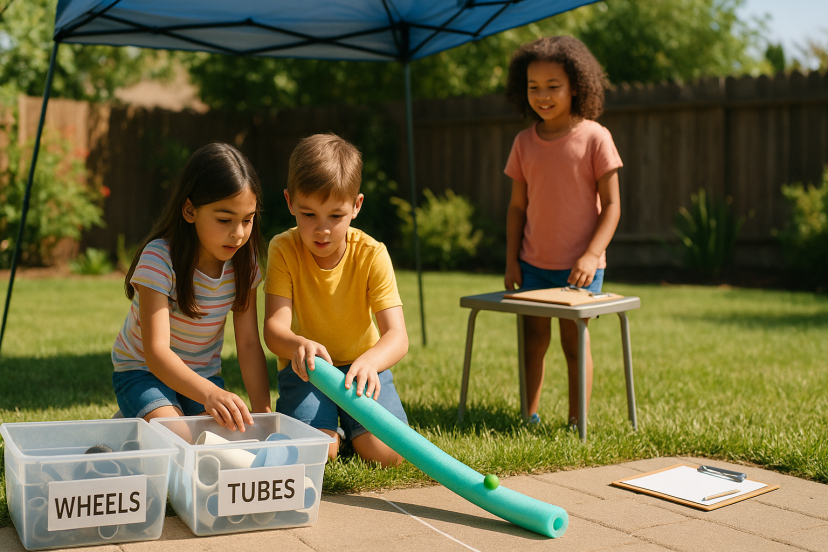
- Store small parts in lidded bins; label by category (wheels, pulleys, tubes).
- Supervise water play closely; empty containers after use.
Design Your STEM Zones (Simple = Sustainable)
Create a few consistent “zones” so kids know where to find materials and where to test ideas:
- Science Corner: clear bins for magnifiers, bug viewers, pH strips, soil/moisture sensors, seed packets, and a simple weather chart.
- Engineering Ramp Lab: boards, cardboard, PVC pipes, pool noodles, painter’s tape, and balls/marbles for distance and speed tests.
- Math in Motion: measuring cups, tape measure, stopwatches, sidewalk number line, and tally sheets clipped to a board.
- Tech Track: chalk courses for coding robots, simple obstacle cones, and a “mission card” stand.
- Maker/Tinker Table: recycled boxes, craft sticks, rubber bands, paper clips, clothespins, binder clips, string, and kid-safe glue guns.
Age-Smart Ideas (By Stage, Not Strict Rules)
Toddlers (1–3):
- Scoop-pour stations, large-piece ramps, jumbo blocks, color sorting, water wheels.
- Vocabulary: more/less, sink/float, fast/slow, big/small.
Preschool (3–5):
- Build a “bridge” from blocks across a bin; test with toy animals.
- Shadow tracing, leaf rubbings, sound hunts (“What’s louder?”).
- Vocabulary: heavier/lighter, longer/shorter, compare, predict.
Early Elementary (6–8):
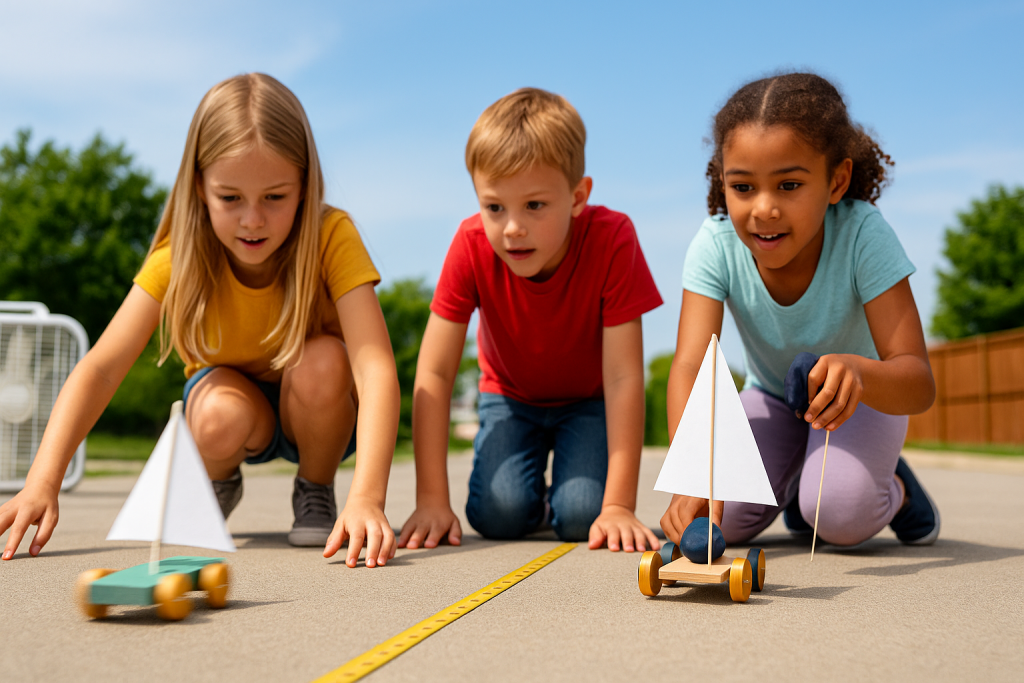
- Paper rocket design, zip-line carriers, wind car challenges.
- Garden math: spacing, counting sprouts, bar-graph growth.
- Vocabulary: friction, force, pattern, estimate, redesign.
Tweens (9–12):
- Rain-gutter canals with valves, catapult iterations, solar oven s’mores.
- Data logs, averages, simple code missions for robots.
- Vocabulary: variables, prototype, iterate, optimize.
Budget & Upcycling Tips
- Pool noodles → split into half-pipes for rolling experiments.
- Cardboard shipping tubes → instant tunnels and “pipes.”
- Binder clips + craft sticks → quick hinges and levers.
- Old shower curtain → ground cover for water or paint-splash tests.
- Reusable zip ties → temporary joints without tools.
Keep one “Yes Bin” of recyclables and a “Maybe Bin” you rotate out. Limiting choices keeps kids focused while still feeling abundant.
Weather-Proof & Small-Space Solutions
- Balcony STEM Playground: a foldable table, lidded bins, chalk tape (for robots), collapsible water tub, and a hanging shoe organizer for tools.
- Rain plan: tarp roof + drip line experiments; test gutters and miniature watersheds in clear trays.
- Heat plan: morning sessions + shade sail + frozen “ice digs” with buried treasures.
Inclusive & Accessible STEM Play
- Offer multi-sensory options: textures (sand, smooth stones), visuals (bold labels), and auditory cues (clicking timers).
- Provide seated stations and lightweight tools; keep pathways wide and clutter-free.
- Use visual “mission cards” with step icons, not just text.
- Let kids choose roles: tester, measurer, designer, note-taker—everyone contributes.
Make It a Habit: Your Weekly STEM Rhythm
- Mon: Mini-challenge (10 minutes): “Make the slowest-rolling ball.”
- Wed: Build + test (20–30 minutes): add/alter one variable.
- Fri: Share + reflect (10 minutes): “What surprised you? What will you try next?”
Document with one photo and a sentence. Progress becomes visible—and motivating.
Family Roles That Build Grit (and Joy)
- You ask questions, not give answers: “What do you think will happen if…?”
- Kids set the goal; you help frame constraints (time, materials, safety).
- Celebrate “almost!” as data. Iteration is the win.
Turn STEM Play Into Storytime
Wrap a build with a story prompt: “Our bridge needs to help a rabbit cross a river.” Stories anchor meaning and vocabulary. For ready-to-go book-plus-activity pairings, explore these STEAM Storytime ideas that connect reading with hands-on experiments and simple builds.
Real-World Mini Challenges (Quick Wins)
- Wind Car: Make a car that moves with just wind (fan or blowing).
- Longest Glide: Design a paper plane to stay aloft the longest—measure seconds.
- Safer Egg Drop: Protect an egg from a shoulder-height drop (use a ball for first tests).
- Water Lift: Build a mini pulley to raise a water cup without spilling.
- Shadow Clock: Mark shadow positions hourly; notice the pattern.
Troubleshooting: When Enthusiasm Dips
- Shrink the task: one variable, one goal, one timer.
- Change the audience: “Make something your cousin would love.”
- Add mystery: reveal a “secret material” halfway (rubber bands! marbles!).
- Switch roles: builder becomes tester; tester becomes designer.
🔹 Amazon STEM Playground Picks (Hands-On, Tested-And-Loved)
Quick note: Always check age recommendations and supervise water, tools, and small parts.
1) NATIONAL GEOGRAPHIC Earth Science Kit
What it is: A classic, crowd-pleasing set with 15+ experiments—volcano, crystals, “water tornadoes,” and a rock collection.
Great for: Weekend science sessions with siblings of mixed ages.
Features: Multiple experiment guides; extras using common household items.
Pros: Lots of variety; clear instructions; high excitement factor.
Cons: Messy fun—plan your tarp and cleanup.
Use cases: “Science Corner” anchor kit; rainy-day lab.
Review snapshot: Families praise the breadth and excitement; a few note that adult setup helps the first time.
2) Stomp Rocket Stunt Planes Launcher
What it is: Kid-powered flight—no batteries—three foam planes (Looper, Glider, Wildcat) designed by aeronautical engineers
Great for: Physics in motion—angle, force, distance.
Features: Adjustable launcher; planes perform different tricks; glider up to ~100 ft.
Pros: Screen-free, durable, big laughs.
Cons: Planes can wander into trees—set launch boundaries.
Use cases: “Engineering Ramp Lab” partner; distance measurement challenges.
Review snapshot: Loved for easy setup and replay value; occasional notes about plane wear/tear over time.
3) Educational Insights GeoSafari Jr. Kidnoculars
What it is: Focus-free binoculars with extra-large eyepieces built just for kids.
Great for: Nature walks, backyard “safaris,” and bird-counting charts.
Features: Comfy over-eye cups; rugged design; 2x magnification options across variants.
Pros: Nearly indestructible; instant “look closer” habit.
Cons: Low magnification compared with adult binoculars.
Use cases: “Science Corner” essential; pair with a sketch notebook.
Review snapshot: Parents like the durability and ease for young explorers.
4) Learning Resources Botley 2.0 (Activity Set)
What it is: A screen-free coding robot with a remote programmer and 78-piece obstacle set.
Great for: Early algorithmic thinking and “debugging without tears.”
Features: Up to 150-step sequences, object detection, light/sound sequences.
Pros: Highly engaging, grows with skills, no tablet required.
Cons: First setup can feel busy—start with short missions.
Use cases: “Tech Track” missions; maze and delivery challenges.
Review snapshot: Consistent praise for expandability; some wish for simpler card storage.
5) Sphero Mini (Coding Robot Ball)
What it is: A ping-pong-size robot ball that kids can drive, game with, and program in the Sphero Edu app.
Great for: Physics meets coding—speed, angles, and obstacle courses.
Features: Gyroscope, accelerometer, LED lights; cones and pins included.
Pros: Small, robust, tons of challenges.
Cons: Battery life ~1 hour—charge between missions.
Use cases: Timed races, “rescue” missions, bowling-style accuracy tests.
Review snapshot: Families love the blend of play and programming; occasional battery-life quibbles.
Quick Comparison
| Model | Key Spec(s) | Warranty | Approx Price/Tier | Best For |
| NATIONAL GEOGRAPHIC Earth Science Kit | 15+ experiments; step-by-step guides | Not specified (see seller) | $ | Multi-age science play |
| Stomp Rocket Stunt Planes | 3 planes; adjustable launcher; kid-powered | Not specified (see seller) | $ | Outdoor physics + distance tests |
| GeoSafari Jr. Kidnoculars | Focus-free; large eyepieces; rugged build | Not specified (see seller) | $ | Nature exploration |
| Botley 2.0 Activity Set | Screen-free coding; 150 steps; obstacles | Not specified (see seller) | $$ | Early coding + problem solving |
| Sphero Mini | App-enabled coding; gyro/accel; cones & pins | Not specified (see seller) | $$ | Physics + coding challenges |
🧪 Research-Backed Confidence (Why This Works)
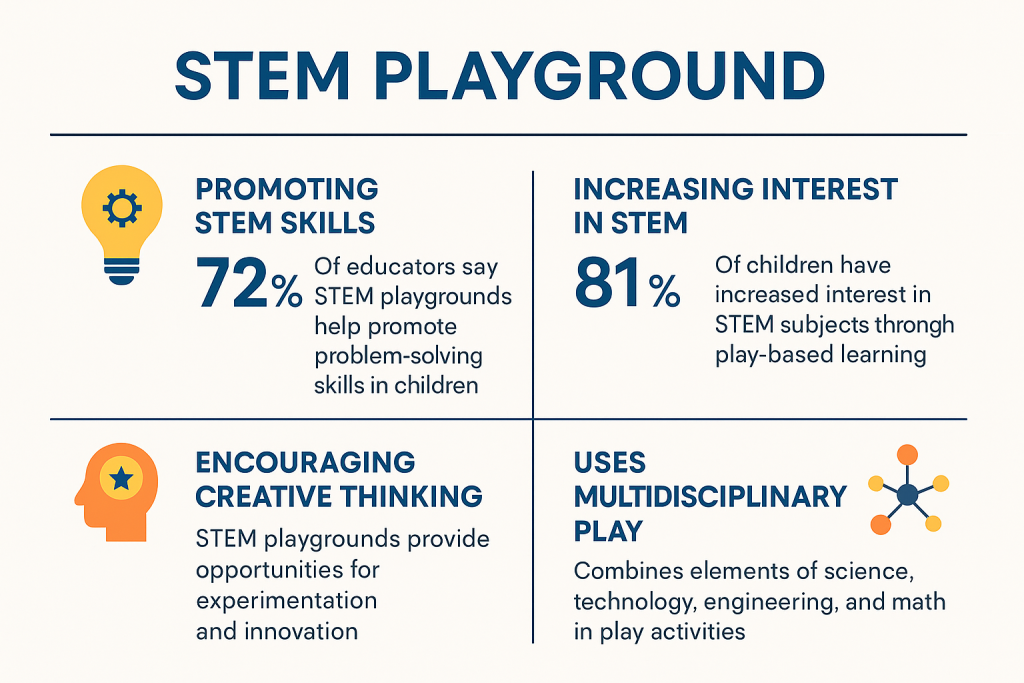
Playful, hands-on learning is consistently linked to better outcomes. A large meta-analysis of undergraduate science courses found active learning boosts exam performance significantly—evidence that doing, not just listening, matters. Read the study via this PNAS meta-analysis on active learning.
Zooming into K-12, a 2025 Frontiers in Psychology systematic review and meta-analysis reported a moderate positive overall effect of STEM education on learning outcomes (overall effect size ~0.46), with notable gains in self-efficacy and problem-solving. Explore the findings: systematic review of STEM education impact.
Want a motivational kicker? A recent longitudinal study suggests that math self-efficacy predicts later math interest, a pathway tied to longer-term STEM identity. Here’s the Nature study on self-efficacy and STEM interest.
What it means for your STEM Playground: keep kids actively building, let them experience success in tiny steps, and watch interest grow with confidence.
FAQs
How do I start a STEM Playground if I have almost no space?
Use a foldable table, two clear bins, chalk tape for robot tracks, and a shoe organizer for tools. Rotate one challenge per week. Small is not a barrier; it’s a focus boost.
What if my child “doesn’t like science”?
Rename the work: “Can you make this go farther?” or “Can you build a bridge for your plushie?” Curiosity often unlocks before labels like “science” or “math.”
How much time should we spend each week?
Aim for 2–3 short sessions (10–30 minutes). Momentum beats marathons. Log one photo and one sentence each time—progress fuels more play.
Can siblings of different ages do this together?
Yes. Set a shared goal with different roles: designer, builder, tester, measurer, note-taker. Everyone wins when the prototype works.
What’s the best first purchase?
Start with what supports the zones you’ll actually use—often Stomp Rocket (outdoor physics) or a starter science kit for quick wins, then add coding or magnifiers later.
Wrap-Up: Build, Test, Smile, Repeat
Your STEM Playground doesn’t need to be perfect; it needs to be used. Give kids a place to wonder, a few sturdy materials, and permission to try again. The results—confidence, problem-solving, resilience—show up fast. Start tiny today, celebrate “almost,” and keep the experiments rolling. You’ve got this. 🚀